The Dosa That Travelled Too Far: Why a Business Should Grow Only as Fast as Its Quality Can Follow

The Sanitiser Summer: How to Tell a Sudden Rush of Customers From Demand That Will Last
November 19, 2026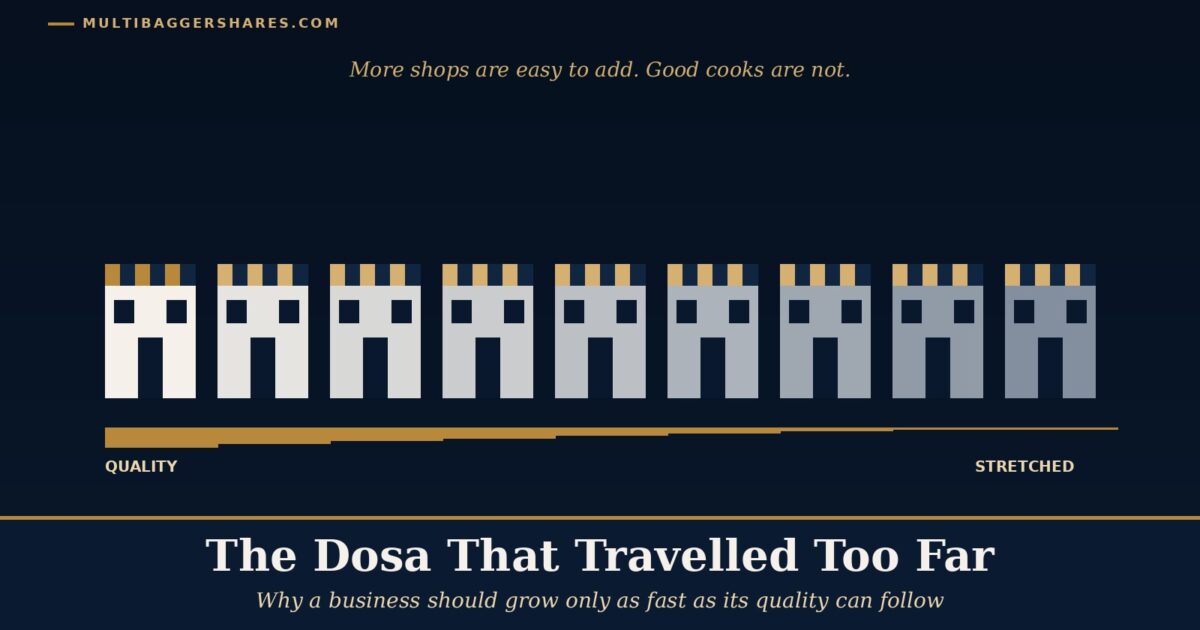
Every evening, a queue forms outside a small dosa stall in Basavanagudi, an old neighbourhood in Bengaluru. Let us call its owner Anand. His dosas are thin and crisp at the edges, the chutney is ground fresh three times a day, and the batter is fermented overnight in a corner of his own kitchen. Anand stands at the griddle himself. He knows which customer likes extra ghee and which one wants the potato on the side. Nothing about the stall is fancy. Yet people drive across the city for it.
One day a well-off customer makes an offer. You are wasting this talent on one stall. I will give you the money. Open twenty outlets across the city in two years. Anand says yes. Who would not?
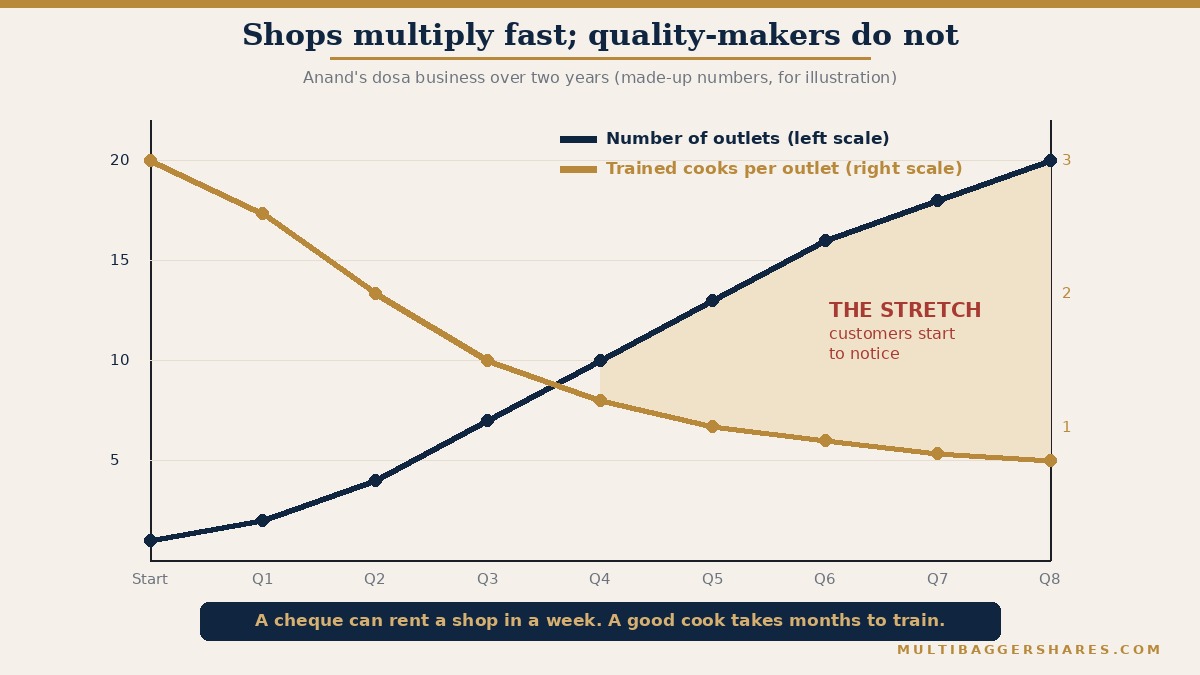
The first year looks wonderful. Ten new outlets open, and each one has a queue on its first weekend. Total sales are five times higher than before. But some quiet changes happen along the way. Grinding chutney three times a day in ten places is hard, so it is now made once in the morning at a central kitchen and sent out in vans. The batter travels too, and by evening it is sour. Anand cannot stand at ten griddles, so new cooks are hired in a rush and taught in three days instead of three months. Anand himself now spends his day on phone calls with landlords, not at the stove.
In the second year, something odd shows up in the numbers. Total sales are still rising, because new outlets keep opening. But the old stall in Basavanagudi, the one that started it all, is selling less than before. Regular customers have noticed that the dosa is not quite what it was. Nobody complains loudly. They simply come a little less often, and tell their friends a little less warmly. The business is growing, and its heart is getting weaker at the same time.
This story is made up, but the pattern is one of the oldest in business. Today’s lesson is about it: a business should grow only as fast as its quality can follow. Learning to spot when growth is running ahead of quality is one of the most useful skills a patient, long-term investor can build.
What it really means
Every good business rests on a few things that make it good. For Anand, it was fresh batter, a skilled hand at the griddle, and his own watchful eye. For a hospital, it may be experienced doctors and nurses. For a software company, it may be careful engineers. For a bank, it may be loan officers who know how to say no. Let us call these the quality-makers (the people, skills, supplies and habits that make customers trust and return to a business).
Here is the problem. Money can multiply shops very quickly. A cheque can rent a new building in a week. But money cannot multiply quality-makers at the same speed. A good cook takes months or years to train. A trusted supplier relationship takes time to build. An owner has only twenty-four hours in a day, no matter how many outlets he owns.
So when a business grows faster than its quality-makers can grow, they get stretched. Each shop gets a slightly less experienced cook, slightly less fresh supplies and slightly less of the owner’s attention. Think of a teacher who is excellent with a class of thirty children. Put ninety children in front of her and she is the same person, with the same skill, but each child now gets a third of her time. The results will slip, even though nobody has done anything wrong.
Two simple terms will help us. The first is same-store sales (the growth in sales only from shops that have been open for at least a year, so that brand-new shops do not flatter the numbers). The second is a brand (a name that customers trust to give them the same good experience every time). A brand is really a promise. Stretching quality is like quietly breaking that promise a little at a time.
Why it works
Why should an investor care so much? Because this kind of damage is very good at hiding.
First, fast growth hides weak shops. When many new outlets open each year, total sales keep rising even if every old outlet is slowly getting worse. It is like filling a bucket that has a small hole. If you pour in fast enough, the water level still rises, and you may never look for the hole. The hole only shows when the pouring slows down.
Second, customers leave quietly. Very few people write a complaint about a slightly soggy dosa. They just visit less often, or try the new place down the road. By the time the loss shows up clearly in the accounts, it has usually been happening for a year or two.
Third, trust is slow to build and quick to lose. A customer’s habit of coming back is one of the most valuable things a business owns, even though it never appears on the balance sheet (the statement that lists what a company owns and owes). That habit took years to form. A few disappointing visits can undo it. Winning a customer back usually costs far more than keeping one would have.
Fourth, repair is expensive and slow. Once quality has slipped, fixing it means slowing growth, retraining people, sometimes closing shops, and spending money that shows no immediate return. Managers who promised fast growth to their investors often find this very hard to do. So the slide can continue for longer than it should.
This is why great investors pay so much attention to the quality of growth, not just its speed. Growth that comes with the same good experience for every customer builds a stronger business each year. Growth that stretches quality thin is borrowing from the future. It feels like progress, but part of it is the business slowly spending the trust it built earlier.
A real example or two
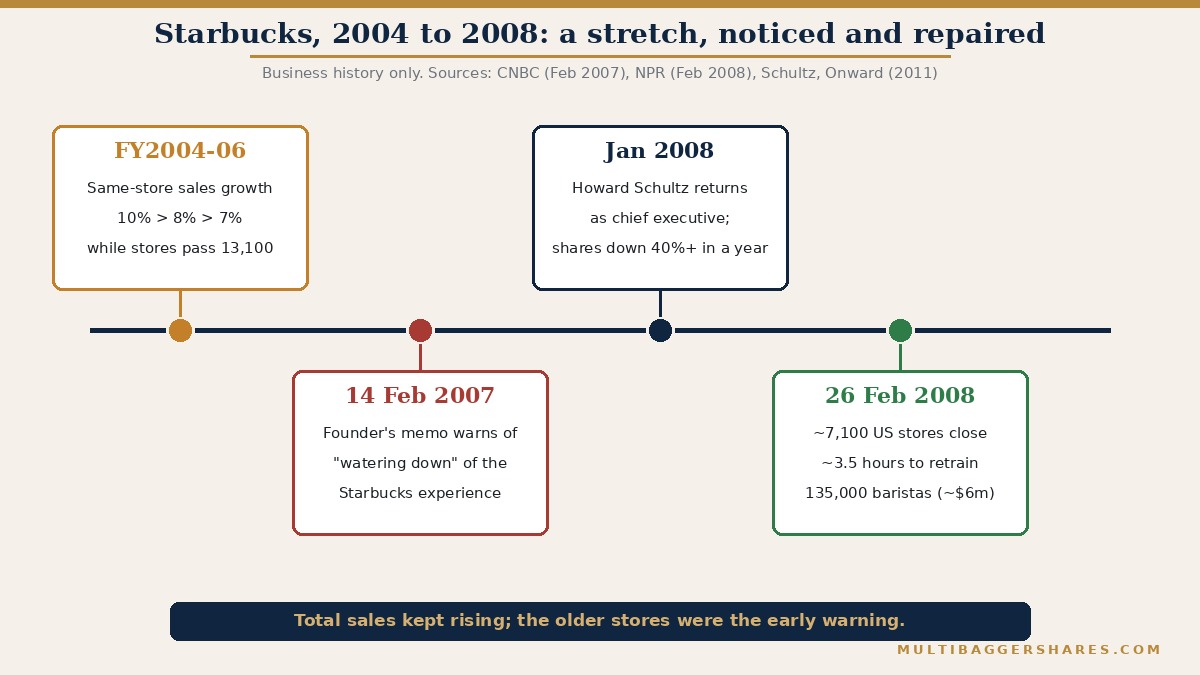
Starbucks, 2007 and 2008. In the decade before 2007, the American coffee chain Starbucks grew from about 1,100 stores to more than 13,100, and it planned to open another 2,400 in 2007 alone. Total sales were rising fast. But one number was getting a little weaker each year: same-store sales growth slowed from 10 percent in fiscal 2004 to 8 percent in 2005 and 7 percent in 2006. Still good, but heading the wrong way.
On 14 February 2007, the company’s founder, Howard Schultz, wrote a memo to the chief executive and other senior leaders. It later became public. In it, he wrote that the decisions taken to grow so fast had, looking back, led to the watering down of what made a Starbucks visit special. He gave plain examples. Automatic espresso machines had solved a real problem of speed, but removed much of the theatre of watching a drink being made. Coffee sealed in bags meant stores lost the smell of freshly ground beans. Store designs had been simplified to save money, and many stores now felt like a chain rather than a warm neighbourhood place. None of these choices was foolish on its own. Each one made growth easier. Together, they stretched the very thing customers came for.
The repair was painful. By early 2008, the share price had fallen by more than 40 percent over the previous year. In January 2008, Schultz returned as chief executive. On the afternoon of 26 February 2008, Starbucks closed all of its roughly 7,100 American stores for about three and a half hours, so that around 135,000 baristas could be retrained in how to make a proper espresso. Schultz later wrote that it cost about 6 million dollars in lost sales. The company also slowed its openings and closed hundreds of weaker stores later that year. It is a rare and clear case of a company saying, in public, we grew faster than our quality could follow, and then paying to fix it.
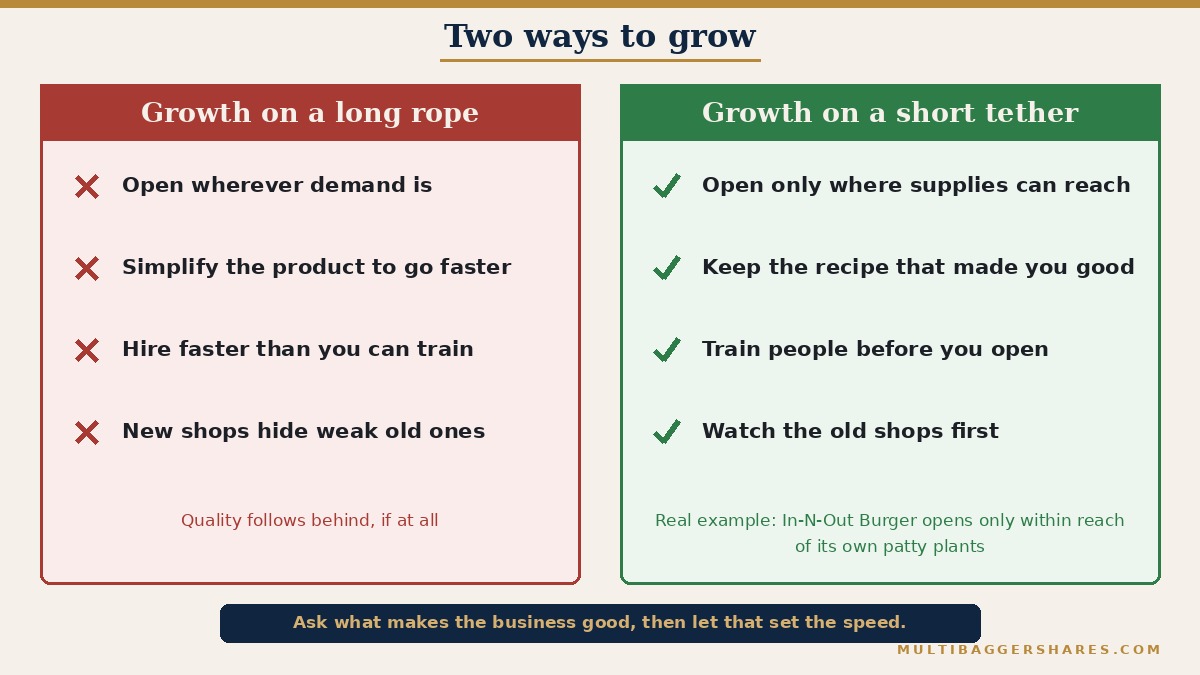
In-N-Out Burger, the opposite choice. In-N-Out is a family-owned burger chain in the United States, started in 1948 in Baldwin Park, California. It has never sold franchises (permission for outside owners to run outlets under its name), and its owners have said they have no plans to list it on the stock market. Its promise is fresh food: its restaurants have no freezers or microwaves. To keep that promise, it ties its growth to a short rope. Its planning head has explained that new restaurant locations are limited by the distance its trucks can travel from the company’s own patty-making plants. So for decades, the chain stayed in a handful of western states, even though people across America asked for it. It grew, but only as fast as fresh meat and trained teams could follow.
We are not holding up In-N-Out as perfect, and it is a private company, so ordinary investors cannot own it anyway. Slow growth is not a virtue on its own. The lesson is narrower and more useful: the owners first asked what makes us good?, and then let that answer set the speed limit. Starbucks, by its founder’s own account, let the speed set itself, and had to go back and repair the quality.
Indian readers will recognise the pattern from daily life too. Most of us know a sweet shop, a coaching class or a restaurant that was wonderful with one branch and ordinary with twelve. The name stayed the same. The experience did not. A kirana owner who opens a second shop and leaves it to a nephew he cannot supervise is running the same risk on a small scale.
How you can use it
You do not need special tools to watch for this. You need a few patient questions, and the habit of looking at more than the total sales figure.
One: are the old shops still growing? Look for same-store sales, or whatever the company calls it, such as like-for-like sales. If total sales are racing ahead while sales from older shops or older customers are flat or falling, the new openings may be hiding a hole in the bucket.
Two: are the quality-makers growing as fast as the business? Read what the company says about hiring, training and keeping its people. If it is adding outlets at thirty percent a year, is it also adding trained staff and managers at that pace? A company proud of its quality will usually explain how it protects it as it grows. Silence on this point is worth noticing.
Three: what is being simplified to grow faster? Some simplification is healthy. But if the thing being cut is the very thing customers came for, such as freshness, service, skilled advice or careful lending, be cautious. Starbucks’s memo is a useful guide here. The danger lay in small, sensible-looking choices that added up.
Four: what do customers say? This is where ordinary investors have a real advantage. Visit the shop. Use the product. Read customer reviews over a few years, not a few days, and look for words like not what it used to be. Ask friends who are regular customers. Peter Lynch, the famous American fund manager, often said that everyday observation is where an investor’s homework can begin, though it should never be where it ends.
Five: does management ever say not yet? Listen to how the people running the business talk about growth. Do they speak only of targets for new outlets, new cities and new products? Or do they also talk about when they chose to wait because people or supplies were not ready? Managers who can say not yet are often the ones who can still say yes ten years later.
Keep one caution in mind. A business that grows quickly is not automatically damaging itself. Some businesses, such as software sold online, can serve many more customers without stretching anything important. The question is never just how fast? It is how fast, compared with the things that make this business good?
This way of thinking is not about predicting next quarter’s numbers, and it is not a judgement on any company’s shares. It is a way to judge the quality of a business and the people who run it. Anand’s dosa was not ruined by greed or dishonesty. It was ruined by speed. The best businesses, like the best cooks, know that a recipe travels only as far as the hands that can make it.
Key takeaways
- Money can multiply shops quickly, but it cannot multiply skilled people, fresh supplies or an owner’s attention at the same speed.
- When growth outruns these quality-makers, quality gets stretched, and customers drift away quietly rather than loudly.
- Fast openings can hide weak old shops, so watch same-store sales, not just total sales.
- Starbucks in 2007 and 2008 shows how costly repair can be; In-N-Out shows growth tied to what keeps it good.
- This is a way to judge the quality of a business and its managers. It is education only, not a judgement on any company or share.
— Manish Goel · multibaggershares.com
Manish Goel is a Chartered Accountant and Principal Officer of Multibagger Securities Research & Advisory Pvt. Ltd. (MSRAPL), a SEBI-registered Investment Adviser, Registration No. INA100007736. This content is published by MSRAPL for education only and is not personalized investment advice.
Disclaimer: This article is published by multibaggershares.com for education and general information only. It is not investment advice, investment research, or a recommendation to buy, sell or hold any security. Any companies named are discussed only as illustrative examples. Markets carry risk; please do your own research or consult a qualified professional before making any investment decision. |