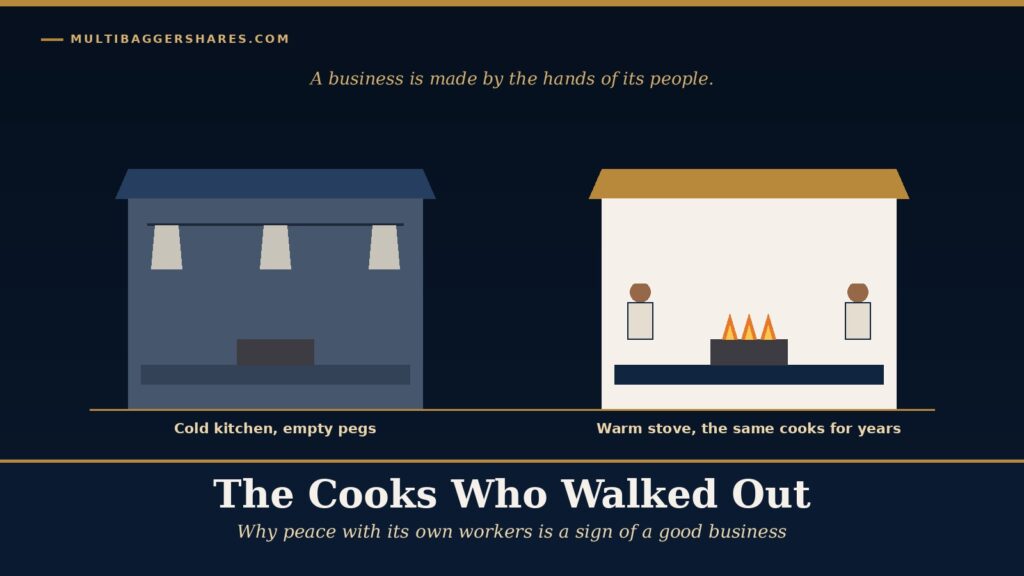
The Shop That Sews by Friday: Why a Business That Responds Faster Than Its Rivals Wastes Less and Wins More

The Notebook of Near Misses: Why a Business That Keeps Its Workers Safe Is Usually a Well-Run Business
November 25, 2026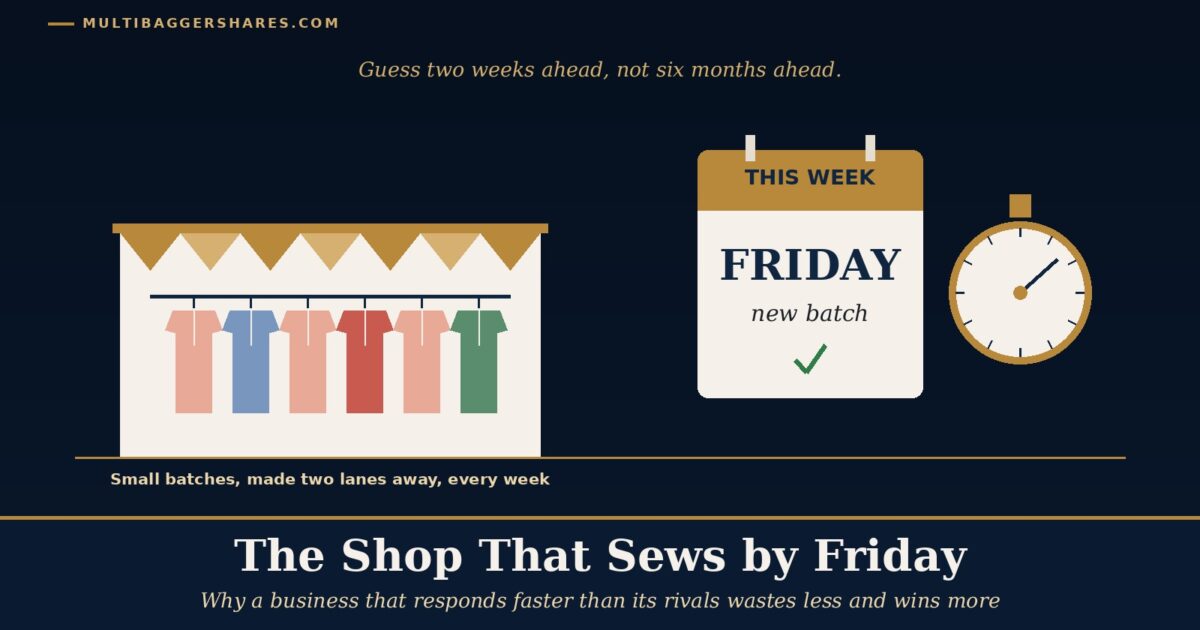
In a busy market in Jaipur, two shops a few doors apart sell kurtas (long, loose shirts worn by men and women across India). Both shops are old and well known. Both sell at about the same price, Rs 1,000 a piece. Both make most of their money in the few weeks before Diwali and the wedding season, when every family wants something new to wear.
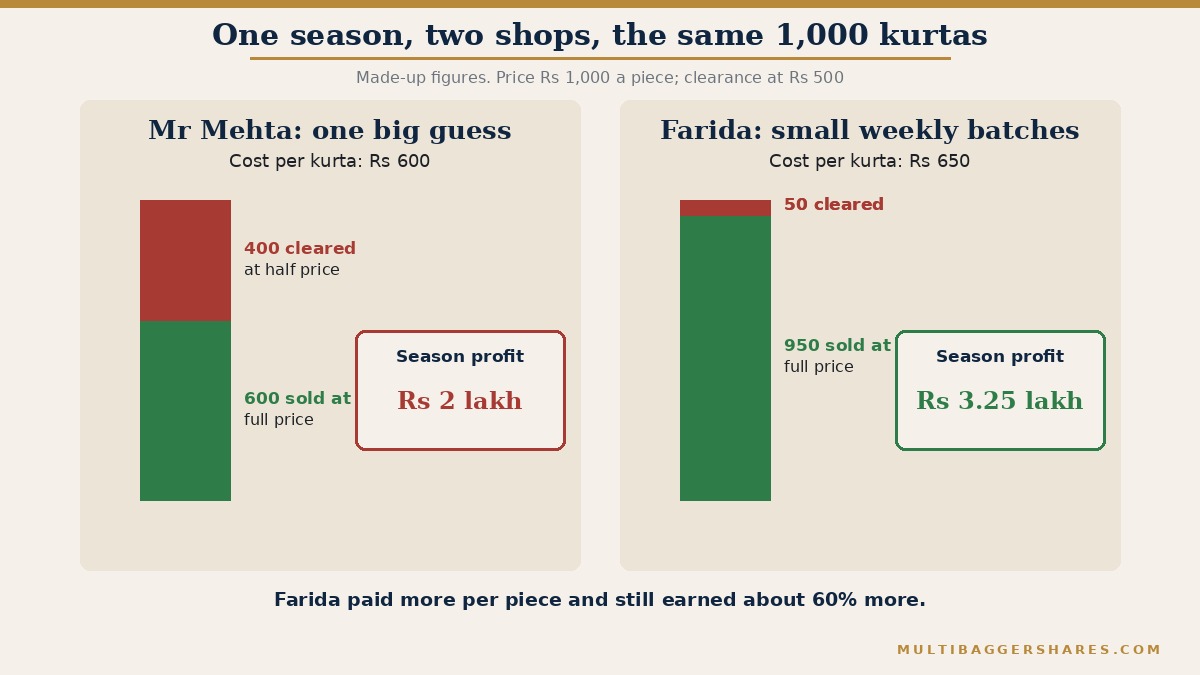
Mr Mehta runs the first shop the way his father did. Every April he sits with a catalogue from a large mill far away and orders the whole festive season in one go: one thousand kurtas, in the colours and patterns he thinks people will want in October. Ordering in bulk from a big mill is cheap. Each kurta costs him Rs 600. Then he waits. The stock arrives in late summer, gets packed onto shelves, and only in the festive season does he find out whether his April guess was right.
Farida runs the second shop. Two lanes behind it she has a small workshop with a handful of tailors and a cutting table. She cannot buy as cheaply as Mr Mehta, so each kurta costs her about Rs 650. But she does not guess the whole season in April. Each week of the season she makes a small batch, about sixty or seventy pieces. Every Friday evening she looks at what sold and what did not, and the next week’s batch follows the customers. When young buyers suddenly wanted a soft peach colour that nobody had predicted, Farida had it on her rail within days.
This year Mr Mehta guessed badly on colours, as everyone sometimes does. He sold 600 kurtas at full price. The other 400 sat on his shelves after the season and went in a clearance sale (selling off leftover stock cheaply) at Rs 500, which is less than they cost him. Farida made the same thousand kurtas over about sixteen weeks. She sold 950 at full price and cleared only 50.
When the two owners did their sums after the season, the result surprised Mr Mehta. He had paid less for every kurta, and still he earned less. His shop made a profit of about Rs 2 lakh. Farida’s made about Rs 3.25 lakh, roughly 60 per cent more, from the same number of pieces. The difference was not cheaper cloth or a better location. It was time.
What it really means
This lesson is about a business’s speed of response: how long it takes to notice what customers want and get it into their hands. People in business often call this the lead time (the time between deciding to make or order something and having it ready to sell). Mr Mehta’s lead time was about six months. Farida’s was about a week.
Think of the weather forecast. Ask anyone what the weather will be tomorrow, and they will usually be right. Ask them what it will be on one particular day six months from now, and their answer is little better than a guess. Customers’ tastes behave the same way. A business that only has to guess two weeks ahead guesses much better than one that must guess six months ahead. The fast business has not become smarter. It has simply made the question easier.
A few more plain words help. Inventory (or stock) is the goods a business has made or bought but not yet sold. A markdown is a cut in price to get rid of goods that did not sell. A business that responds slowly usually carries more inventory and takes more markdowns, because it has to make big bets far in advance.
Three earlier lessons on this site sit close to this one, so it helps to draw the lines. The Slowest Step in the Kitchen was about the bottleneck inside one process. The Cart That Must Be Empty by Nightfall was about goods that spoil if they are not sold quickly. The Weekend Special was about testing a new idea small before betting big. This lesson is about the whole loop, from noticing to delivering, and about what a short loop tells an outsider about a business.
Why it works
A business that responds faster than its rivals tends to be a better business for four plain reasons.
First, shorter guesses are better guesses. Because Farida decides each week, she makes fewer things nobody wants and runs out less often of the things everybody wants. Mr Mehta’s one big guess left him with too much of the wrong colour and too little of the right one, both at the same time. Leftovers have to be sold cheaply, and missed sales are simply lost.
Second, less money is stuck waiting. Mr Mehta paid for his whole season months before most of it sold, so about Rs 6 lakh of his money sat on shelves through the summer. At any moment Farida had only a week or two of stock, about Rs 80,000 to Rs 90,000. Money that is not stuck in stock can pay suppliers on time, avoid a costly loan, or open a second counter. Accountants call the money a business needs to run day to day its working capital, and a quick business usually needs less of it for the same sales.
Third, customers get what they want while they still want it. A shopper who finds the peach kurta she saw at a friend’s wedding pays full price happily. Two months later she may not want it at any price. Speed lets a business sell more at full price and fewer things at a discount, which is why a fast business can pay more for each item and still keep more of every rupee.
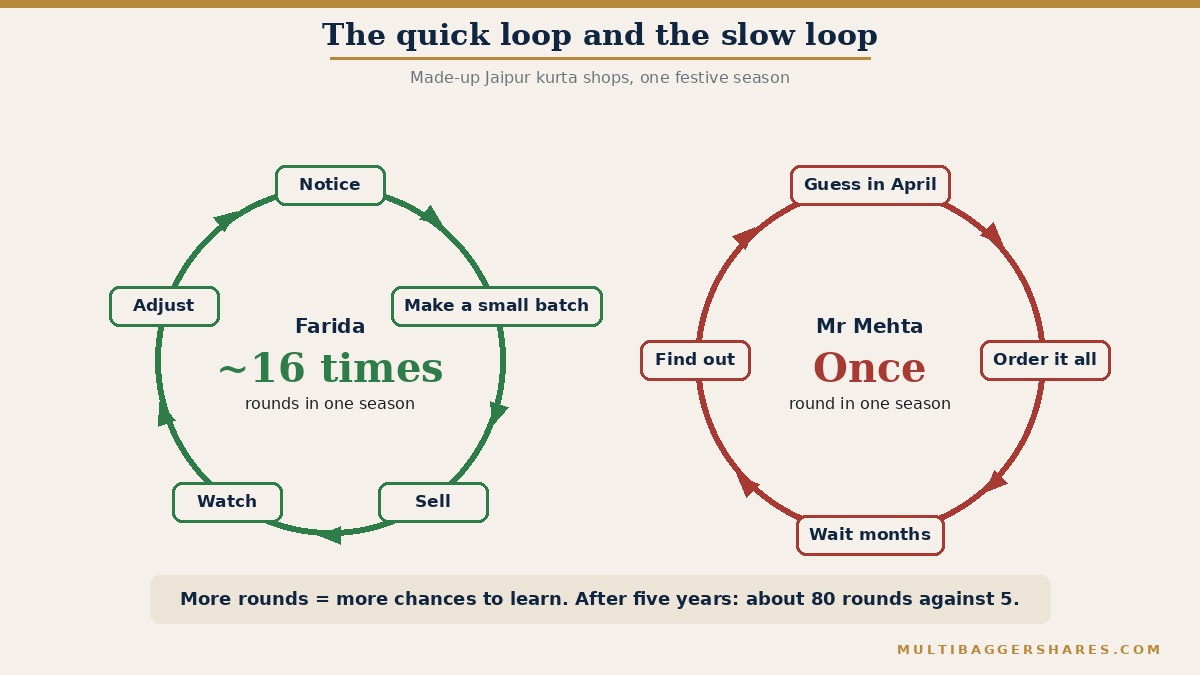
Fourth, a short loop means faster learning. Farida goes round her loop about sixteen times in one season: make, sell, watch, adjust. Mr Mehta goes round his once. After five years, Farida has had about eighty chances to learn what her customers like. Mr Mehta has had five. Like a cricketer who faces a hundred balls in the nets for every one his rival faces, she simply gets better faster.
There is a quieter benefit too. Waiting is rarely free. Goods sitting in a godown (a storeroom or warehouse) need space, insurance and someone to guard them. Work that waits often has to be redone. So when a business takes the waiting out of its process, it often finds that its costs fall and its quality rises at the same time. Speed, done properly, is not hurry. It is the removal of waste.
A real example or two
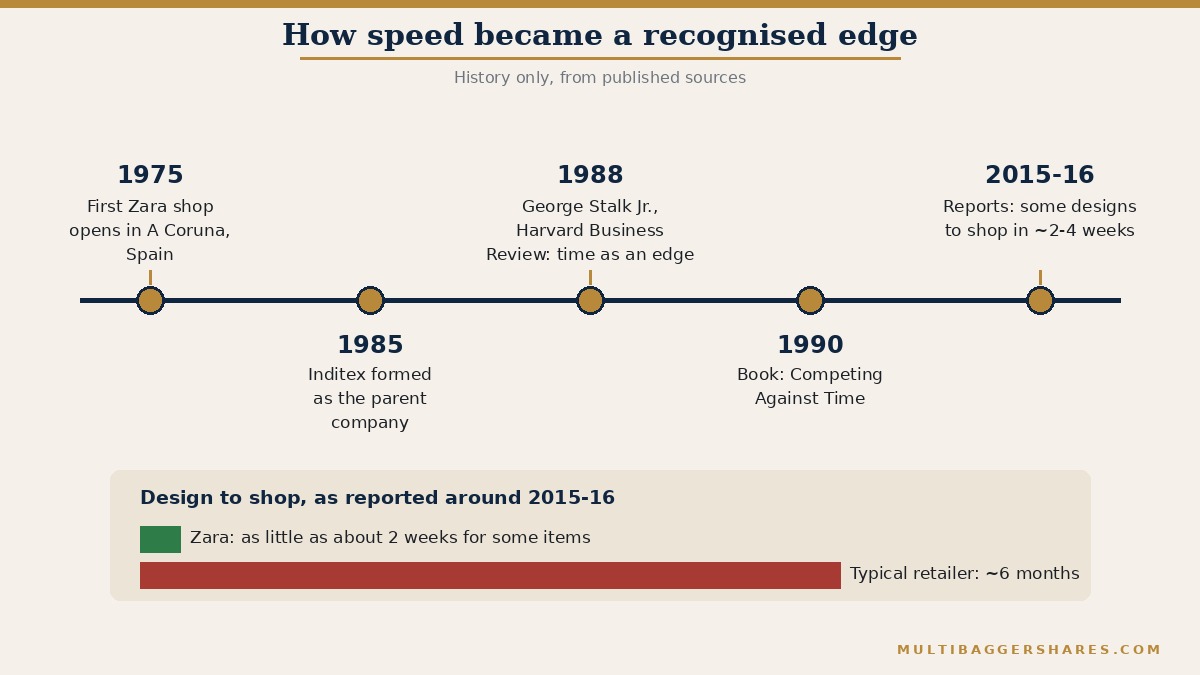
These ideas were given a name in the 1980s by the Boston Consulting Group, a firm of business advisers. In July 1988 one of its partners, George Stalk Jr., wrote an article in the Harvard Business Review titled ‘Time — The Next Source of Competitive Advantage’. His point was that the best companies were no longer winning only by being cheaper or better. They were winning by being faster: faster to make, faster to deliver, and faster to bring out new products. He followed it in 1990 with a book, Competing Against Time. The firm’s own history of the idea says it helps companies cut costs, improve quality and stay closer to their customers, the same three gains Farida found.
The best-known story of speed in shops is the Spanish clothing chain Zara, told here only as history. Amancio Ortega and Rosalía Mera opened the first Zara shop in A Coruña, in northern Spain, in 1975. Ten years later a parent company, Inditex, was formed to hold the business. Over the following decades Zara became famous in business schools for one thing above all: how quickly it could turn an idea into clothes on a rail.
Studies written around 2015 and 2016 describe the system. A typical clothing retailer might need about six months to design a garment and get it into its shops. Zara was reported to do it in as little as two weeks for some items, and within a few weeks for many others. Shop managers sent orders twice a week, and the clothes usually arrived within about two days. Designs that did not sell were reportedly pulled quickly and replaced. One business-school study noted that markdowns were rare.
Here is the part that connects back to Farida. Zara did not chase the cheapest factory for everything. Reports say it made roughly half of its goods, the most fashion-sensitive ones, in its own or nearby factories in Spain and neighbouring countries, where each piece cost more. Basic items that rarely change, like plain T-shirts, were made more cheaply far away, mainly in Asia. It paid extra for speed only where speed mattered. In 2016 an analyst at the bank Société Générale summed up the company’s success, in a story reported by the Wall Street Journal, as short lead times, the ability to offer designs that other shops did not yet have.
Nothing here is a comment on any company’s shares today. The story is told to show how a habit works, not what anyone should do with any stock.
Where speed is not enough
Like every lesson, this one has limits, and a careful reader should know them.
Speed costs money. Farida pays Rs 50 more for every kurta. That extra cost is worth it only because tastes in clothes change fast and leftovers are expensive. In a business where the product hardly changes, such as cement or electricity, being a week faster may earn very little. Ask whether speed matters to this business’s customers before giving it credit.
Speed without quality is just hurry. A business that rushes half-finished goods to customers will soon lose them. The earlier lesson The Dosa That Travelled Too Far showed how growth that outruns quality eats a business from the inside. True speed comes from removing waiting and waste, not from cutting corners.
Speed must earn its keep. Some businesses promise customers ever-faster delivery and lose money on every order to do it. Being quick is a strength only if the business still keeps a fair profit after paying for the speed. Farida’s quickness made her more money. A promise of speed that makes a business poorer is not an advantage. It is an expensive habit.
How you can use it
You do not need to visit a factory to get a feel for how quickly a business responds. Annual reports, results and management talks hold many of the clues. Here are five simple questions.
1. How long does it take to reach the customer, and is that getting shorter? Some companies say plainly how many days or weeks it takes them to launch a product, fill an order or restock a shop. A number that falls over the years is a good sign. A business that never mentions time at all may not be measuring it.
2. How much stock does it carry compared with its sales? A simple way is inventory days (roughly, how many days of sales are sitting in stock). Compare it over five years. A business whose sales grow while its inventory days stay steady or fall is usually responding well. One whose stock grows much faster than its sales may be guessing wrong.
3. How often does it hold clearance sales or write down stock? The notes to the accounts sometimes mention inventory written down (stock whose value had to be cut because it could not be sold at the planned price). Heavy discounts year after year are often a sign of slow, big guesses.
4. How quickly did it adjust when the world changed? Look back at a sudden shock, such as the months of 2020 when demand for many goods collapsed and then jumped. Did the business change what it made within weeks, or did it take a year to catch up?
5. Does management talk about time, with numbers? Listen for words like cycle time, turnaround time, order-to-delivery and days of stock, along with real figures. A management that tracks time closely usually understands where its waste hides.
One word of balance. Judge a business against others in the same line of work. A shipbuilder will always need years and a bakery will always need hours. The question is not whether a business is fast in general, but whether it is faster and steadier than its own rivals, and whether that speed shows up in less waste and fewer markdowns.
This is a way to judge the quality of a business, not a way to predict what any share price will do. Mr Mehta and Farida sold the same kurtas in the same market. One had to guess six months ahead and the other only had to guess until Friday. Over the years, that small difference in time quietly became a large difference in results.
Key takeaways
- Speed of response is how long a business takes to notice what customers want and deliver it.
- A business that guesses two weeks ahead guesses better than one that guesses six months ahead, so it wastes less.
- Quick businesses usually carry less stock, take fewer markdowns, tie up less money and learn faster.
- Speed matters only where tastes change and only if it still earns a fair profit; it must never cost quality.
- Check lead times, inventory days, stock write-downs and past reactions to shocks. This is education only.
— Manish Goel · multibaggershares.com
Manish Goel is a Chartered Accountant and Principal Officer of Multibagger Securities Research & Advisory Pvt. Ltd. (MSRAPL), a SEBI-registered Investment Adviser, Registration No. INA100007736. This content is published by MSRAPL for education only and is not personalized investment advice.
Disclaimer: This article is published by multibaggershares.com for education and general information only. It is not investment advice, investment research, or a recommendation to buy, sell or hold any security. Any companies named are discussed only as illustrative examples. Markets carry risk; please do your own research or consult a qualified professional before making any investment decision. |