Water and Diamonds: Why Something the World Cannot Do Without Can Still Be a Hard Business

The Month the Money Runs Short: What Families Never Stop Buying, and Why It Matters to a Business
October 9, 2026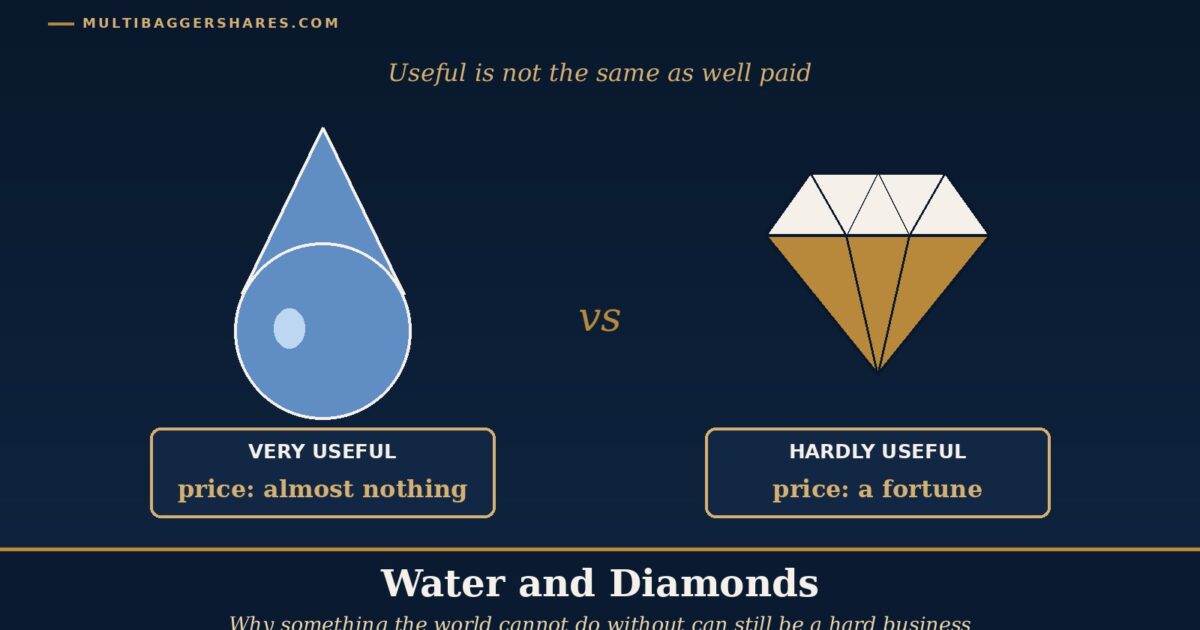
Imagine the most useful thing in your kitchen. Many people would say salt. Without it, food tastes of nothing. It has been used to preserve food for thousands of years. Yet salt is so cheap that nobody haggles over it. Now think of a small stone set in a ring. It cannot feed you, warm you or cure you. But people will pay enough for it to cover a whole year of salt for the entire street.
This is an old puzzle. In 1776, a Scottish thinker named Adam Smith wrote a famous book called The Wealth of Nations. In it he pointed out that nothing is more useful than water, yet it will buy almost nothing, while a diamond has hardly any use, yet a great deal of other goods can be had in exchange for it. Economists still call this the water and diamonds paradox (a puzzle where two true facts seem to contradict each other).
Why should a person who owns shares in businesses care about a puzzle from 1776? Because it sits right under one of the most common mistakes in investing. The mistake is to think that a business which sells something the whole world needs must be a very profitable business. Today we will see why that does not follow, and how to tell the difference.
What it really means
Smith split value into two kinds. The first is value in use, which means how much a thing helps us. Water has enormous value in use. The second is value in exchange, which means what other people will give us for it, in rupees or in other goods. A diamond has a high value in exchange, though its value in use is small.
A business lives on the second kind. A company cannot pay its workers, its landlord or its shareholders with gratitude. It is paid in rupees, and the number of rupees depends on what customers are willing to hand over. How useful the product is only sets the ceiling of its worth to us. What decides the price in the real world is something else.
So what decides it? Economists later worked out that price is not set by how useful water is in total. It is set by how much you value one more glass when you already have plenty. If you have just finished a big bottle, one more glass is worth very little to you. A rare thing, on the other hand, can stay precious even when you have a few of it.
For a business owner this boils down to a handful of plain forces. The first is scarcity: how few others can supply the same thing. The second is difference: whether customers see your product as truly different, or as just another one of the same. The third is switching: how easily a customer can walk across the road to someone else. The fourth is rules: whether a government or a regulator (an official body that sets the rules for an industry) limits what you may charge.
Together, these forces make up what is called pricing power (the ability to raise your prices without losing your customers). Water scores badly on every one of them. There is plenty of it, one drop is the same as another, and in most places the price of tap water is set by the local government. Useful, yes. Pricing power, almost none.
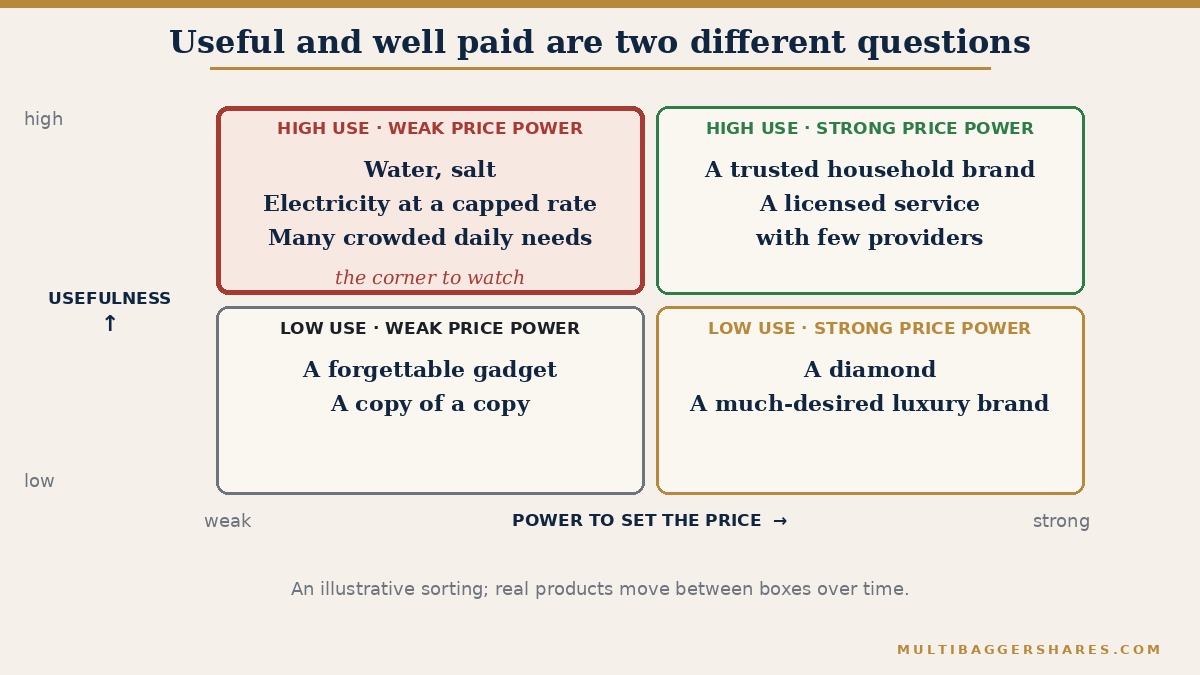
Look at the grid above. The top left corner is the one to watch. It holds the things we cannot live without and the businesses that sell them in a crowd. Next to it, in the top right, sits a different kind of useful business: one that people need and that also has some pricing power, for example a household brand that families ask for by name. The two corners look alike from outside. They behave very differently on the profit line.
Why it works
Let us put some numbers on it. They are imaginary, chosen only to keep the sums easy. Take two businesses. Each makes Rs 100 of sales in a year.
Business A sells something very useful in a crowded market, and the price it can charge is held down. After paying all its costs, it keeps Rs 4 out of every Rs 100. That is a thin slice, but it is a profit. Business B sells something that customers want and cannot easily replace. After paying its costs, it keeps Rs 20 out of every Rs 100.
Now a bad piece of news arrives for both. The cost of what they buy goes up by 5 percent, as it does from time to time with fuel, raw material or wages. At Business A, costs of Rs 96 grow to about Rs 100.80. The price cannot be raised, because customers would walk to the next seller, or because the rate is capped. Sales stay at Rs 100. So the Rs 4 profit turns into a loss of about 80 paise.
At Business B, costs of Rs 80 grow to Rs 84. But B can raise its price by 5 percent, and its customers stay. Sales become Rs 105. The profit is not hurt. It even edges up from Rs 20 to Rs 21.
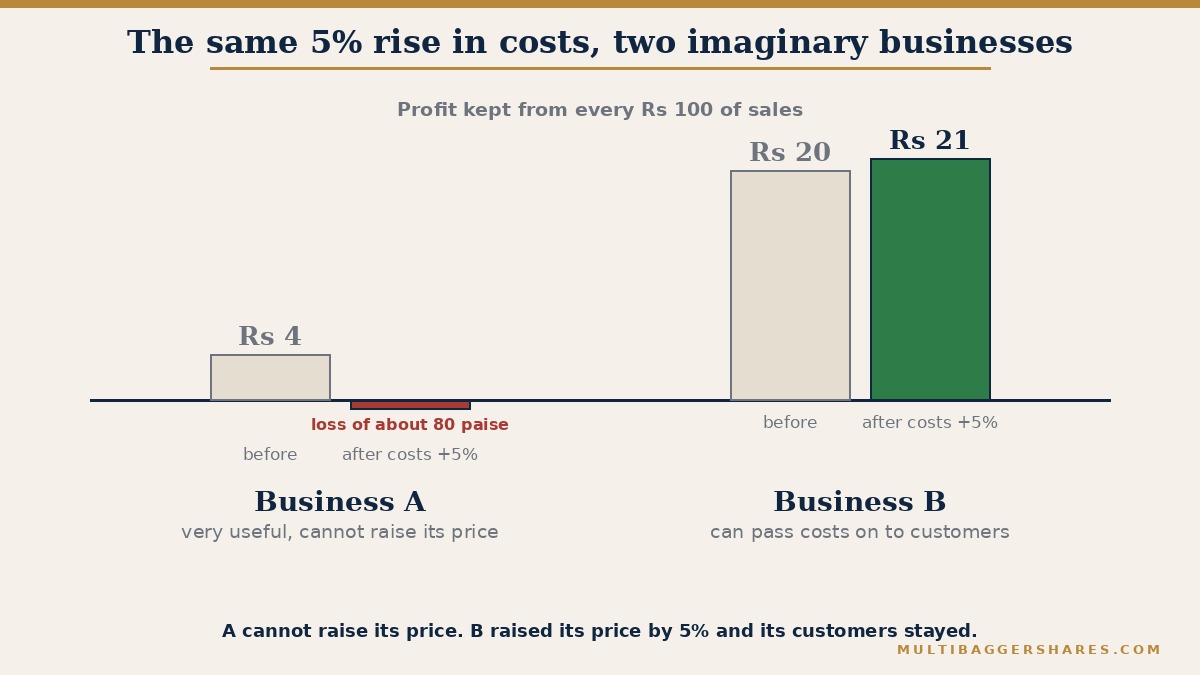
Both businesses sell something that people want. Both had customers lining up. The difference is not usefulness. The difference is who holds the pen when the price is written. When the owner holds it, a cost rise can be passed on. When the market or the government holds it, the owner has to swallow the cost.
There is a second reason this matters, and it is about growth. A business with thin margins (the share of each rupee of sales that is kept as profit) has little to reinvest. It must often borrow to grow. A business that keeps a fair slice can pay for its own growth, and that is how compounding (earning returns on your past returns, like a snowball rolling downhill) gets the room it needs. A big market is a promise of sales. It is not a promise of profit.
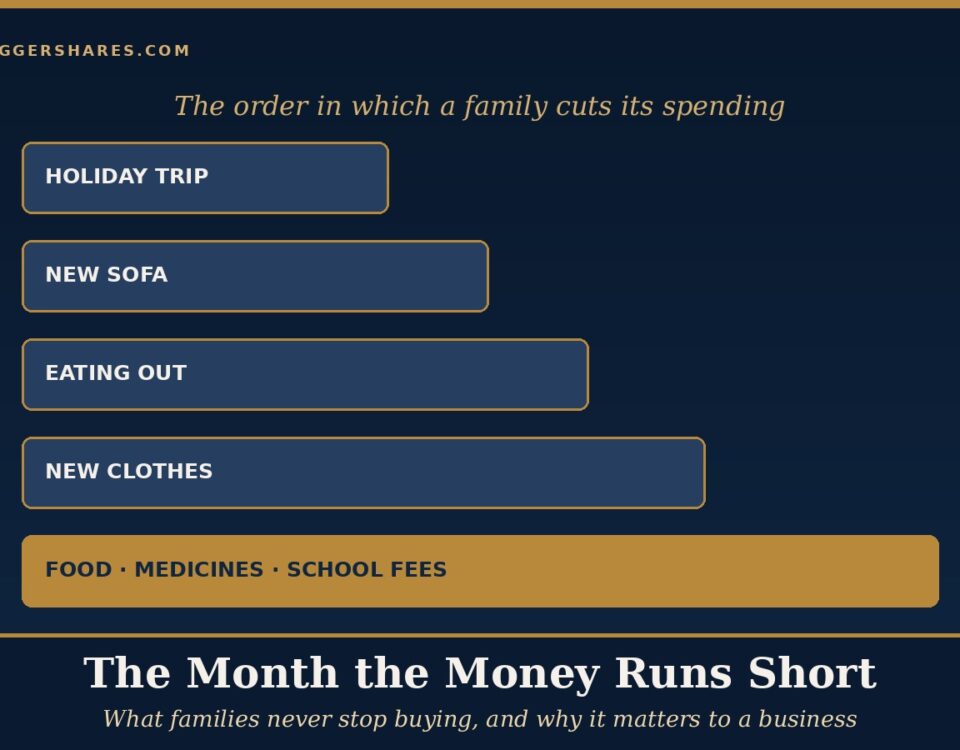
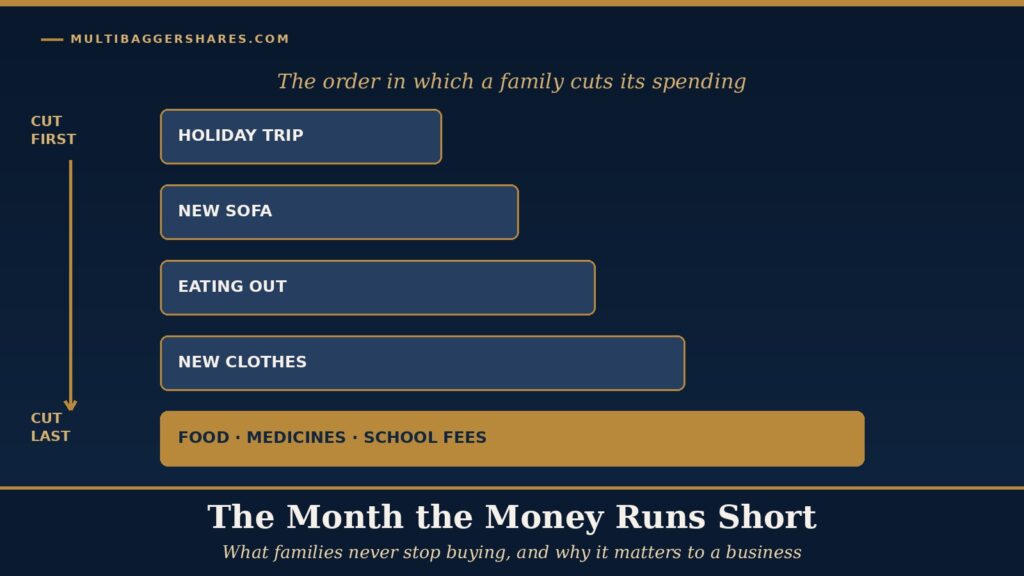
In our last lesson, on the things families keep buying when money runs short, we saw that need protects sales. Today’s lesson is the other half of the story. Need protects the sales. It does not, by itself, protect the profit.
A real example or two
One of India’s best-known investors thought about exactly this. Parag Parikh was a stockbroker and investor who founded the fund house PPFAS and wrote two books on investing and the way investors behave. In remarks reported on his firm’s website, he used the very pair that Adam Smith used. Water, he said, has high value in use, but few people will pay much for it. A diamond may be of no use to you, but it fetches a high price.
He then applied it to a part of the stock market that many people find exciting: companies that generate and sell electricity. Power is something modern life cannot do without. But, as he pointed out, there are limits to how much electricity can be priced at. In India, the rates at which power is sold to homes and farms are decided by state electricity regulators, and for some customers, such as farms, they are often set low. His warning was that chasing such businesses for huge, long-term profits, just because the product is essential, could be a mistake.
Notice that he was not saying electricity is a bad thing, or that the people running such companies are doing anything wrong. He was making a narrower and more useful point. A product the nation cannot do without and a business that makes its owners rich are two different things. We are describing his idea here as a lesson in thinking, not as a view on any company or any share.
The same report lists what he looked for in a good business. There were four things: credible managers who treat small shareholders fairly, a simple business that you can understand, a strong moat (a lasting advantage that keeps rivals away, like the wall and water around a castle), and pricing power. Pricing power was on the list as a separate item, not a free gift that comes with being useful.
What about the diamond? Part of its price comes from scarcity. Part comes from a story that people choose to believe. In 1947, an American advertising agency coined the line ‘A diamond is forever’ for the diamond trade, and it went on to become one of the best-known slogans of the century. You do not need to judge whether this is fair. The lesson is simply that desire and trust can build pricing power for a product that has little use, just as plenty and sameness can destroy it for a product that has a lot.
None of this means useful businesses are bad businesses. A trusted household brand, a restaurant with a queue at the door, or a service that only a few firms are licensed to provide can all combine a real need with a real ability to charge. They are strong exactly because they have both. A useful product is a good start. It is not the end of the checking.
How you can use it
You can use this idea at your kitchen table, with a company’s annual report beside you (the yearly booklet in which a company explains how it did). Here is a simple order of questions.
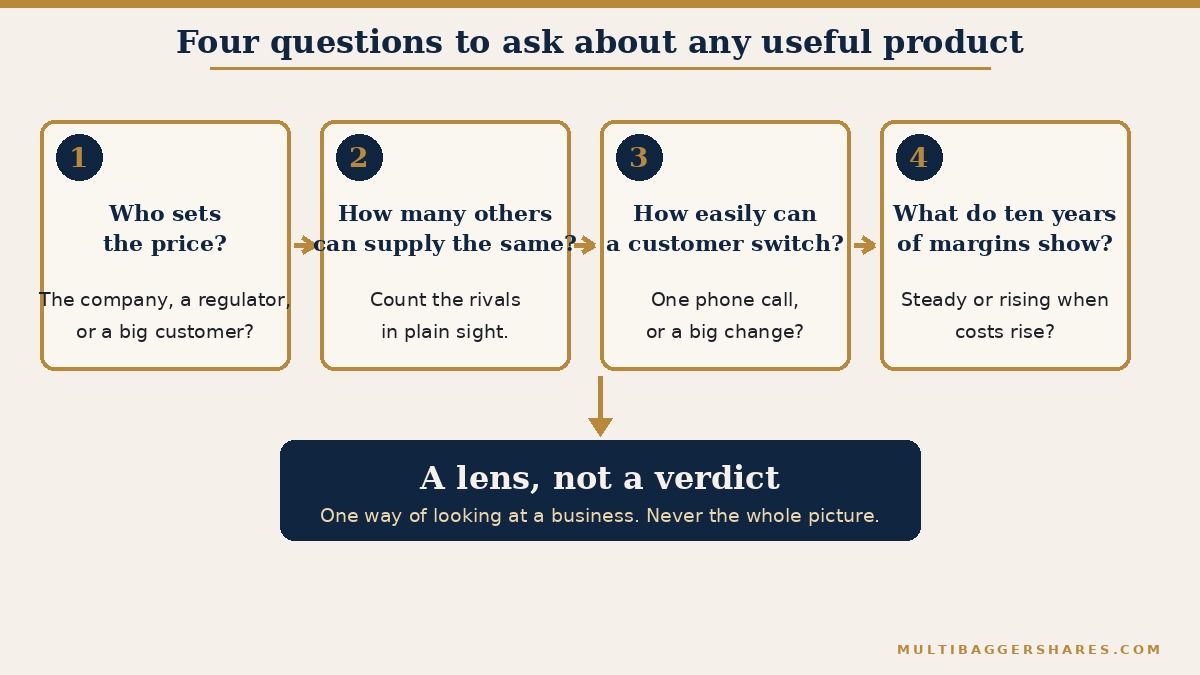
First, ask who sets the price. Does the company write its own price list, or does a government, a regulator or a big customer decide it? If someone else holds the pen, the company’s profit depends on that person’s mood. This is the cleanest test, and it often settles the matter by itself.
Second, ask how many others can supply the same thing. Count the rivals in plain sight. A town with ten firms selling the same can of drinking water has little room for any one of them to raise its price. A product that only two or three firms are able to make has a lot more.
Third, ask how easily a customer can switch. Would a customer have to change habits, retrain staff, or throw away something they have already bought? Or can they change supplier with one phone call? The harder it is to leave, the more power the seller holds.
Fourth, read the record. Free websites show about ten years of numbers for most listed companies. Find the operating margin (the share of each rupee of sales that is left as profit from the main business, before interest and tax). A business that can pass on its costs tends to show a margin that stays fairly steady, or rises, even when its costs rise. A business with no pricing power shows a margin that shrinks whenever costs go up and recovers only when costs come down.
Fifth, read the managers’ own words. Most annual reports have a section where the managers explain the year (it is often called the management discussion). Look at how they describe prices. Do they talk about raising them when costs rose, and did sales hold up afterwards? Or do they write that prices are ‘under pressure’ year after year? Plain language here is a good sign. Complaints about the market, the regulator and the weather, repeated every year, are a signal to look more carefully.
Last, keep the lesson in its place. It is one lens. It does not tell you whether the company has too much debt, whether the managers are honest, or whether it earns a good return on the money put into it. And it says nothing about whether a share is priced high or low today. It asks only a quiet question: when this company’s costs rise, who pays? That is a question about the business. This is a lesson in how to think, and nothing more.
Key takeaways
- Value in use (how much a thing helps us) and value in exchange (what others will pay for it) are different, as Adam Smith noticed in 1776.
- A company is paid in rupees, so the question is not how useful the product is, but how much of a price the company can set.
- Scarcity, difference, difficulty of switching and rules decide pricing power, which is the ability to raise prices without losing customers.
- When costs rise, a business that holds the pen on its price passes the rise on, while one that does not swallows it.
- Ask who sets the price, how many others can supply the same, how easily customers switch, and what ten years of margins show.
— Manish Goel · multibaggershares.com
Manish Goel is a Chartered Accountant and Principal Officer of Multibagger Securities Research & Advisory Pvt. Ltd. (MSRAPL), a SEBI-registered Investment Adviser, Registration No. INA100007736. This content is published by MSRAPL for education only and is not personalized investment advice.
Disclaimer: This article is published by multibaggershares.com for education and general information only. It is not investment advice, investment research, or a recommendation to buy, sell or hold any security. Any companies named are discussed only as illustrative examples. Markets carry risk; please do your own research or consult a qualified professional before making any investment decision. |