The Last Mile: Why Getting to the Shop Shelf Is One of India’s Quietest Moats

The Owner’s Chair: The Quiet Rights That Come With a Single Share
August 9, 2026
The Promise Ledger: How to Check What a Company Said Last Year Against What It Actually Did
August 15, 2026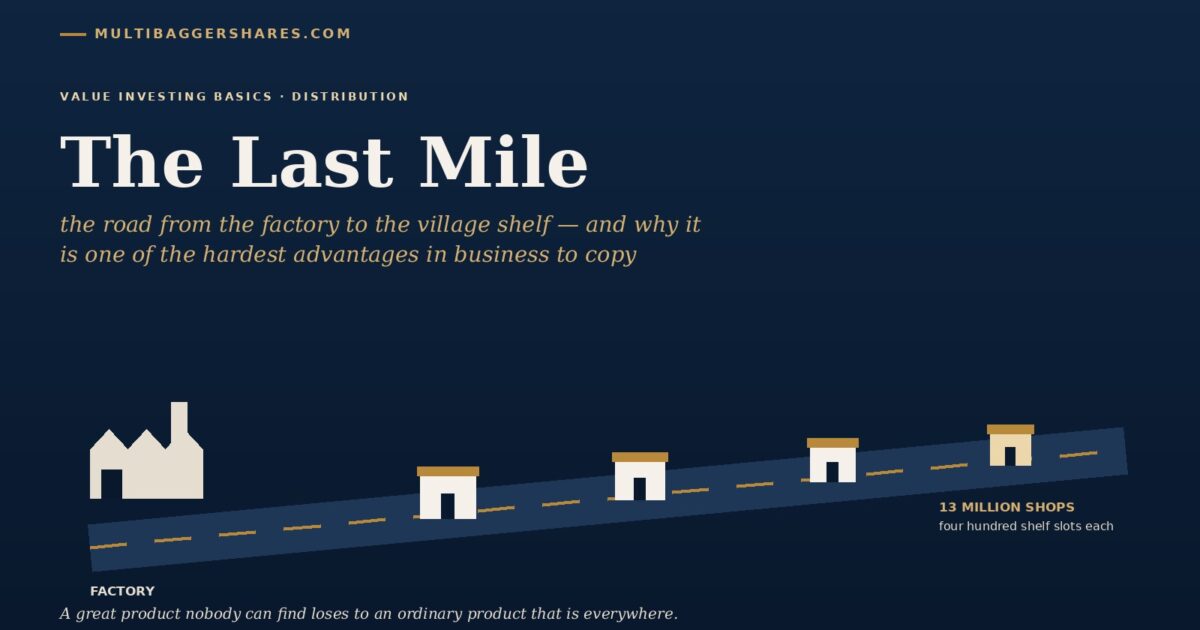
Value Investing Basics
There is a shop in a village off the Pune–Solapur road that is roughly the size of a small bedroom. The owner sits behind a wooden counter with a ceiling fan turning slowly above him. Behind him, on shelves that reach the roof, sit maybe four hundred items — soap, biscuits, hair oil, tea, matchboxes, a jar of sweets, two kinds of shampoo in tiny sachets.
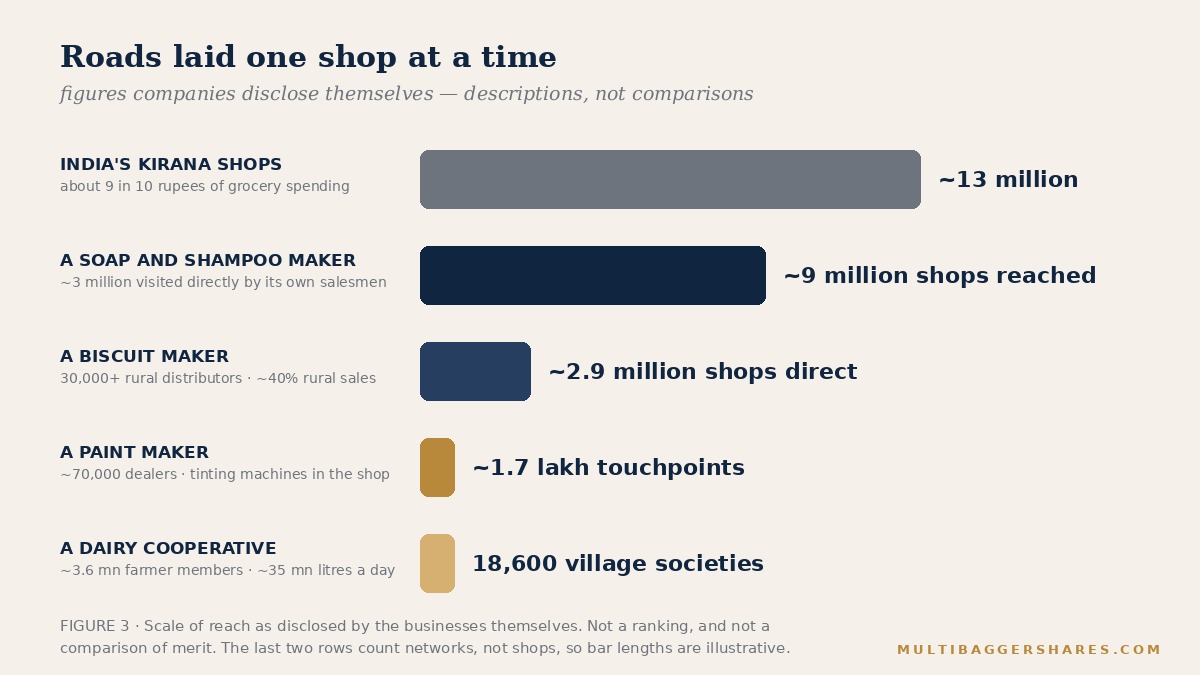
Four hundred items. That is his entire shop. And there are, by common estimates, close to 13 million shops like his across India — the kirana stores that still handle about nine out of every ten rupees spent on groceries in this country.
Now think about what those four hundred shelf slots mean for a company. India has thousands of soap brands. Only a handful of them are in that shop. The rest may be excellent. They may be cheaper. They may be made with better ingredients by kinder people. It does not matter. If the product is not on that shelf on the evening a customer walks in, the sale is simply gone. It does not get postponed. It goes to whatever is on the shelf instead.
This is the part of business that beginners almost never think about, because it is invisible from the outside. We judge companies by their products and their advertisements. But between the factory and the customer there is a long, dusty, unglamorous chain of vans, warehouses, salesmen and shopkeepers. Investors call it distribution (the system a company uses to physically get its product from its factory into the customer’s hands). And the final stretch of it — factory to that little shop in the village — is what people mean by the last mile.
Distribution is one of the quietest signs of a wonderful business. It is also one of the hardest things in the world to copy.
What distribution really means
Picture a packet of biscuits leaving a factory near Hyderabad. It does not fly to the village shop. It travels.
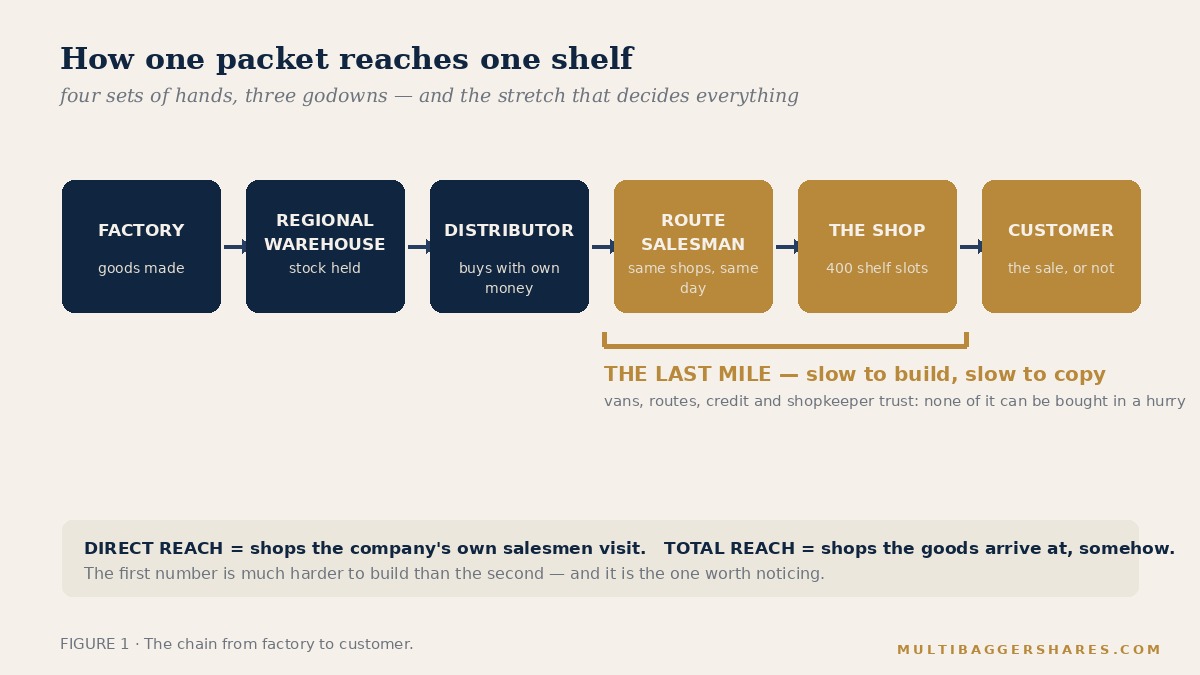
First it goes to a large regional warehouse. From there it is sent to a distributor (a local businessman who buys stock from the company with his own money and sells it onward in his territory). The distributor keeps it in a godown, breaks the large cartons into smaller ones, and sends a salesman out on a fixed route with an order book. That salesman visits the same shops on the same day every week, takes an order for eight packets, and a delivery van drops them off the next morning. Somewhere in that chain there may also be a wholesaler (a middleman who sells in bulk to many small shops at once).
So one packet of biscuits may pass through four sets of hands and three godowns before a child buys it. Every one of those hands must be paid, trusted, chased and kept happy.
When a company says it has “direct reach” of three million outlets, it means its own salesmen physically visit three million shops. When it says its products “reach” nine million outlets, it means the goods arrive there somehow — often through wholesalers the company does not control. The first number is much harder to build than the second, and it is the one worth noticing.
Two more terms, and then we are done with jargon. A stockist is another word for a distributor. A route is the fixed list of shops one salesman covers, so that no shop is forgotten and no shop is visited twice.
Why the last mile is so hard to copy
Anyone with money can build a factory. In eighteen months, with a bank loan, you can have a plant making soap as good as anybody’s.
Now try to build a route network that touches two million shops.
You need to find thousands of distributors who are willing to put their own capital into your stock. You need to convince a shopkeeper with four hundred shelf slots to give one of them to a brand nobody has asked for. You need salesmen who know which lane floods in the monsoon and which shop pays on time. You need to keep paying all of them in the years before the brand sells well, because a route that is visited irregularly is a route that dies.
None of this can be bought in a hurry. It is built one shop at a time, over decades, by people walking in the sun. That is exactly why it lasts. A moat (an advantage that protects a business from competitors, like a water ditch around a fort) made of habit, trust and thousands of small relationships cannot be knocked down by a rival’s advertising budget.
Philip Fisher understood this in 1958. Fisher was an American investor whose book Common Stocks and Uncommon Profits shaped how Warren Buffett thinks about business quality — Buffett has often described himself as part Benjamin Graham and part Fisher. Fisher listed fifteen questions to ask about any company. His fourth question was not about the product, the profit or the price. It was: “Does the company have an above-average sales organization?”
Fisher’s point was simple. A great product that customers cannot find loses, every single time, to an ordinary product that is everywhere.
Robert Woodruff, who ran Coca-Cola from 1923, put the same idea in one line. He told his bottlers that Coca-Cola should always be “within an arm’s reach of desire.” Not in the best shops. Not in the biggest cities. Within arm’s reach — everywhere a person might get thirsty.
Three Indian stories
Consider Amul, which is not a company in the usual sense at all but a farmers’ cooperative (a business owned collectively by the people who supply it). Its marketing federation collects milk through roughly 18,600 village societies, from about 3.6 million farmer members, and handles on the order of 35 million litres of milk a day. Milk spoils in hours. To move that much of it, twice a day, from villages to city breakfast tables, someone had to build collection centres, chilling plants, and a delivery system that runs before dawn. That system took more than half a century to build. A well-funded competitor cannot simply order one.
Consider Hindustan Unilever, whose products reach around 9 million retail outlets in India, of which roughly 3 million are covered directly by its own field force, supported by some 3,500 distributors. In recent years it has added a mobile ordering app for shopkeepers that is used by well over a million of them, so a kirana owner can place an order at midnight from his phone. Notice what that app really is: not a technology story, but a stronger grip on the same last mile.
Consider Britannia, whose biscuits reach close to 2.9 million outlets directly, served by more than 30,000 rural distributors, with roughly 40% of its sales now coming from rural India. The company has said plainly that it wants to keep adding outlets year after year. That is what a company sounds like when it understands where its real asset sits.
And consider Asian Paints, which shows a different shape of the same idea. It serves around 1.7 lakh retail touchpoints through roughly 70,000 active dealers — a far smaller number of shops than a biscuit company needs. But it placed tinting machines (a machine in the dealer’s shop that mixes thousands of shades on the spot from a few base tins) in tens of thousands of those shops, and built a supply system that can restock a dealer several times a day. The dealer therefore needs almost no shelf space and almost no working capital to offer any colour a customer imagines. Try persuading that dealer to switch.
These are descriptions of how businesses were built, nothing more. But the pattern in all four is identical: the visible thing is a product, and the invisible thing is a road network of relationships that took decades to lay.
Where distribution stops being a moat
Now the honest other side, because a lesson without its limits is a half lesson.
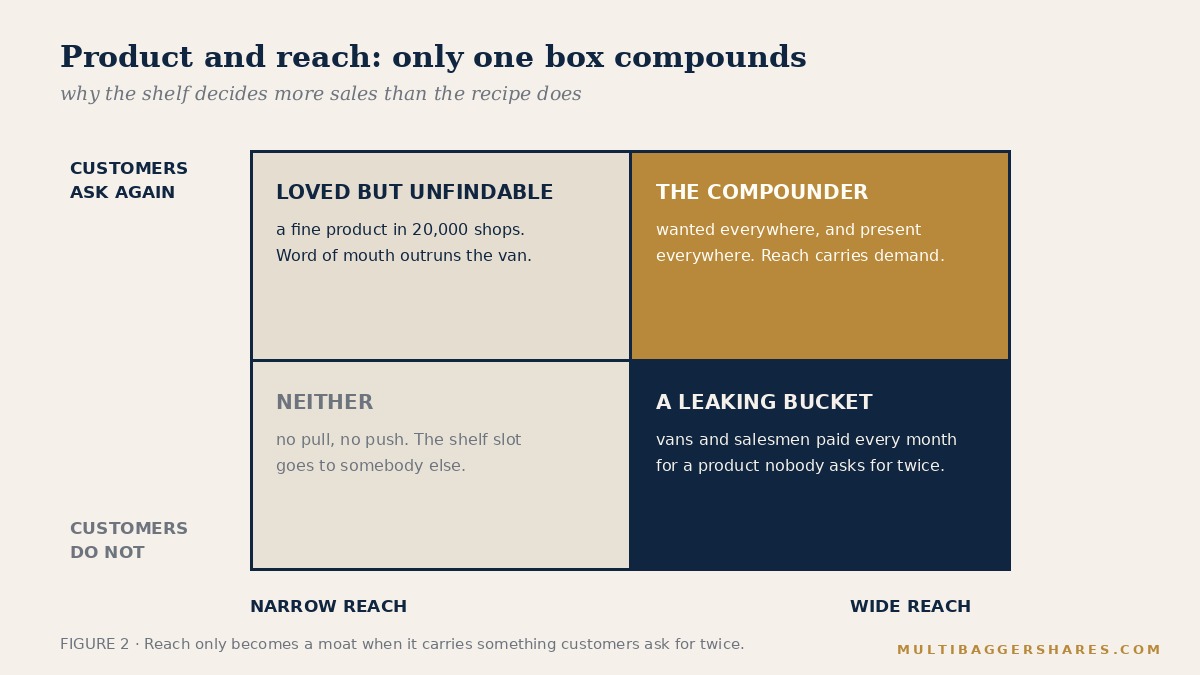
First, distribution is expensive to maintain. Salesmen, vans, godowns and distributor margins all cost money every single month. A wide network attached to a product nobody wants is not a moat; it is a leaking bucket. Reach only becomes valuable when it is carrying something customers actually ask for again.
Second, reach can be faked in the short run. A company under pressure to show growth can push extra stock onto its distributors near the end of a quarter — the industry calls this channel stuffing. Sales look wonderful. The goods, however, are sitting in a distributor’s godown, not in a customer’s home. This is why patient investors read the cash flow statement (the part of the annual report that shows actual money coming in and going out, as opposed to sales merely recorded on paper) rather than only the sales line.
Third, roads change. Quick-commerce apps that deliver in ten minutes, modern retail chains, and direct-to-consumer websites have all created new paths to the customer that did not exist twenty years ago. A company whose entire advantage sits in one old channel can find that channel quietly shrinking. The strong ones adapt — the app for kirana shopkeepers is exactly that kind of adaptation.
So the question is never simply “how many outlets?” It is “is this reach getting deeper, is it being paid for by real cash, and is the company present wherever customers have moved?”
How you can use this
You do not need a terminal or a database for any of this. You need a phone, an annual report and a walk to the market.
Start with the annual report, which every listed company puts on its own website for free. Search it for the words “distributor”, “outlets”, “direct reach” and “touchpoints”. Write the numbers down. Then find last year’s report and do the same. A company whose direct reach went from 1.9 million to 2.2 million outlets is telling you something real about its ambition and its spending — something no advertisement will tell you.
Then go and look. Visit three shops near your home: one large, one small, one in a poorer neighbourhood. See whether the brand is present in all three, or only the first. Ask the shopkeeper two questions, politely: how often does this company’s salesman come, and does the company take back stock that does not sell? Shopkeepers are wonderfully blunt. In two minutes you will learn more about a company’s field discipline than an hour of reading.
Watch the shelf position too. Eye level, near the counter, in a branded display rack — none of that is an accident. It was negotiated, and often paid for, by a salesman who visits every week.
Finally, put the reach next to the money. If outlet numbers keep climbing but the cash a business actually collects does not follow, the reach is being bought rather than earned. If both rise together for years, you are probably looking at a real road network, laid one shop at a time, of the kind that outlives every clever competitor who arrives with a better product and no way to deliver it.
The village shopkeeper on the Pune–Solapur road will never read an annual report. But every evening, without knowing it, he casts a vote about which businesses in India deserve to be called wonderful. Four hundred shelf slots. That is the whole election.
Key takeaways
- Distribution is how a product physically travels from factory to customer; the hardest stretch is the last mile into small shops.
- A great product that customers cannot find loses to an ordinary product that is everywhere — Fisher’s fourth question asked about the sales organisation for exactly this reason.
- Reach is slow to build and therefore slow to copy: it is made of distributors, routes, salesmen and shopkeeper trust, not of capital alone.
- “Direct reach” (the company’s own salesmen visiting shops) is a stronger signal than total outlets reached through wholesalers.
- Check that growing reach is matched by growing cash collections, and that the company is present in the newer channels customers have moved to.
— Manish Goel · multibaggershares.com
Disclaimer: This article is for educational purposes only and does not constitute financial advice. The author may hold positions in stocks mentioned. Always conduct your own research and consult a SEBI-registered financial advisor before making investment decisions. Stock market investments are subject to market risks. Past performance does not guarantee future returns.