The Ten-Rupee Part That Stops a Ten-Lakh Machine: How to Judge a Business Nobody Bargains With

Who Chooses, Who Uses, Who Pays: The Three People Hiding Inside Every Sale
September 2, 2026
The Sweet Shop That Took the Box Back: How a Business Behaves When Something Goes Wrong
September 4, 2026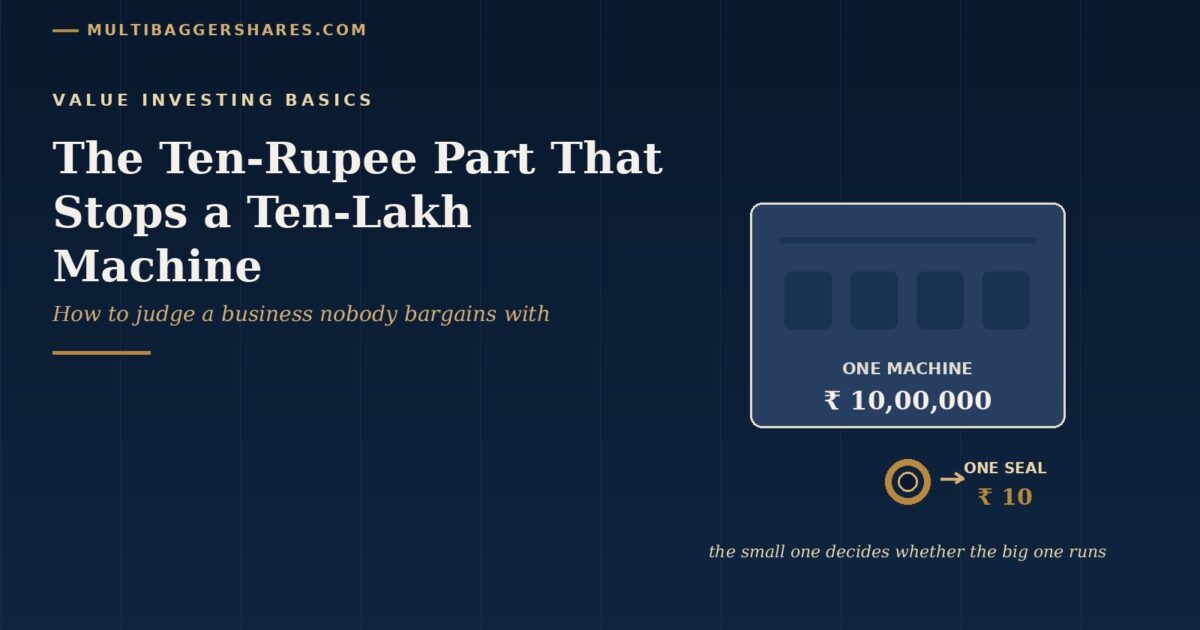
The workshop that lost a day
A small engineering workshop outside Rajkot runs a machine that cost about ten lakh rupees. One Tuesday morning it stops. The owner calls the mechanic, who opens the casing, looks inside for four minutes, and says a seal has failed. A seal is a small rubber-and-metal ring that keeps oil in and dust out. It costs around ten rupees.
The mechanic then says something more interesting. He says the ten-rupee seal is not in stock, but there is a similar one from another maker for six rupees, available immediately.
The owner does not think about this for even a second. He says: get me the proper one, I will wait till evening.
Look carefully at what just happened. A man who negotiates hard over the price of steel, who argues with his electricity board about the bill, who compares three quotations before buying a welding rod, has just refused to save four rupees. He did not refuse because he is careless with money. He refused because the four rupees he might save is nothing next to what he loses if the seal fails again next month and the machine stops for another day.
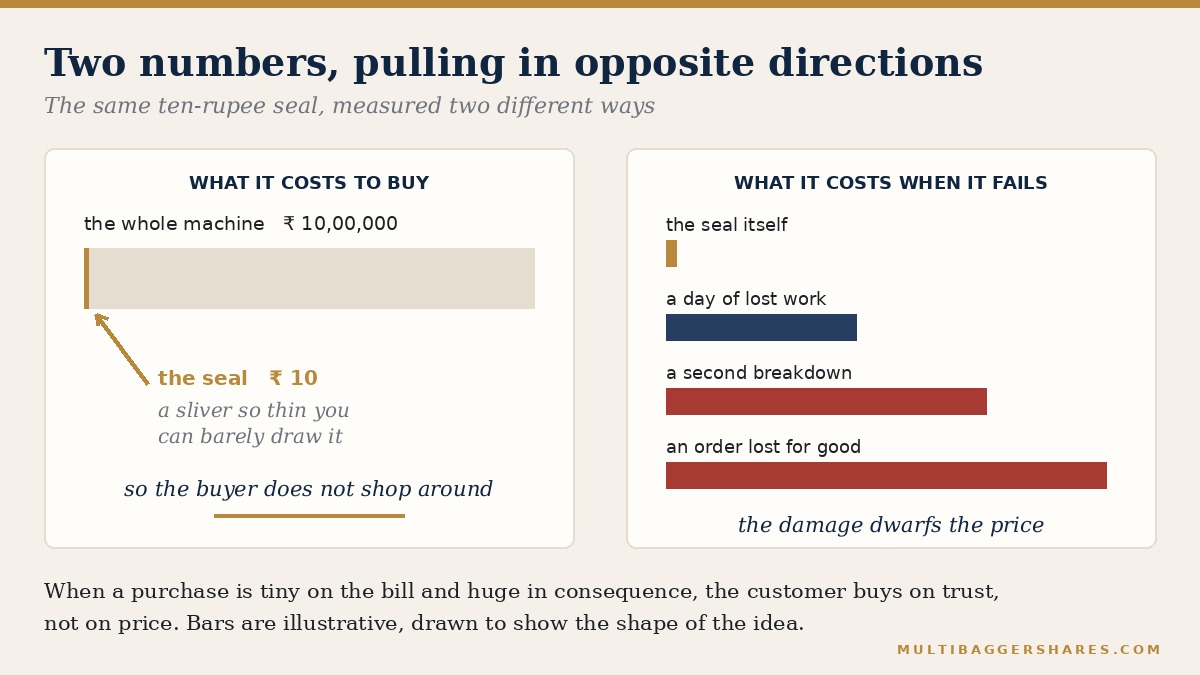
That is the whole idea of this letter. Some businesses sell things that are very small on the customer’s bill and very large in the customer’s mind. When those two facts sit together in the same product, the customer stops bargaining. And a customer who has stopped bargaining is one of the pleasantest things that can happen to a company.
What “small in cost, large in consequence” really means
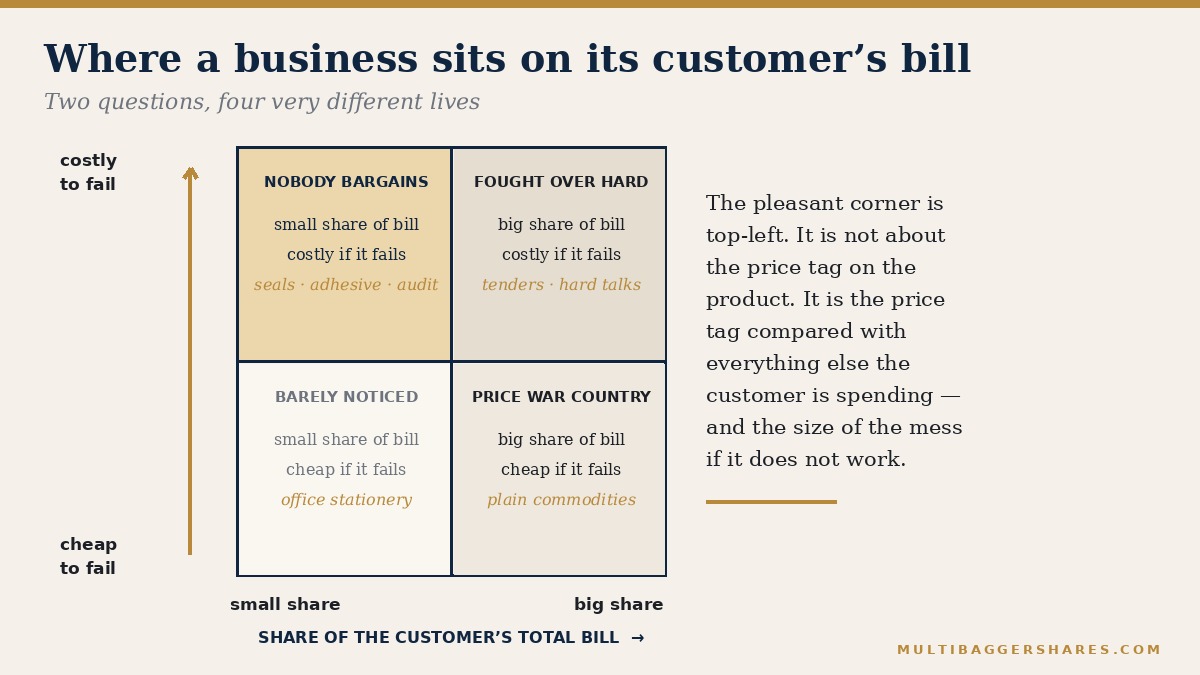
There are two separate questions here, and beginners often mix them up. Keep them apart and the whole thing becomes easy.
Question one: how big is this on my customer’s bill? Not how big is it in rupees, but how big is it as a share of what the customer is spending in total. Ten rupees is small in absolute terms. But it is also small as a share of a ten-lakh machine, and that is what matters. A tin of good adhesive is a few hundred rupees inside a wardrobe that costs a lakh. Plumbing pipes are a modest slice of the cost of building a house. Audit fees are a rounding error next to the size of the company being audited.
Question two: what happens if it goes wrong? If the seal fails, the machine stops and the workshop loses a day of production and possibly a customer’s order. If the adhesive gives way, the wardrobe door comes off in two years and the carpenter’s name is ruined. If a pipe leaks inside a wall, the wall has to be broken open. The cost of the failure is many, many times the cost of the item itself.
When the answer to question one is “tiny” and the answer to question two is “terrible”, you are looking at a purchase that is decided on trust rather than on price. The buyer is not being generous. The buyer is being sensible. Saving four rupees on something that can cost you forty thousand is not thrift; it is gambling.
Now turn it around, because the reverse is equally useful. When the item is a big share of the customer’s bill — steel inside a bridge, fuel inside a transport company, packaging inside a mass-market food company — the customer will fight over every paisa, call for tenders (a formal process where several suppliers submit sealed prices and the lowest usually wins), and switch suppliers for a two per cent saving. That is not a bad business by definition. It is simply a harder one, and the company selling into it has to earn its living some other way, usually by being the lowest-cost producer.
One more distinction, because it saves a lot of confusion later. This is not the same thing as selling something expensive, and it is not the same thing as having a famous brand. A very cheap item can be in this happy position and a very costly one can be nowhere near it. What decides the matter is not the price tag on the product; it is the size of that price tag compared with everything else the customer is spending, and the size of the mess if the thing does not work.
Why this quietly matters so much
Nearly fifty years ago, in the March–April 1979 issue of the Harvard Business Review, a young professor named Michael Porter published an article called “How Competitive Forces Shape Strategy”. It became one of the most widely taught pieces of business writing ever produced. In it, he set out when a buyer has power over a seller and when the buyer does not, and two of his conditions are exactly the two questions above.
Porter wrote that buyers push hardest on price when what they are buying “forms a component of its product and represents a significant fraction of its cost”, and that they push much less when the seller’s product affects the quality of what they themselves make. And then he put the whole thing in one sentence that is worth reading twice: “Where the industry’s product or service can pay for itself many times over, the buyer is rarely price sensitive; rather, he is interested in quality.”
His own examples were not from factories at all. He pointed to services such as investment banking and public accounting, where a mistake in judgement is costly and embarrassing, and to the logging of oil wells, where an accurate survey can save an oil company thousands of dollars in drilling costs. Nobody hires the cheapest auditor to sign off a large company’s books. Nobody drills a well on the strength of the cheapest survey.
Why should an investor care about any of this? Because of what it does to the seller’s economics. A company whose customers do not bargain tends to have three good things at once.
First, it usually keeps a healthier margin (the portion of each rupee of sales that is left over as profit after costs). It is not being forced to give away a slice of that rupee every year just to hold on to the order.
Second, it tends to have some pricing power (the ability to raise prices without losing customers to a rival). When the raw material it uses becomes dearer, it can pass on the increase. A ten-rupee seal becoming an eleven-rupee seal does not make the workshop owner call a meeting. A ten-lakh machine becoming an eleven-lakh machine certainly does.
Third, and most underrated, it tends to have stable business. Orders keep coming from the same customers because nobody wants the excitement of experimenting. Boring, repetitive, predictable demand is exactly what allows a company to plan, to invest calmly, and to compound (to earn returns on top of past returns, like a snowball rolling downhill and picking up more snow with every turn).
There is a fourth effect, quieter than the other three, and it is the one seasoned investors value most. A company in this position does not have to spend heavily every year simply to stay where it is. It is not buying its customers back with discounts each quarter. The relationship renews itself, because the customer has more to lose from changing than from staying. Money that a weaker company must burn on defending its position is money this company can keep, or reinvest in growing.
Two more places you have already seen this
Take the wedding photographer. An Indian wedding may cost fifteen or twenty lakh rupees across venue, food, clothes and jewellery. The photographer is a small fraction of that. And yet almost no family chooses the cheapest photographer they can find. The wedding happens once. The food is eaten and forgotten; the photographs are all that survive. Small cost, permanent consequence — so the family asks for the good one, not the cheap one.
Or take the adhesive that holds furniture together. India’s furniture is largely made by individual carpenters rather than in big factories, and the glue is a very small part of what a customer pays for a wardrobe. But a wardrobe that comes apart is a disaster for the carpenter’s reputation, which is the only asset he has. This is a large part of why one Indian adhesive brand — Fevicol, made by Pidilite Industries — became so difficult for cheaper rivals to dislodge, even in a market where price competition is usually ferocious. The company spent decades building its standing directly with carpenters. Once that trust existed, a rival offering the same thing for less was not offering a bargain; it was offering a risk. I mention this only as a well-known illustration of the idea, not as a comment on the company’s shares.
The same shape turns up in bearings inside machines, in specialised lubricants, in industrial fasteners, in the tiny electronic components inside a car, in laboratory reagents, in aircraft parts, in vaccines for a farmer’s livestock. In every case the item is a small line on a large bill, and in every case getting it wrong is expensive out of all proportion.
It is worth noticing what these examples have in common, because it is not the industry. A photographer, a glue factory and a bearings plant have nothing to do with one another. What they share is a position: each one sits at a place in somebody else’s spending where being cheap is not the point. That is why this is such a useful lens for a beginner. It cuts across sectors. You do not have to know anything about chemistry or engineering to apply it. You only have to know who the customer is and what the customer stands to lose.
How you can actually use this
You do not need a spreadsheet for this. You need four questions, and you can answer most of them from a company’s annual report (the document a listed company publishes every year describing its business and its accounts) and from ordinary common sense.
One: what does this company sell, and who buys it? Write it down in one plain sentence. If you cannot, you do not yet understand the business well enough to have an opinion about it.
Two: roughly what share of the buyer’s total spending is it? You will rarely get an exact number, and you do not need one. You only need to know whether it is a large slab of the bill or a thin sliver of it. Ask yourself: if this item became twenty per cent dearer tomorrow, would the buyer notice it on the final bill?
Three: what breaks if it fails? Does the customer lose a few rupees, or lose a day, a machine, a licence, a reputation, a patient? The bigger and more public the damage, the less the customer will shop around.
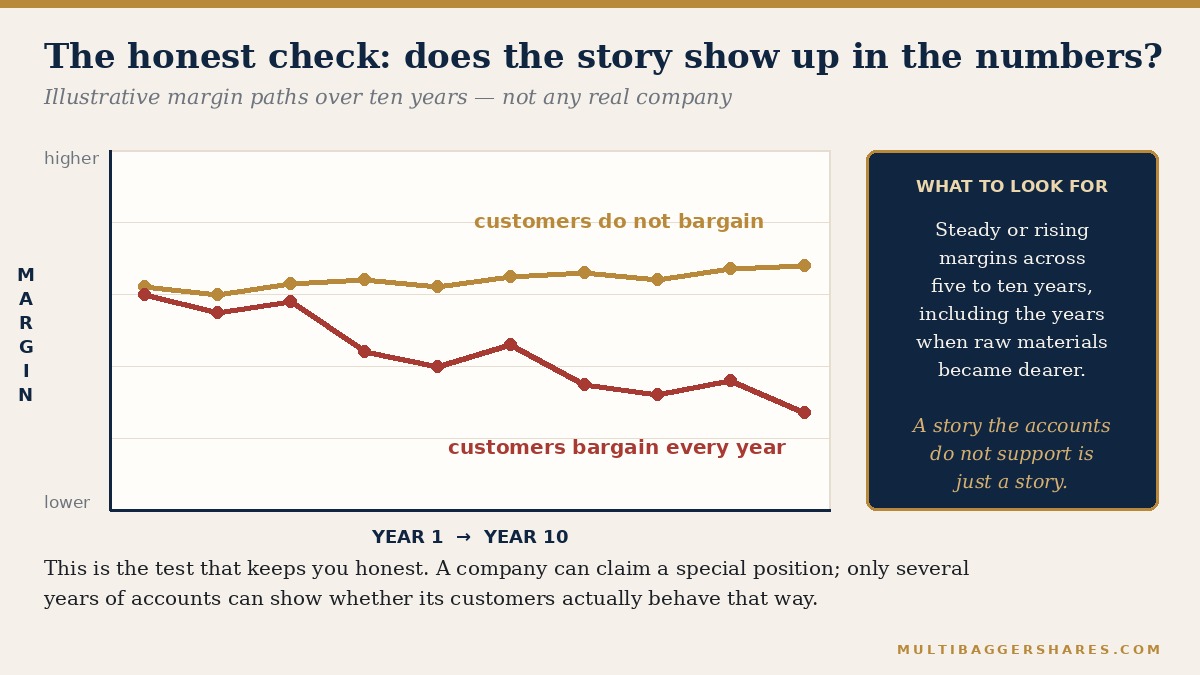
Four: is the evidence visible in the numbers? This is the honest check on the story. A company that truly enjoys this position tends to show margins that hold steady, or drift up, across several years, including years when its raw materials became dearer. A company that merely tells you it has a special position, while its margins sag every time input costs rise, is telling you a story its own accounts do not support. Look at five or ten years, not one.
And do keep the limits of the idea in view, because every good lens has a blind spot. Being small on the bill does not protect a company forever. If the customer’s own business comes under pressure, even small line items get squeezed. If a much better technology arrives, the trusted component can become the obsolete one. If the seller becomes greedy and raises prices far beyond what the trust is worth, some large customer will eventually fund a rival just to escape. “Nobody bargains” is a description of today, not a guarantee about the next decade.
Nor should this single question decide anything on its own. It sits alongside everything else worth asking about a business: whether the people running it are honest and capable, whether it carries debt it cannot comfortably service, whether the cash it reports actually arrives in the bank. A wonderful moat around a badly run castle is still a badly run castle.
But as a first filter, it is unusually good value for the effort. It takes about a minute, it needs no finance background at all, and it very quickly separates companies that must fight for every order from companies whose customers quietly re-order without asking the price. Over ten or twenty years, those two kinds of businesses tend to lead very different lives — and it all begins with something as ordinary as a ten-rupee seal.
Key takeaways
- Ask two questions about any product: how small is it on the customer’s total bill, and how large is the damage if it fails.
- When the item is a thin sliver of the bill but the failure is expensive, customers buy on trust rather than on price — and stop bargaining.
- Michael Porter set this out in 1979: where a product can pay for itself many times over, the buyer is rarely price sensitive and is interested in quality instead.
- This tends to show up as steadier margins, the ability to pass on cost increases, and repeat orders that need no persuading.
- Check the story against several years of accounts, and remember the limits: no position lasts forever, and this is one question among many, not a verdict on its own.
— Manish Goel · multibaggershares.com
Disclaimer: This article is published by multibaggershares.com for education and general information only. It is not investment advice, investment research, or a recommendation to buy, sell or hold any security. Any companies named are discussed only as illustrative examples. Markets carry risk; please do your own research or consult a qualified professional before making any investment decision.