The Milk Bill That Comes Even When You Are Away: What a Guaranteed Contract Really Guarantees

The Shop With the Price List on the Wall: How to Judge a Business Whose Profit Is Decided by Someone Else
September 16, 2026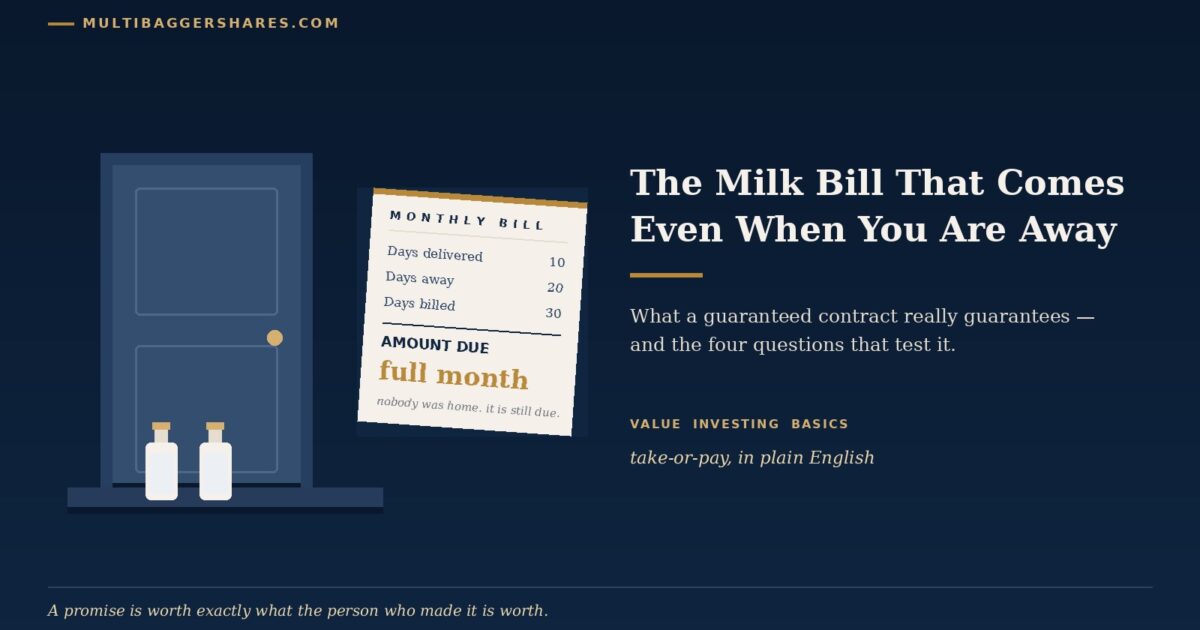
There is a man who leaves two litres of milk outside our door every morning before six. We have never agreed anything in writing. At the end of the month a folded slip arrives with a number on it, and we pay. Last year we went away for twenty days. The slip that month was for the full month.
Nobody argued. Not because we are generous, but because both sides understood what had been agreed. We had not asked him to sell us milk when we felt like buying it. We had asked him to keep two litres aside for us every single morning, which meant turning away the family on the next street who wanted the same two litres. On the strength of our word he had gone and bought a second buffalo. He could not un-buy the buffalo for twenty days.
That small domestic arrangement has a formal name in business, and it sits underneath some of the largest industrial assets in the world. It is called a take-or-pay contract (an agreement where the buyer promises to pay for a minimum quantity every year, whether or not he actually takes delivery of it). Gas terminals, pipelines, ports, industrial gas plants, warehouses and toll roads are all built on promises of this shape.
For an owner of a business — and owning a share means owning a slice of a business — a customer who must pay anyway looks like the nearest thing to a salary. Today’s letter is about how much that promise is really worth, where it quietly fails, and the four questions that separate a guarantee you can lean on from one that is decoration.
What “take-or-pay” really means
Strip away the vocabulary and the idea is simple. The buyer commits to a minimum quantity for a fixed number of years. Each year he has a choice, and only a choice: take the goods and pay for them, or leave them and pay anyway. The word for the amount he actually lifts is offtake (the quantity a buyer genuinely collects, as opposed to the quantity he promised to collect). If offtake falls short of the promise, a bill still arrives for the difference.
The same idea wears different clothes in different industries, and it helps to recognise the costume. A gas pipeline calls it ship-or-pay: you pay for the space you booked in the pipe, full or empty. A port concession agreement calls it minimum guaranteed cargo, or minimum guaranteed throughput — a floor on the tonnage that must move across the berth each year. A power or gas supply contract usually splits the bill into a capacity charge (a fixed amount for keeping the plant ready and available, payable even on a day when nothing is produced) and an energy charge that moves with actual use. Different names, one idea: somebody has agreed to pay for being ready, not merely for being served.
It is worth understanding why sellers ask for this, because it is not simple greed. Assets of this kind cost thousands of crores and take four or five years to build, and almost all of that money is spent before a single rupee of revenue arrives. No bank lends against a hope. The contract is what makes the loan possible: it converts a guess about future demand into a schedule of payments a lender can look at. In that sense the take-or-pay clause does not just protect the seller after the plant is built. It is the reason the plant exists.
Why a promise like this is worth so much
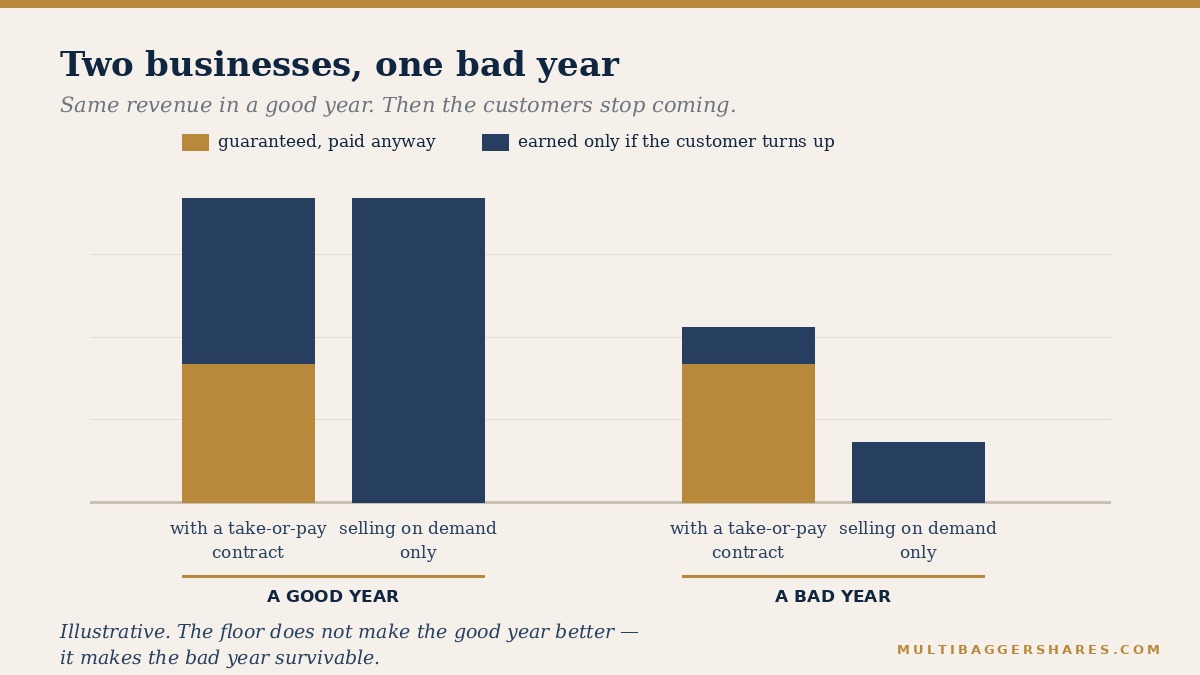
The real gift here is not extra profit. It is the transfer of volume risk — the risk that customers simply do not turn up — from the seller to the buyer. In an ordinary business, a bad year means idle machines and a wretched profit and loss account, because the costs of being open do not shrink just because the customers vanished. Rent, salaries, insurance, depreciation (the yearly charge that spreads the cost of a long-lived asset over its working life) and interest all carry on. A take-or-pay contract puts a floor under the revenue exactly where those unavoidable costs sit.
You can see how differently the same company treats the two situations. Linde, one of the world’s two big industrial gas companies, builds oxygen and nitrogen plants right next to a steel mill or a refinery and pipes the gas straight over the fence. Its latest annual filing describes those on-site contracts as running “typically ranging from 10-20 years and containing minimum purchase requirements and price escalation provisions”. The very next paragraph describes its merchant business — the same gases, delivered by tanker to whoever wants them — and there the customer agreements are “usually three to seven-year requirement contracts”. One company, two products that come out of the same plant, and two completely different promises behind them.
Notice something else in that filing, because it is the kind of detail that decides whether a guarantee is really safe. Linde says its on-site plants are “typically not dedicated to a single customer” — the surplus can be liquefied and sold into the open market. That is the difference between an asset with a second life and an asset that is scrap the day the contract ends. A jetty built to serve exactly one buyer’s exactly one cargo has no second life. A plant that can sell its spare output to anybody does.
So the honest way to describe a take-or-pay business is not “guaranteed profits”. It is this: the swings have been taken out and handed to somebody else, and in exchange the seller has usually accepted a lower price than he could have charged in a boom. That is a trade, not a free lunch. It suits a patient owner very well, and it will never make anyone rich in a hurry.
When the promise bends: a gas contract that got rewritten
Here is the part that a contract summary will never tell you. India’s biggest gas importer had signed a long-term agreement with a Qatari supplier for 7.5 million tonnes of liquefied natural gas a year, running all the way to April 2028. Classic take-or-pay. Then global energy prices collapsed. The contract price was tied to a five-year average of the crude oil Japan imports, and that five-year average was still sitting at about 94 dollars a barrel while the market had moved on. Indian buyers could get gas far cheaper elsewhere, so they stopped lifting the contracted cargoes. In 2015 the importer under-lifted by 32 per cent.
On paper, the seller was owed an enormous amount. Press reports at the time valued the cargoes that were not lifted at around twelve thousand crore rupees. On the last day of December 2015 the two sides signed a revised contract instead. The penalty was waived entirely. The pricing formula was rebuilt around a three-month average of Brent crude, which at the time was about 44 dollars a barrel, taking the delivered price from roughly twelve to thirteen dollars per unit down to six or seven. In return, the buyer agreed to take an extra million tonnes a year.
Read that carefully, because the lesson is not the one people usually draw. The seller did not go to court and win. The seller did not go to court at all. He looked at a customer who could not pay without being destroyed, and at thirteen more years of business he wanted to keep, and he chose the customer over the clause. That is the normal outcome. A take-or-pay penalty large enough to bankrupt the person who owes it is not really money owed; it is an opening position in a negotiation.
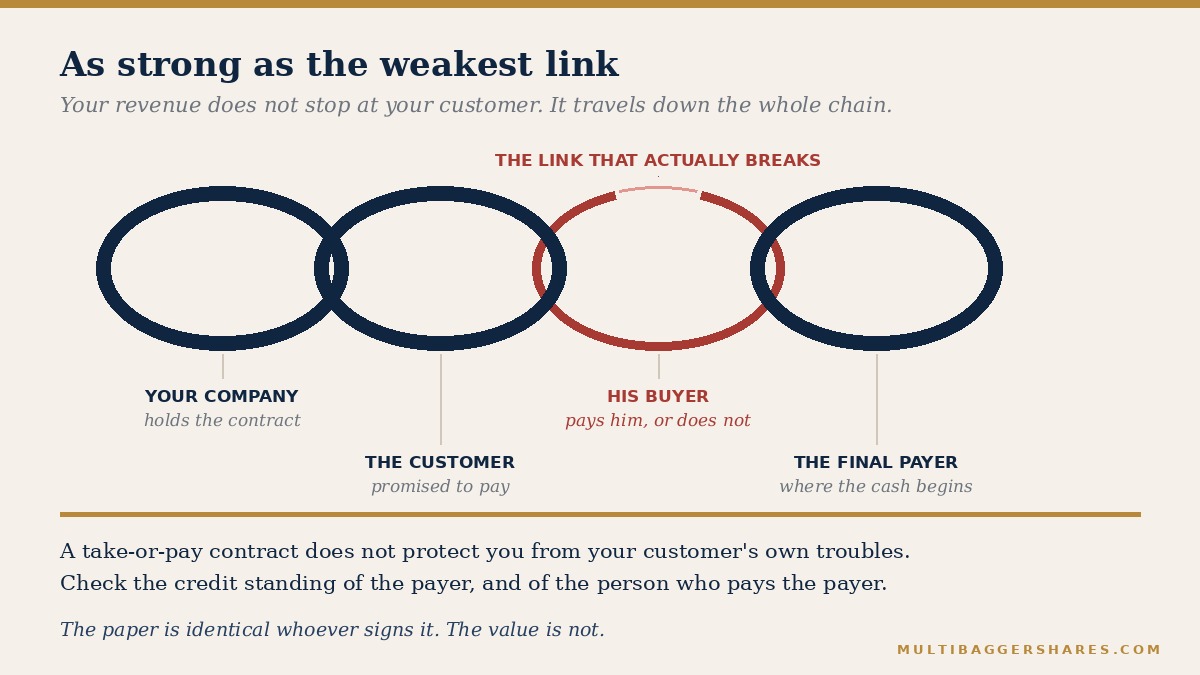
Warren Buffett made the same point about a different kind of contract in his 2002 letter to Berkshire Hathaway shareholders, warning that unless such contracts are collateralised or guaranteed, “their ultimate value also depends on the creditworthiness of the counterparties to them”. A counterparty is simply the person on the other side of your agreement. Their ability to pay is your revenue. There is no version of this where a strong contract rescues you from a weak customer.
The other side of the counter
Everything so far has assumed your company is the one receiving the promise. Often it is the one giving it, and that changes the picture completely. Read which way the arrow points before you celebrate.
Consider what happened to a coal-handling terminal at Visakhapatnam on India’s east coast. The operator had won the concession (the long-term right to build and run a facility on somebody else’s land, in exchange for payments and performance promises) and had guaranteed the port a minimum tonnage of cargo every year. Then national policy shifted towards domestic coal and away from imports. The cargo the terminal had been designed around simply stopped arriving. The operator invoked force majeure — the clause that excuses you when something genuinely outside your control makes performance impossible — and asked to end the arrangement by mutual agreement. The port authority issued a breach notice in October 2020, another in November, and a termination notice that December, effective from April 2021. An arbitration tribunal later awarded the operator about 155 crore rupees for handing over the terminal assets.
The expensive part came afterwards. Indian public port tenders carry a standard clause disqualifying any bidder whose contract has been terminated by a public entity in the previous three years. One terminated concession at one port therefore locked the group out of bidding at other ports altogether, and the courts declined to interfere. A promise the company had made about volumes it did not control ended up costing it not just that asset, but three years of opportunities elsewhere.
This is why the direction of the promise matters more than its existence. A guarantee you receive is an asset whose value depends on somebody else’s solvency. A guarantee you give is a liability whose cost depends on things you may not control at all — the weather, a policy change, a customer’s own customers.
How you can use this
When you find a company that leans on contracts of this kind, four questions do most of the work. First: who made the promise? A government-owned buyer, a highly rated private group and a loss-making start-up are three entirely different assets wearing the same paper. Look up the customer’s own credit rating if it has one, and read what the rating agency says about it.
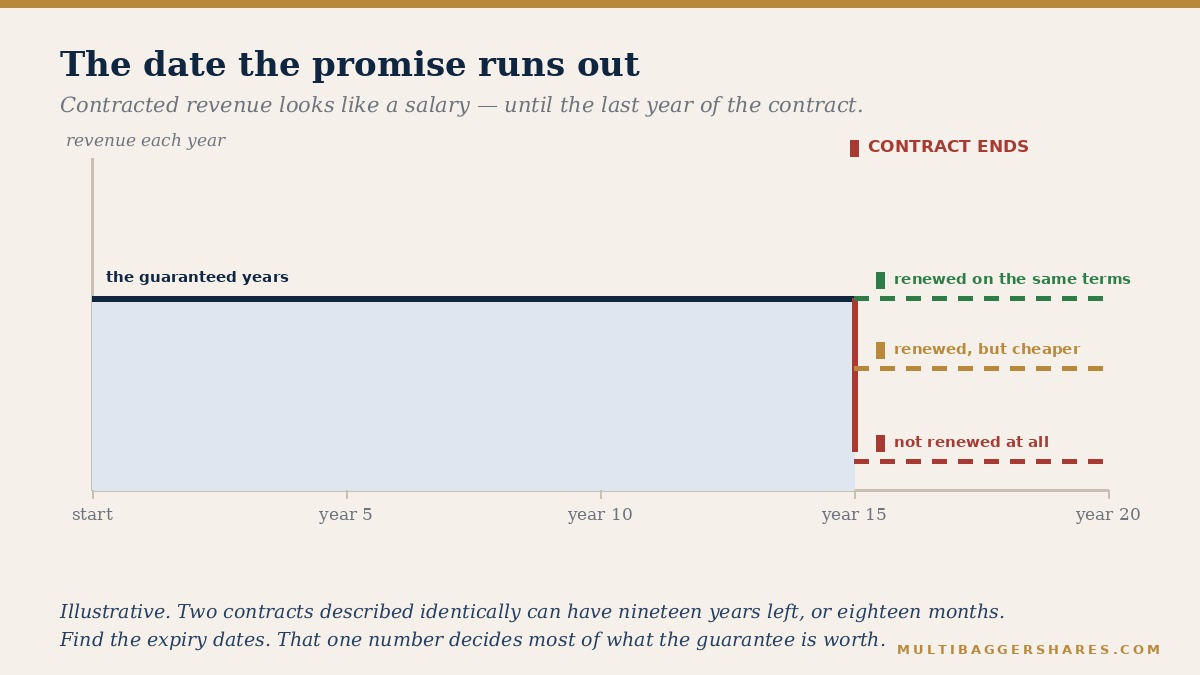
Second: how many years are left? A twenty-year contract with nineteen years to run and a twenty-year contract with eighteen months to run are described identically in a presentation and are worth completely different amounts. Find the expiry dates, add them up, and see what share of revenue faces renewal in the next three years. This is the single most useful number in the whole exercise and it is almost never in the headline.
Third: what does the fixed part actually cover? Compare the guaranteed portion of revenue with the costs that cannot be switched off — interest, depreciation, permanent staff, maintenance. If the floor sits above those costs, a bad year is dull. If the floor sits below them, the guarantee only slows the bleeding. Fourth: what happens to the asset if the promise ends? Can it serve a different customer, a different cargo, a different product? Or does it become an expensive monument?
Where to look: in the annual report, the revenue note under “revenue from contracts with customers” often discloses remaining performance obligations, which is contracted revenue not yet earned. Contingent liabilities (amounts the company might have to pay if something specific happens) are where disputed shortfall claims hide. The management discussion usually names the big counterparties, and credit-rating rationales published by the agencies are often franker about contract risk than the company is.
Two things this is not, because both are easy to confuse. It is not an order book, which tells you how much work has been booked but not whether anyone must pay if the work never happens. And it is not a regulated return, where a regulator fixes the rate of profit but nobody guarantees the volume. Take-or-pay does the opposite: it fixes the volume and leaves the profit to the price you negotiated. A business can have one, both or neither, and the three arrangements fail in completely different ways.
The milkman’s arrangement has lasted eleven years, which is longer than most industrial contracts. It has lasted because neither side has ever pushed it to the point where the other would rather walk away. That is the real test of every guarantee in this letter. A contract is a description of what two parties intend to do while they both still want to. Judge the parties first, and the paper second.
Key takeaways
- A take-or-pay contract moves volume risk from seller to buyer: the customer pays for a minimum quantity whether or not he takes delivery.
- The promise is worth exactly what the customer’s solvency is worth. A penalty big enough to bankrupt the payer usually gets renegotiated, not enforced.
- Find the expiry dates. Contracted revenue coming up for renewal in the next three years is the number that actually decides what the guarantee is worth.
- Check which way the promise runs. A guarantee your company gives is a liability, and breaching it can cost far more than the contract itself.
- Ask what the asset does the day the contract ends. A plant that can serve other customers is protected; a facility built for one buyer is not.
— Manish Goel · multibaggershares.com
Disclaimer: This article is published by multibaggershares.com for education and general information only. It is not investment advice, investment research, or a recommendation to buy, sell or hold any security. Any companies named are discussed only as illustrative examples. Markets carry risk; please do your own research or consult a qualified professional before making any investment decision.