The Umbrella in the Cupboard: Why Spare Cash Lets a Strong Business Go Shopping When Everyone Else Is Panicking

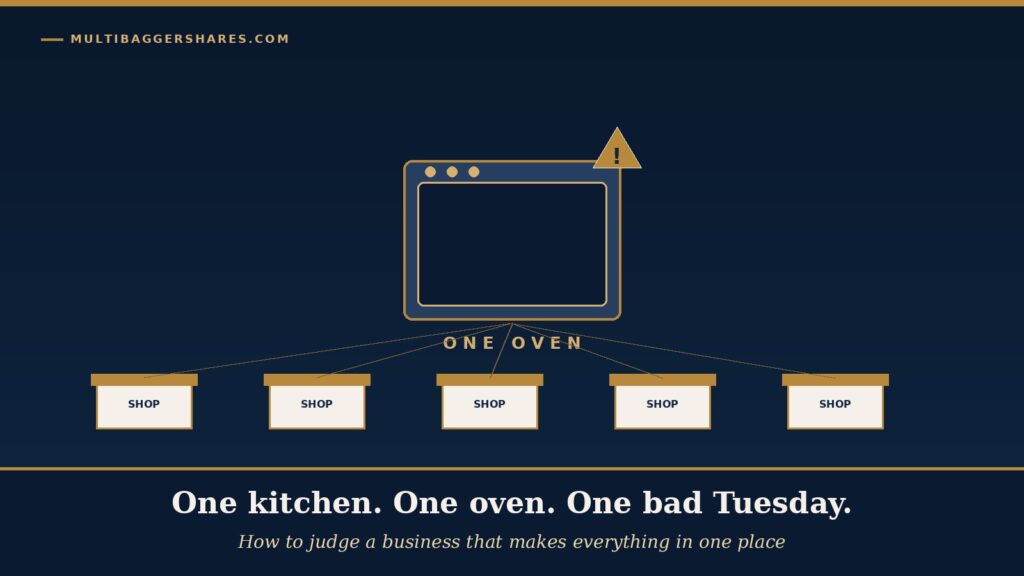
One Kitchen, One Oven: How to Judge a Business That Makes Everything in One Place
September 30, 2026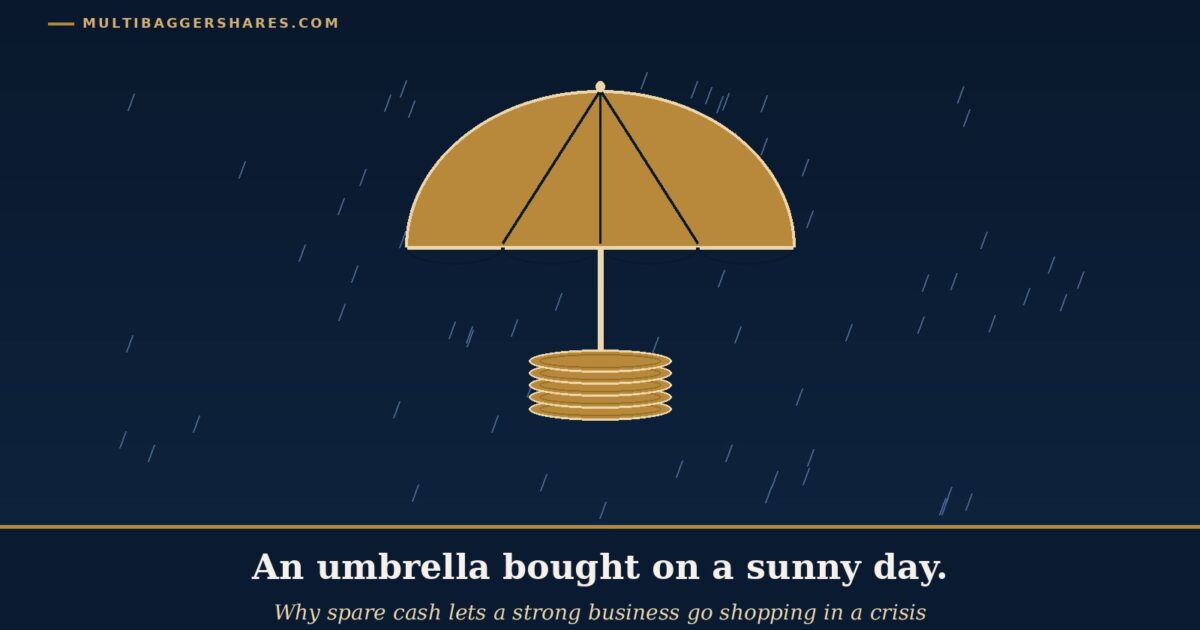
Every Indian household has an umbrella somewhere. It sits in a cupboard for most of the year. On a sunny Tuesday in April nobody gives it a thought. Then the monsoon arrives, and suddenly that humble umbrella is the most useful thing in the house.
Nobody calls the person who bought it a genius. They simply thought ahead. They bought it on a sunny day, when it was cheap and easy, so that they would not be standing in the rain trying to buy one.
Businesses have umbrellas too. We call them spare cash. It is money the business holds in the bank (or in very safe, easily sold investments) beyond what it needs for this month’s bills. On a sunny day it looks a little lazy. Money sitting still does not seem to be working hard. Today’s letter is about why that picture is incomplete, and about a second use of the umbrella that most beginners never think about.
What it really means
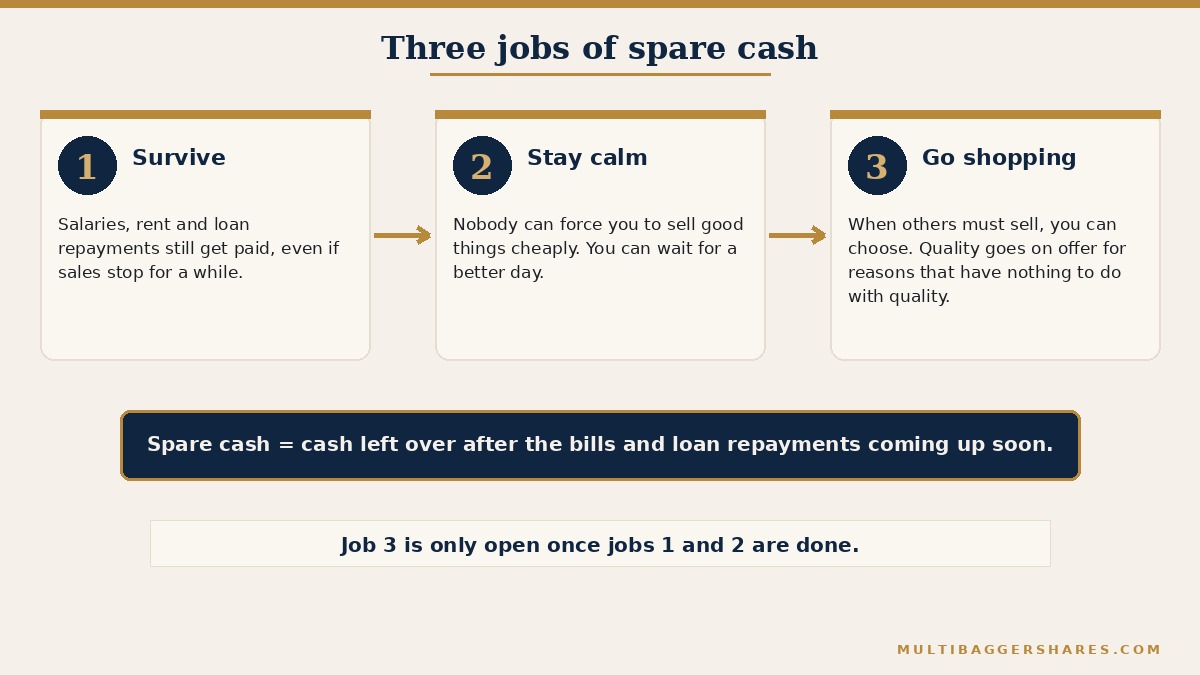
Let us start with the first use, the one everybody knows. Spare cash lets a business survive a bad patch. If sales stop for two months, the salaries, the rent and the electricity bills still arrive. A business with savings pays them and carries on. A business without savings has to borrow in a hurry, or sell something it never wanted to sell.
The second use is quieter. Spare cash lets a business stay calm. Think about what a shopkeeper with an overdue loan instalment does in a bad month. He cannot wait. He has to raise cash by Friday, so he sells his best stock at whatever price anyone offers. Spare cash means nobody can force his hand. He can wait for a better day.
The third use is the interesting one. Spare cash lets a business go shopping when others cannot. In a real crisis, many people and many companies are forced to sell. They are not selling because they want to. They are selling because a lender has called, a deadline has arrived, or fear has taken over. Whoever has cash on that day gets to choose from things that are suddenly on offer.
Investors have a name for this. They call it optionality (the value of having choices that other people do not have). The umbrella does not only keep you dry. On the right day, it lets you walk out into the rain, calmly, while everyone else is running for cover.
Be careful with one word here: spare. Cash is only an umbrella if it is truly yours to use. Imagine a business with 100 rupees in the bank and 120 rupees of loans falling due next month. On paper it has cash. In real life that cash is already spoken for. We want money that is left over after the near-term bills and repayments are accounted for. That is the cash that gives a business its choices.
Why it works
Here is the simple logic. Good things sometimes go on sale for reasons that have nothing to do with how good they are. A fine factory, a strong brand or a share of a very good company can be offered cheaply when the person holding it is in trouble. The quality has not changed. The seller’s situation has.
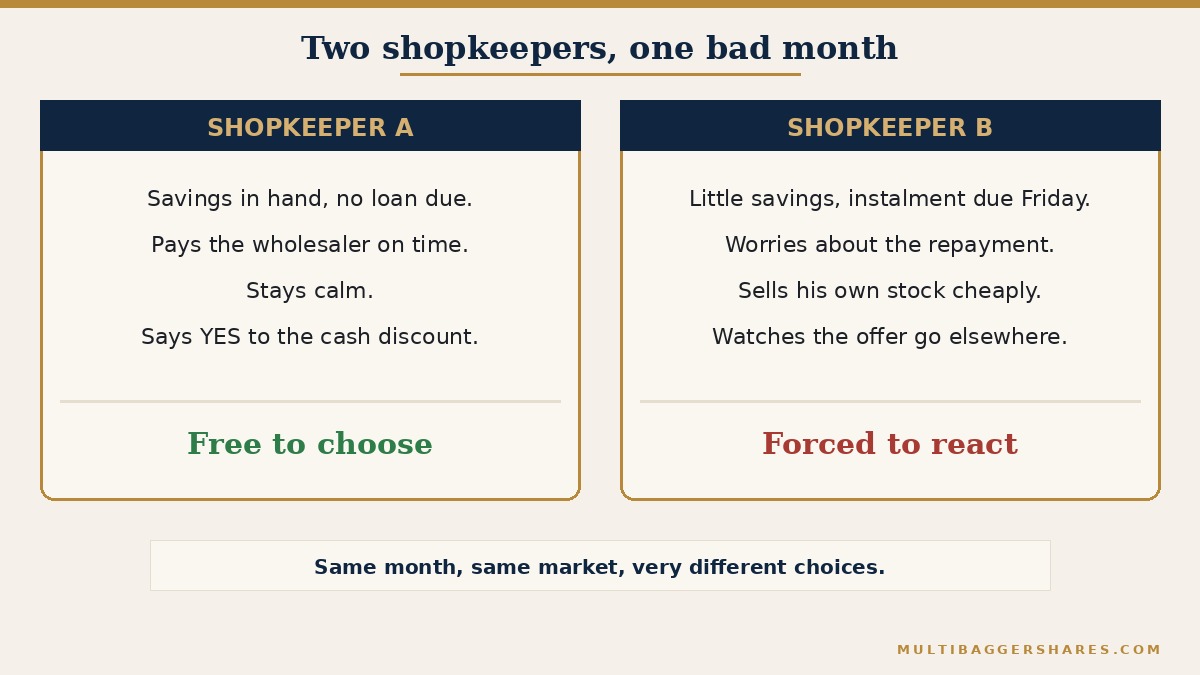
Now picture two shopkeepers on the same street. Both run good, honest businesses. In a bad month, a wholesaler who is short of money offers a large discount to anyone who pays cash immediately. The first shopkeeper has savings and no loan due, so he says yes. The second has a loan instalment due on Friday and almost no savings. He has to say no, and he may even be selling his own stock cheaply to meet the instalment. The market is the same for both of them. Their choices are completely different.
Notice that the first shopkeeper did not predict the bad month. He did not need to. He simply arranged his affairs so that a bad month could not hurt him. Everything else followed from that. This is why careful investors spend so much time on a company’s balance sheet (the page of an annual report that lists what a company owns and what it owes). It tells you who gets to make choices when times turn hard.
There is a second, quieter reason it works. Fear is contagious. When the news is frightening, even sensible people stop thinking clearly. A business that does not need anything from anyone can keep thinking clearly while others cannot. That calm is worth more than it looks.
History is full of forced sellers. Think of a promoter (the family or group that founded and controls a company) who borrowed against his shares, and the lender suddenly asks for more security when prices fall. Or a company with a large loan that must be refinanced (replaced by a fresh loan) in a month when no lender is feeling generous. Neither is a bad person. Both are simply on a clock. And the clock usually runs fastest exactly when prices are lowest.
This is also why the third job is only available after the first two are done. A business that is itself short of cash cannot go shopping. It is too busy trying to stay afloat. Surviving comes first, staying calm comes second, and choosing comes last. You cannot skip the steps.
A real example, and an everyday one
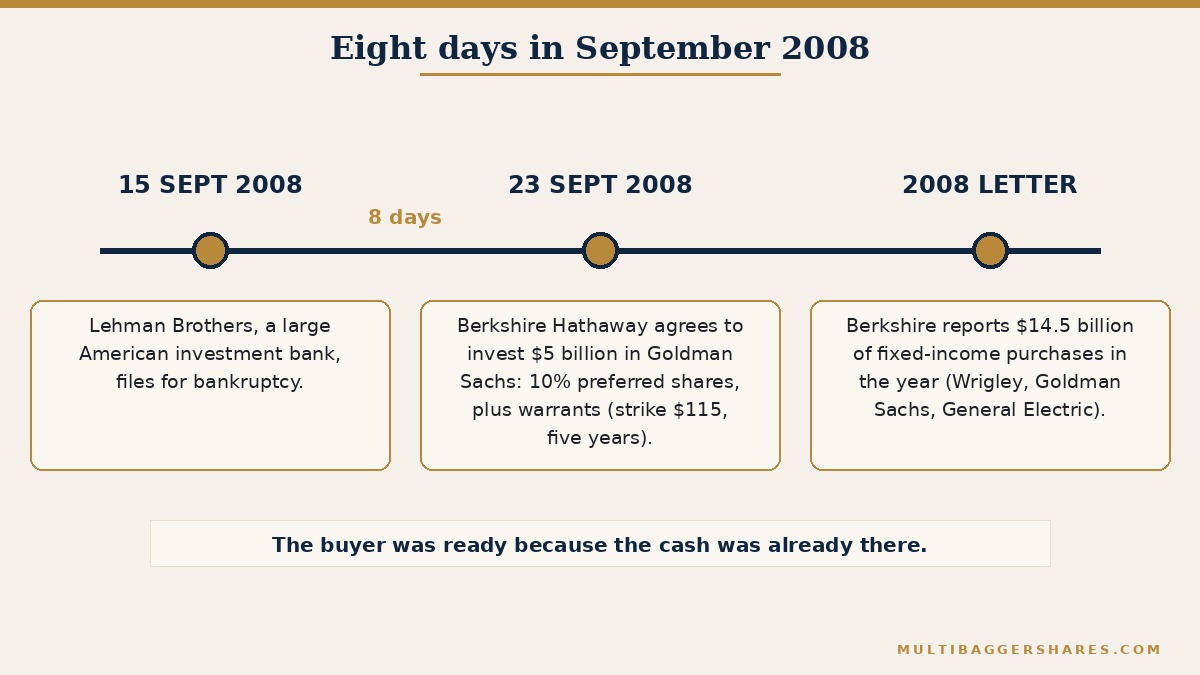
The most famous example is from the autumn of 2008, the worst of the global financial crisis. On 15 September 2008 a very large American investment bank called Lehman Brothers filed for bankruptcy. Confidence in banks everywhere fell sharply. Many strong institutions suddenly found that nobody wanted to lend to them.
Eight days later, on 23 September 2008, Berkshire Hathaway (the company run by Warren Buffett) announced that it would invest 5 billion dollars in another large bank, Goldman Sachs. It bought preferred shares (a kind of share that is paid its fixed dividend before ordinary shares) that paid 10 percent a year. It also received warrants (the right to buy more shares later at a fixed price of 115 dollars, for five years). Berkshire did this at a time when most people were looking for ways to get out, not in.
Mr Buffett’s own annual letter for 2008 tells the wider story. He wrote that Berkshire made purchases totalling 14.5 billion dollars in fixed-income securities (loans that pay a set return) issued by Wrigley, Goldman Sachs and General Electric. He also wrote a sentence that sums up the first two jobs of the umbrella: “We never want to count on the kindness of strangers in order to meet tomorrow’s obligations.” And he added another line about the third job: “When investing, pessimism is your friend, euphoria the enemy.”
Please read this as a story about preparation, not as a story about any one company. We are not saying anyone should buy or sell anything today. The point is the order of events. Long before the crisis, the cash was already there. That is why the choice was available on the day it mattered.
Notice, too, how rarely such a day comes. For most years the umbrella stays in the cupboard, and a business holding spare cash can look a little too careful. That idle time is the price of owning an umbrella. Patient owners accept it, because they know one good day of choice can matter more than many ordinary days of looking busy. Again, this is a lesson about preparation. It is not a suggestion about any share.
Now an everyday example. Think of a family that has quietly saved an emergency fund (money set aside for bad times, kept separate from everyday spending). One year a neighbour needs to sell a small plot urgently because of a family illness, and offers it at a price below what similar plots usually sell for. Many families would love to buy it. Only the family with ready money can say yes in time. The emergency fund was bought for rain. On that day it also let them walk through a door that was closed to others.
How you can use it
You do not need any special tools. An annual report and fifteen unhurried minutes are enough. Ask these three plain questions of any business you are studying.
Question one: how much spare cash is there, compared with what is owed in the next year or two? You are not looking for a huge pile. You are looking for comfort. If cash and easily sold investments comfortably cover the bills and loan repayments coming up, the umbrella is real.
Question two: can anyone call the loan early? This is the question beginners miss. A loan that must be repaid next month is very different from one that runs for ten years. Short loans can turn a calm day into an emergency very quickly. The report’s notes on borrowings usually show when each loan falls due.
Question three: what did the owners do the last time it rained? Look at how the business behaved in a hard year, such as 2008 or 2020. Did it stay calm and keep investing sensibly, or did it scramble? The past is not a promise, but it shows character.
A quick note on what counts as cash. Money that customers still owe the business (receivables, which are bills sent but not yet paid) is not the same thing as money in the bank. Neither is a stock of unsold goods in the warehouse. Both may turn into cash one day, but a crisis is exactly when that can take longer than planned. Look for cash that is already in hand, or in very safe investments that can be sold in a day.
It also helps to look at the trend over several years rather than one year. Did the cash pile grow steadily while the business grew? Or did it appear suddenly, perhaps because of a fresh loan or a one-time sale? A cushion that has been built slowly, out of the business’s own earnings, is far more comforting than one that arrived last quarter.
One caution. Cash is a tool, not a goal. A business that piles up cash for years and never does anything sensible with it is not showing discipline. It may simply have run out of ideas. The best umbrella is one that is used wisely when the weather turns, not one that is simply carried around forever. We are also not talking about how cheap or expensive any share is today. We are only asking whether the business has the freedom to choose.
Come back to the cupboard. On a sunny day the umbrella looks like a small, boring thing. It only reveals its worth when the weather changes. The same is true of a strong balance sheet. It is easy to ignore in good times. It is exactly what you will be glad of in the bad ones, and it is a quiet sign of an owner who thinks ahead.
Key takeaways
- Spare cash is a business’s umbrella: it is bought on a sunny day and valued on a rainy one.
- It does three jobs, in order: it helps the business survive, it keeps the owners calm, and it lets them go shopping when others are forced to sell.
- Good things sometimes go on offer for reasons unrelated to their quality. Only a buyer with ready cash gets to choose.
- Ask three questions: how much cash against what is owed soon, can anyone call the loan early, and what did the owners do the last time it rained?
- Cash is a tool, not a goal. An umbrella that is never used wisely is just something heavy to carry.
— Manish Goel · multibaggershares.com
Manish Goel is a Chartered Accountant and Principal Officer of Multibagger Securities Research & Advisory Pvt. Ltd. (MSRAPL), a SEBI-registered Investment Adviser, Registration No. INA100007736. This content is published by MSRAPL for education only and is not personalized investment advice.
Disclaimer: This article is published by multibaggershares.com for education and general information only. It is not investment advice, investment research, or a recommendation to buy, sell or hold any security. Any companies named are discussed only as illustrative examples. Markets carry risk; please do your own research or consult a qualified professional before making any investment decision. |