The Cheapest Money in Town: Why What a Bank Pays for Its Money Decides How Good the Bank Can Be

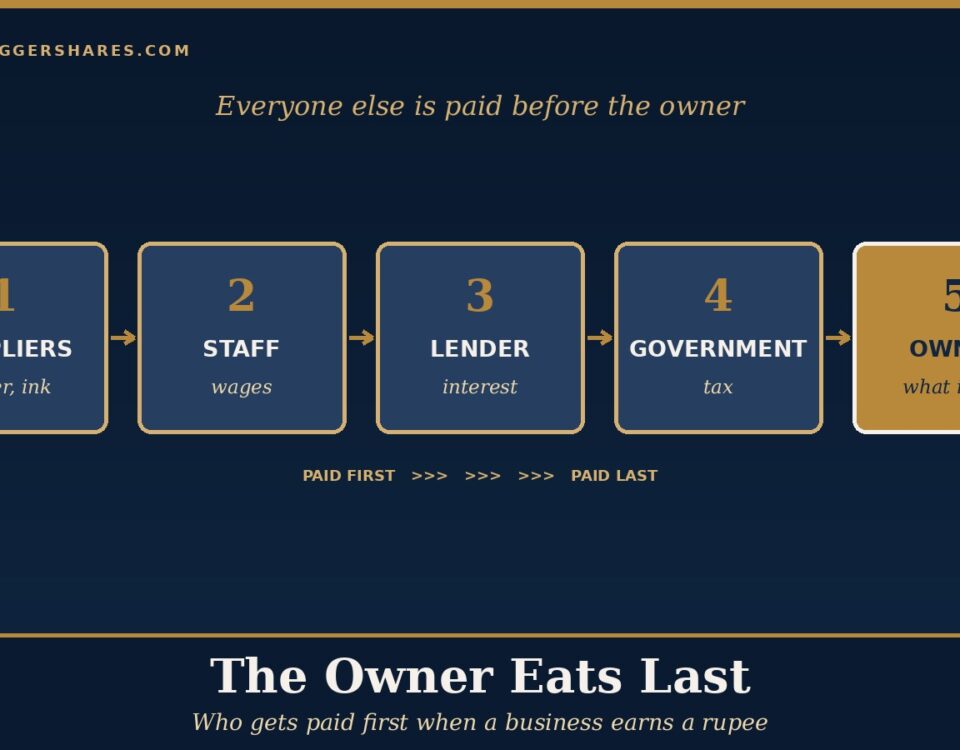
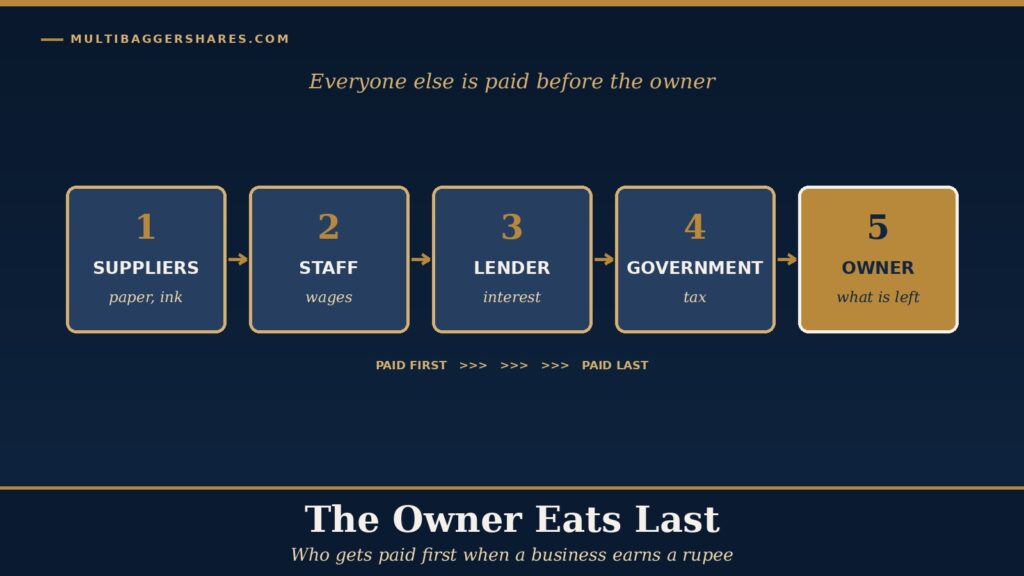
The Owner Eats Last: Who Gets Paid First When a Business Earns a Rupee
October 12, 2026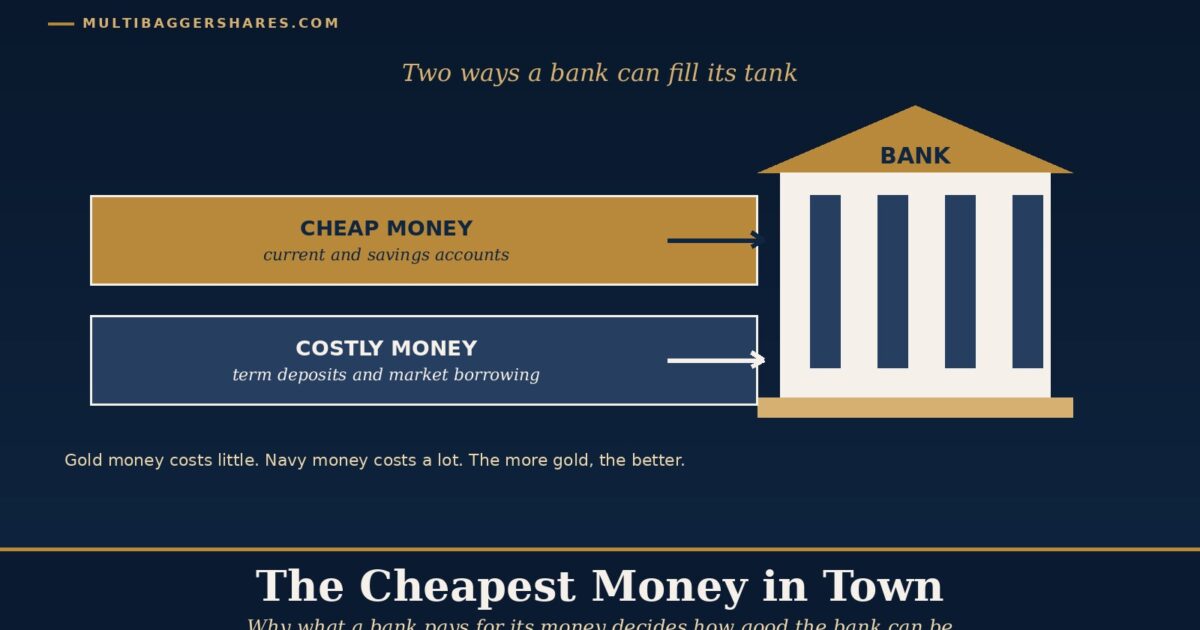
Every shop has a supplier. The sweet shop buys sugar, and the tailor buys cloth. A bank is a shop too, and what it sells is money. It buys money from one group of people and sells it to another group at a higher price. The price a bank pays for the money it buys is called its cost of funds (what a lender pays to get hold of the money it lends out). That one number quietly decides how good the shop can ever be.
Picture two money counters in the same market, run by Meena and Raju. Both lend to local traders at 10 percent a year. Both have Rs 100 to lend. Their loans are equally good, their customers are equally honest, and they work equally hard. The only difference is where the Rs 100 came from. That small difference turns out to matter a great deal, and it is the idea we will explore today.
What it really means
A bank mostly lends other people’s money. Those people are called depositors (customers who keep their money safe in the bank). Banks hold three main kinds of customer money, and each one costs the bank a different price.
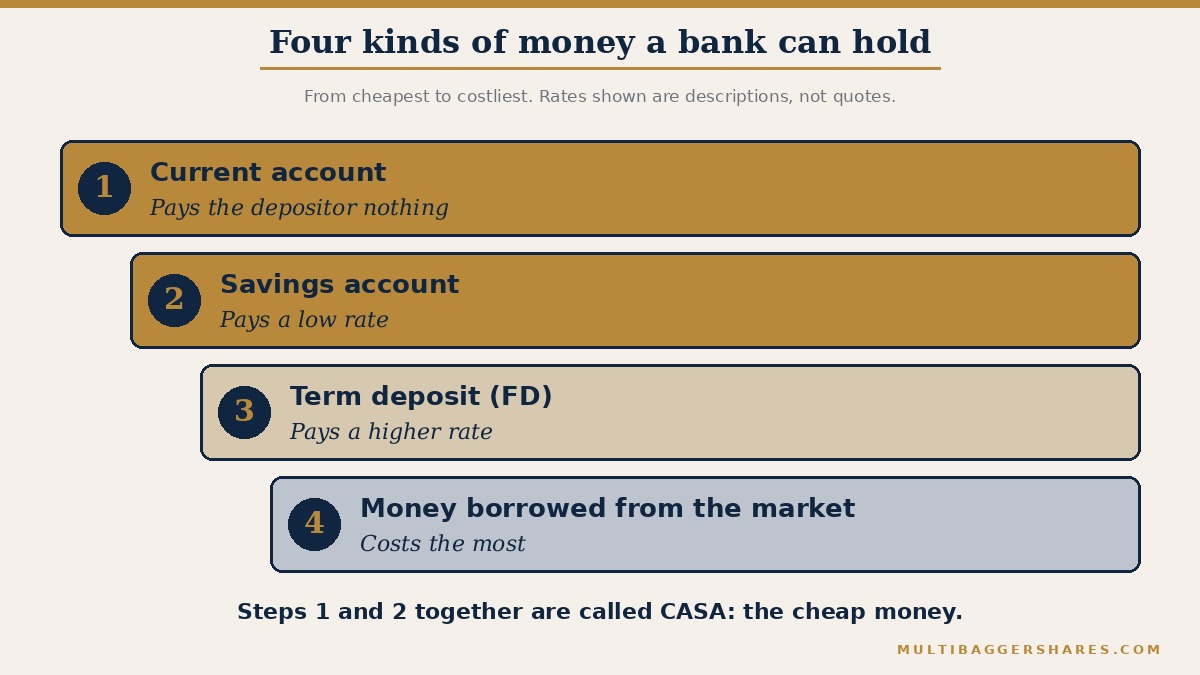
The first is the current account (the account that shops and firms use to receive and pay money every day). In India, banks are not allowed to pay interest on current accounts. So this money costs the bank almost nothing. The second is the savings account (the ordinary account that most families hold). It pays a low rate of interest, because people want to take their money out whenever they like. The third is the term deposit, also called a fixed deposit (money locked in for a fixed period, like the FD your parents may hold). It pays a higher rate, because the customer promises not to touch it for a while.
Current account money and savings account money together are called CASA (short for current account and savings account). Bankers call this their cheap money. When a bank needs more than its customers will give it cheaply, it pays higher rates for term deposits, or it borrows from other lenders in the market. That is its costly money.
You may wonder why anyone leaves money in an account that pays so little. The answer is that customers are not only buying interest. They are buying safety, because the money sits in a regulated bank. They are buying convenience, because they can pay a bill, receive a salary or swipe a card whenever they like. And they are buying habit, because changing banks is a nuisance. A bank that serves these needs well is paid in cheap money. That is the quiet trade that happens behind every savings account.
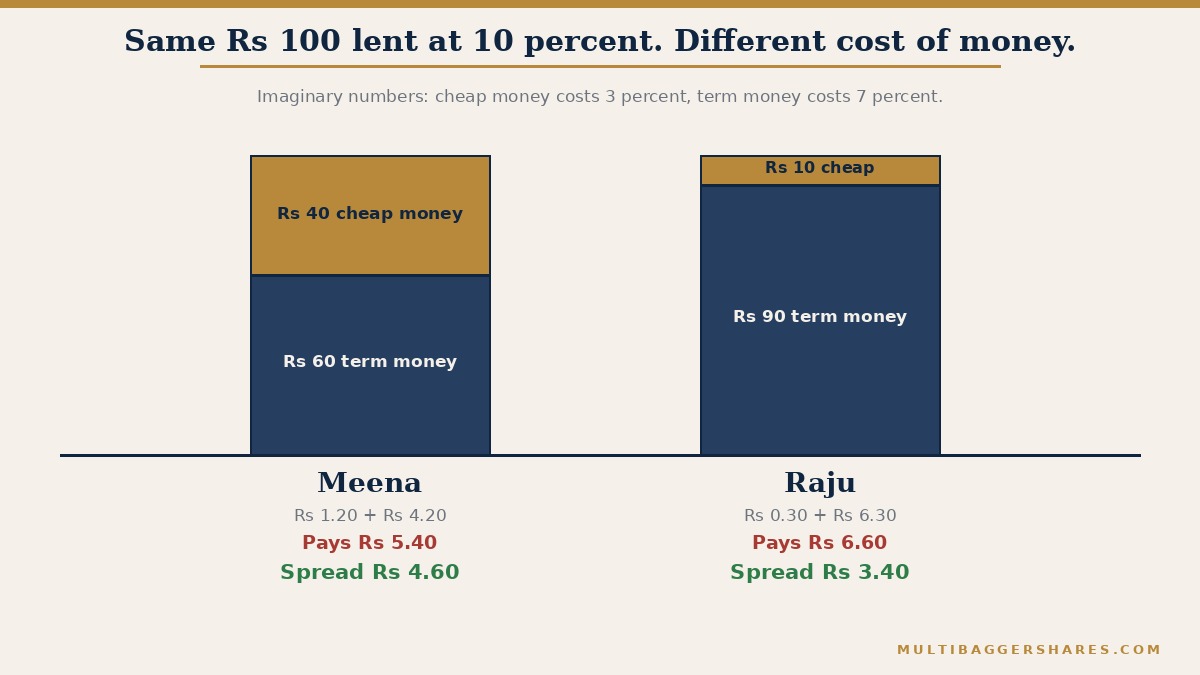
Now watch what the mix does. Say cheap money costs the bank 3 percent a year, and costly term money costs 7 percent. Meena’s counter funds its Rs 100 with Rs 40 of cheap money and Rs 60 of term money. Her bill for money is Rs 1.20 plus Rs 4.20, which is Rs 5.40. Raju, who is newer and has fewer loyal customers, funds his Rs 100 with only Rs 10 of cheap money and Rs 90 of term money. His bill is Rs 0.30 plus Rs 6.30, which is Rs 6.60.
Both lend their Rs 100 at 10 percent and earn Rs 10. The gap between what a lender earns and what it pays for its money is called the spread (the margin the lender keeps before running costs and bad loans). Meena’s spread is Rs 4.60. Raju’s spread is Rs 3.40. Same loans, same customers, same effort, yet Meena keeps more than a third more. Bankers measure this gap as a share of the bank’s assets and call it the net interest margin, or NIM for short.
Notice that Meena did not do anything clever. She did not find better borrowers or charge a higher price. She simply bought her stock more cheaply. In an ordinary shop we call that a good supplier deal. In a bank, the cheapest stock is the money that customers leave behind without asking for much in return.
If this sounds familiar, think of two kirana shops on the same street. One buys its goods from a trusted wholesaler who gives thirty days to pay, at a fair price. The other must pay cash on the day and often borrows from a moneylender to do it. Both sell rice and oil at the same prices to the same neighbours. At the end of the year, the first shop has kept far more, because its stock cost less to carry. Nobody would call the first shopkeeper lucky. He built a relationship, and the relationship pays him every month. A bank with a large base of cheap money has done the same thing at a much larger scale.
Why it works
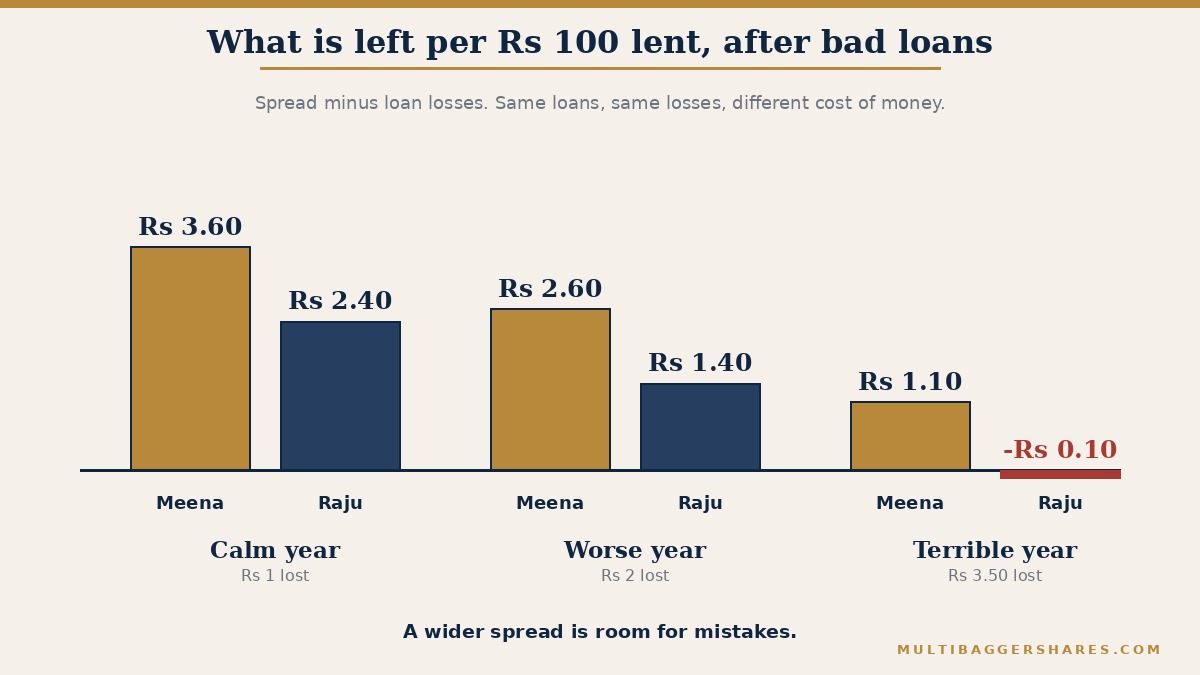
The first reason is room for mistakes. Every lender, however careful, sometimes loses money when a borrower cannot repay. Those losses are paid out of the spread. So the wider the spread, the more bad luck the lender can survive. Let us test our two counters.
In a calm year, say that Rs 1 of every Rs 100 lent is lost. Meena keeps Rs 3.60 and Raju keeps Rs 2.40. In a worse year, with Rs 2 lost, Meena keeps Rs 2.60 and Raju keeps Rs 1.40. Raju’s profit has shrunk by about two-fifths, while Meena still has a comfortable cushion. In a really terrible year, with Rs 3.50 lost for every Rs 100 lent, Meena still earns Rs 1.10. Raju slips into a loss of ten paise. The same storm that dents one counter sinks the other.
The second reason is quieter, and it is about behaviour. Suppose Raju wants to match Meena’s profit. His money costs him Rs 6.60 per Rs 100, so he must charge about 11.2 percent on his loans to keep a spread of Rs 4.60. But the market price is 10 percent. Who will pay 11.2 percent when others offer 10? Usually only the borrowers that others have turned away. So the lender with costly money is slowly pushed towards riskier customers, and riskier customers are exactly the ones who fail to repay.
Meena faces no such push. She can be picky. She can say no to a doubtful borrower and still earn a healthy spread. A lender who can say no is a lender who sleeps well. This is why people who study banks say that cheap money lets a lender stay disciplined, while costly money tempts a lender to stretch.
The third reason is that cheap money is hard to copy. Think about why a family keeps its salary account in one bank for twenty years. It is habit, trust, convenience, and the branch around the corner. A shopkeeper leaves his daily cash in a current account because his suppliers know the account number and his staff know the bank manager. None of this can be bought quickly. A rival can offer a higher interest rate for a few months, but higher interest rates are exactly what make the money costly. So the cheapest money is the stickiest money, and it takes years to build.
The fourth reason shows up in bad times. Money that comes from term deposits or from borrowing in the market is quick to ask for a better rate, and quick to leave when people grow worried. A salary account or a shopkeeper’s daily-cash account rarely moves overnight. So cheap money is not only cheaper. It is also calmer, and calm money lets a lender make long-term decisions without looking over its shoulder every week.
One honest warning is needed. Cheap money is not free money. To collect it, a bank must run branches, pay staff, and keep a mobile app working. A good reader looks at both sides: how cheaply the money comes in, and how much it costs to keep customers happy. Still, the principle holds. All else equal, a bank whose customers hand it large amounts of low-cost money starts every year with a head start.
A real example or two
The best-known remark on this idea comes from Warren Buffett. In a 2009 interview with Fortune magazine, he spoke about a large American bank in which his company, Berkshire Hathaway, then held a big stake. He said a bank like that gets its money extraordinarily cheap, and so it does not have to do dumb things. Read that carefully. He was not praising cleverness. He was saying that cheap money removes the need for cleverness, as long as the bank stays sensible.
A second example comes from India, and it shows how much cheap money is worth. For years, the interest on savings accounts was fixed by the Reserve Bank of India, the country’s central bank. In October 2011, the Reserve Bank freed the rate, so each bank could set its own, with one rule: a bank had to offer a single rate to all savings balances up to Rs 1 lakh. Within days, Kotak Mahindra Bank announced 6 percent on its savings accounts, while the State Bank of India said it had no immediate plan to raise its own rate from 4 percent.
Why did the two react so differently? The reason is simple arithmetic. A bank that holds a vast pile of savings money would pay far more in interest if it matched a higher rate across the whole pile. A bank that wanted to attract new savings customers had every reason to pay up. The episode shows that cheap money is not an accident. It is something banks guard, compete for and pay dearly to defend, and the price a bank is willing to pay tells you how much it values the money.
Notice that we have named these banks only to tell a story about how money was priced. We are not saying that any bank is strong or weak, or that anything should be bought or sold. The lesson is about the idea, and the idea works for any lender: a housing loan company, a vehicle finance company or a small cooperative bank.
How you can use it
You can use this idea whenever you read about a bank. Here are six simple habits.
First, find the CASA share. Banks usually report it every quarter in their results presentation. It tells you what part of the bank’s customer money is cheap. A higher share usually means cheaper funding, though the number must be read against the bank’s own history and its peers.
Second, watch the direction over years, not months. A CASA share that holds steady or rises through good and bad times suggests loyal customers. A share that keeps slipping suggests the bank may be paying more and more to hold on to its money.
Third, compare how fast loans grow with how fast deposits grow. If a bank lends faster than customers hand it money, the gap must be filled with costly money. Fast growth is exciting, but it is often funded at a higher price.
Fourth, ask where the bank’s profit comes from. Is a wide spread coming from cheap funding, or from lending to riskier borrowers at high rates? A wide spread built on cheap money is sturdier than the same spread built on risky loans.
Fifth, remember the cost of keeping customers. Branches, staff and technology are the price of cheap money, so look at the bank’s running costs alongside its funding costs.
Last, keep the idea in its place. Cheap money gives a bank a head start, but it does not guarantee good lending. Buffett’s remark has two halves: the money is cheap, and the bank must not do dumb things. A bank with the cheapest money in town can still waste it. Use this as one lens among many, and never as the whole picture. This article is for education only.
Key takeaways
- A bank is a shop that sells money, and the price it pays for that money is its cost of funds.
- Current account and savings account money (CASA) is the cheapest, so a higher CASA share usually means a wider spread.
- A wide spread gives a lender room for mistakes, so the same bad loans hurt a cheap-money bank far less.
- Costly money pushes a lender towards riskier borrowers, while cheap money lets it say no.
- Cheap money is built slowly through trust and habit, which makes it hard to copy, but it still needs sensible lending.
— Manish Goel · multibaggershares.com
Manish Goel is a Chartered Accountant and Principal Officer of Multibagger Securities Research & Advisory Pvt. Ltd. (MSRAPL), a SEBI-registered Investment Adviser, Registration No. INA100007736. This content is published by MSRAPL for education only and is not personalized investment advice.
Disclaimer: This article is published by multibaggershares.com for education and general information only. It is not investment advice, investment research, or a recommendation to buy, sell or hold any security. Any companies named are discussed only as illustrative examples. Markets carry risk; please do your own research or consult a qualified professional before making any investment decision. |