The Owner Eats Last: Who Gets Paid First When a Business Earns a Rupee

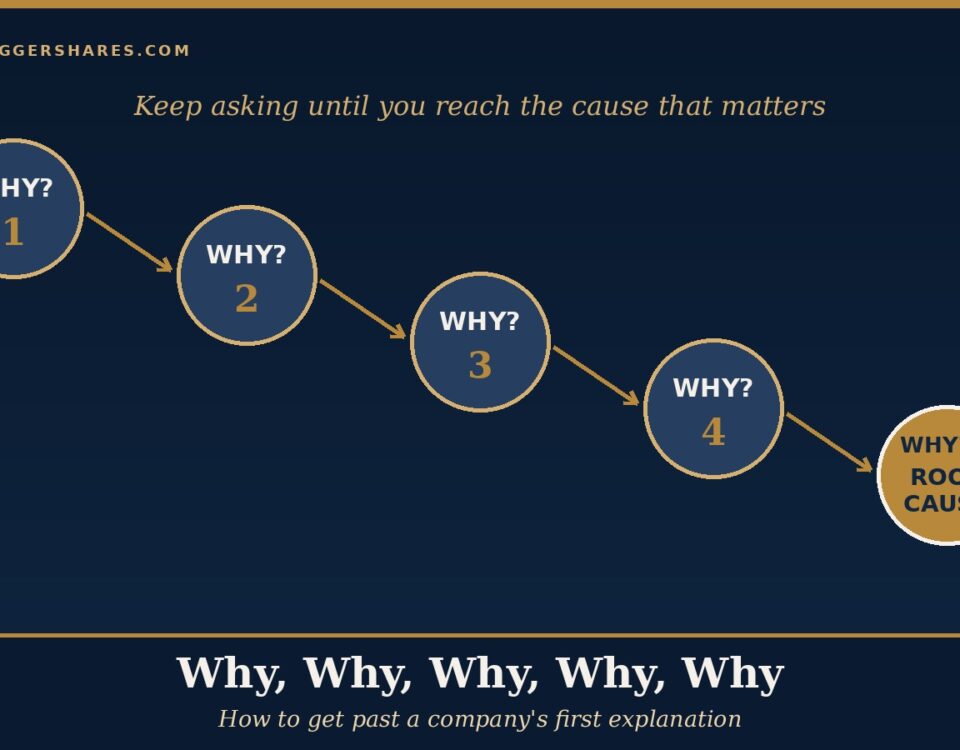
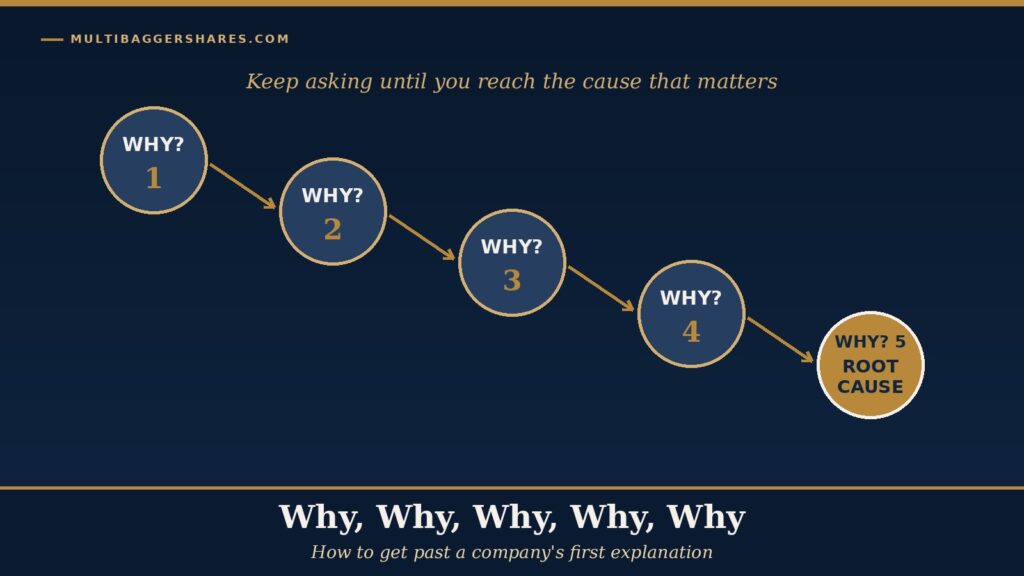
Why, Why, Why, Why, Why: How to Get Past a Company’s First Explanation
October 11, 2026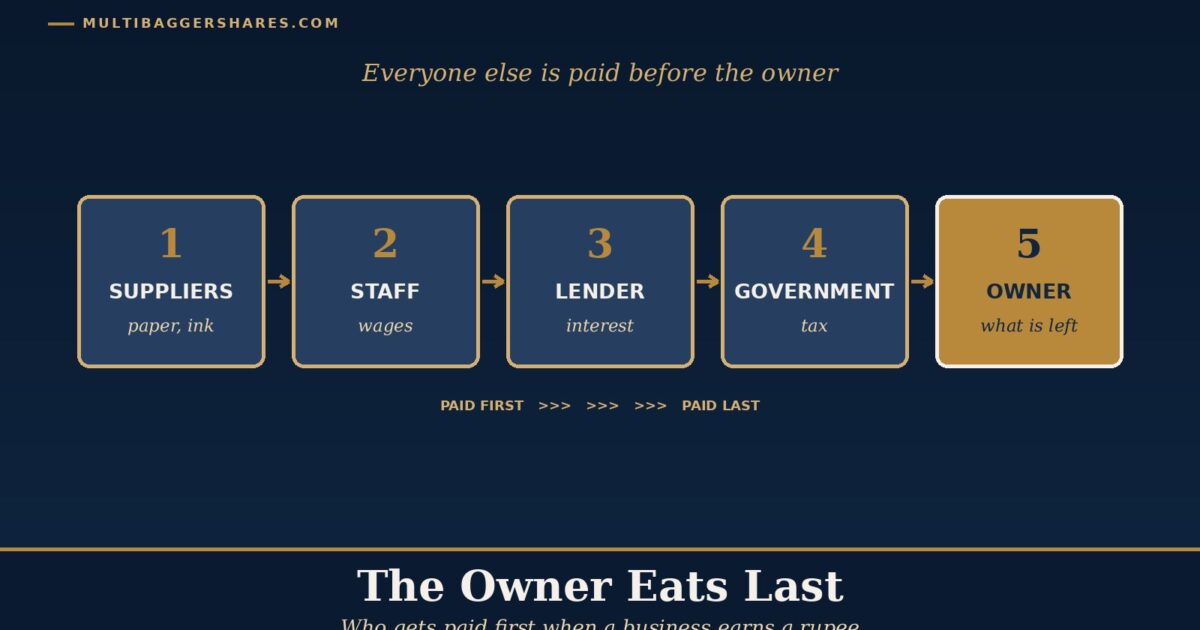
At a big family feast, watch who eats last. The guests sit down first. The elders are served next. Then the children are fed. The host, the person who invited everyone and paid for the food, walks between the rows checking that every plate is full, and sits down only when everyone else has eaten. If the food is plentiful, the host eats well. If a few extra guests turn up, the host eats very little, or nothing at all.
A company is a little like that feast. Many people take a share of every rupee the business earns, and the owner takes his share last. Today’s lesson is about that queue, the order in which a business’s money is paid out. Once you can see the queue, you can see why the owner’s share is both the biggest prize in the business and its most fragile part.
What it really means
A business earns money by selling things. The money that comes in from customers is called sales, or revenue. It does not all stay with the owner. Before the owner sees a single paisa, other people must be paid. Let us follow every Rs 100 of sales through an imaginary printing press called Sai Print House. All the numbers are made up, chosen only to keep the sums easy.
First in the queue are the suppliers. These are the people who sell the press what it needs, such as paper and ink. They take Rs 50 out of every Rs 100. Next come the staff, who are paid wages and salaries. They take Rs 24. Then the landlord and the electricity company are paid, and together they take Rs 10. Add these up and Rs 84 has gone. That leaves Rs 16.
Now comes the lender. The press once borrowed money from a bank to buy its machines. Interest is the fee for borrowing, like rent on money. Suppose the interest bill works out to Rs 4 for every Rs 100 of sales. That leaves Rs 12. Then the government takes its tax on that profit. To keep the sums easy, say tax is one-fourth, which is Rs 3. What remains is Rs 9.
That Rs 9 belongs to the owner. It is called net profit, the final profit after everybody else has been paid. Look at the picture below. Out of every Rs 100 the customers pay, the owner’s slice is the thin gold bar at the end.
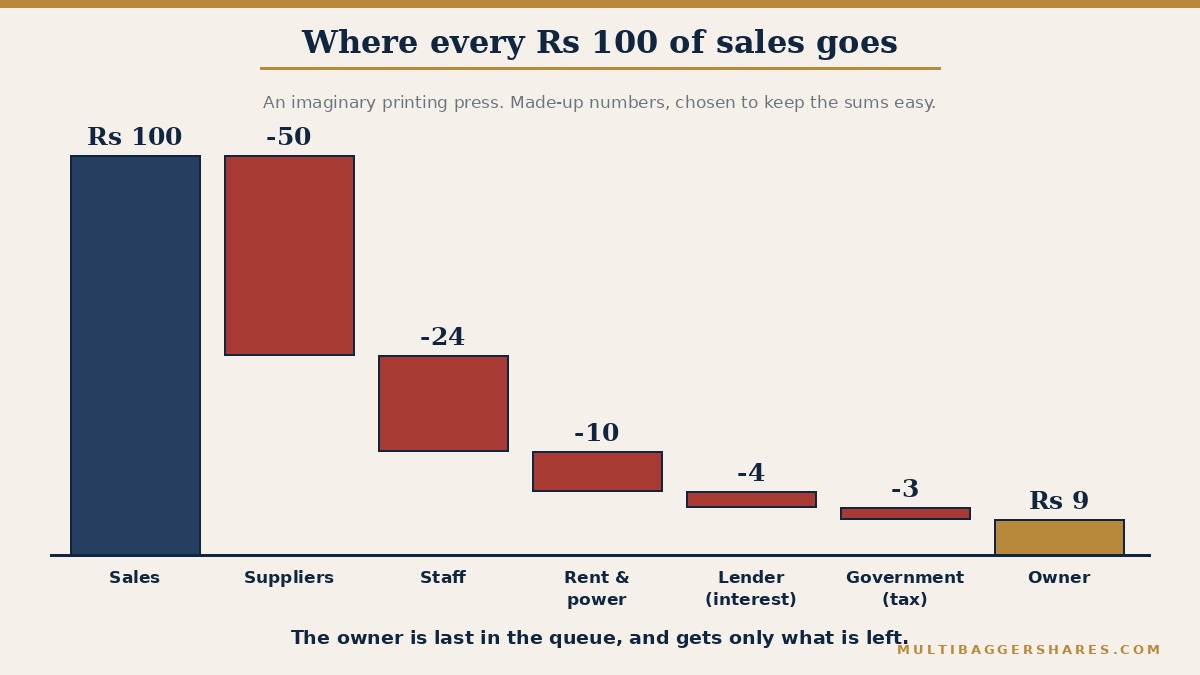
Two things stand out. The first is that the owner is last. The second is more subtle. Almost everyone ahead of the owner is owed an amount that is agreed in advance. The bank is owed Rs 4 whether the year is good or bad. The staff are owed their wages. The landlord is owed his rent. The owner is owed no fixed amount at all. He is owed whatever is left.
The word for this is residual, which simply means what remains after everything else is taken out. The people who own a company’s shares are its owners, and they hold a residual claim. A claim is just a right to be paid. Everyone else has a claim for a fixed sum. The shareholder has a claim on the leftovers.
Why it works
Think of the owner’s slice as a shock absorber. When business is good, the extra money has nowhere to go but to the owner, because the others are already paid their agreed amounts. When business is bad, the shortfall lands on the owner first, for the same reason. The owner’s share swings up and down by far more than anyone else’s.
Let us see this with two printing presses next door to each other. They have the same machines, the same staff and the same customers. There is only one difference. Press A has no loan. Press B borrowed heavily and pays Rs 8 of interest on every Rs 100 of sales. Debt, simply, is money borrowed that must be paid back with interest.
In a normal year, with sales of Rs 100, each press has Rs 16 left after suppliers, staff, rent and power. Press A pays tax of Rs 4 and the owner keeps Rs 12. Press B pays Rs 8 to the bank first, has Rs 8 left, pays tax of Rs 2, and the owner keeps Rs 6.
Now suppose a bad year comes and sales slip to Rs 92. Less printing is done, so paper and ink cost less, Rs 46. But wages, rent and power stay at Rs 34 because the staff and the shop do not shrink. That leaves Rs 12. Press A pays tax of Rs 3 and the owner keeps Rs 9. Press B pays its Rs 8 to the bank, is left with Rs 4, pays tax of Rs 1, and the owner keeps Rs 3.
A fall in sales of only 8 percent has cut Press A’s owner’s share by a quarter, from Rs 12 to Rs 9. It has cut Press B’s by half, from Rs 6 to Rs 3. The bank, meanwhile, was paid Rs 8 in every year without fail.
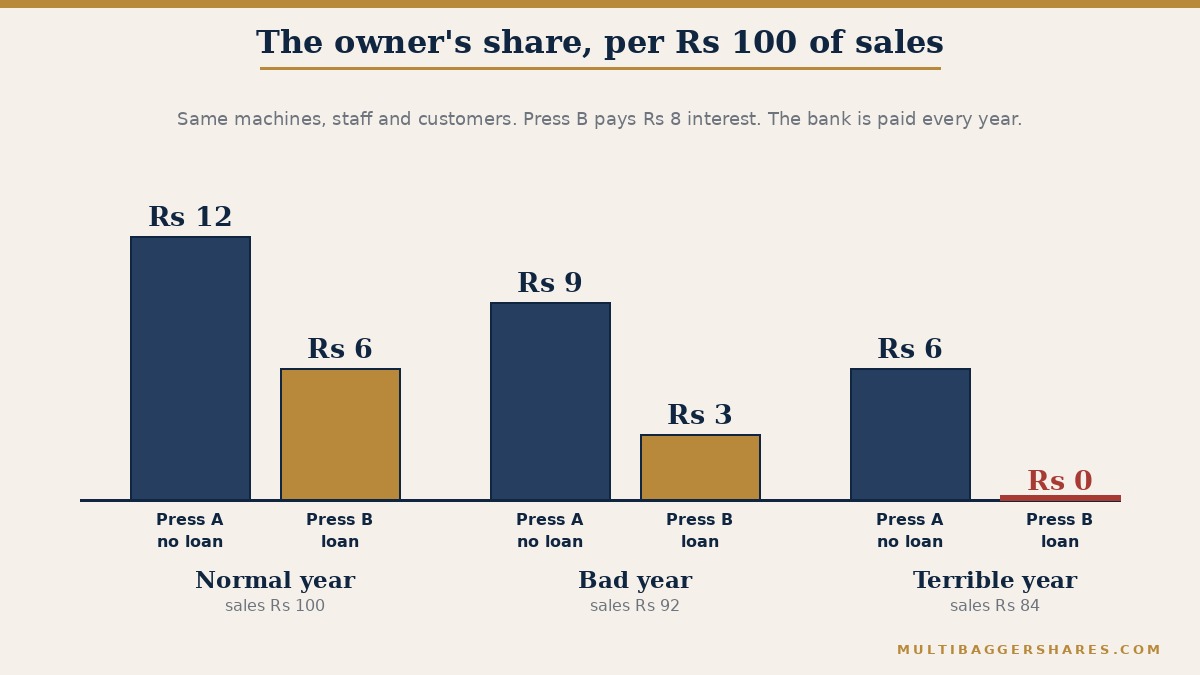
Now imagine a terrible year, with sales of Rs 84. Paper and ink cost Rs 42, and wages, rent and power still cost Rs 34, so Rs 8 is left. Press A pays tax of Rs 2 and its owner still keeps Rs 6. Press B’s whole Rs 8 goes to the bank. Its owner gets nothing. If sales fall a little further, the press cannot even pay the bank in full, and it is in real trouble.
The same shock absorber works in the other direction too. In an unusually good year, the owner of the press with the loan sees his share jump by a larger proportion, because the bank’s Rs 8 does not grow. This is why borrowing can make owners look brilliant in good years and unlucky in bad ones. The queue does not choose. It simply passes every swing along to the last person in line.
This is also why a thoughtful investor treats the owner’s slice with respect. It is where the whole reward of owning a business sits, and it is where every problem lands first. It is a prize, and it is also a cushion that others are standing on.
A real example or two
The clearest real example is written into Indian law. When a company can no longer pay its debts and is wound up, which means its assets are sold off to pay what it owes (the word for this is liquidation), the queue is not left to chance. Section 53 of the Insolvency and Bankruptcy Code, passed in 2016, lists exactly who is paid and in what order.
First come the costs of running the process itself. Then come the dues of workmen, the ordinary workers, for the previous 24 months, together with those secured lenders who gave up their claim on the company’s property. (A secured lender is one whose loan is backed by a pledge of property, so the bank can claim that property if the loan is not repaid.) Next come the unpaid dues of other employees for 12 months. After them come unsecured lenders, whose loans had no property pledged. Government dues for two years follow, along with secured lenders for whatever their property did not cover. Then come all other dues.
At the very end of the list come two kinds of owners. Preference shareholders are owners who were promised a fixed dividend (a share of profit paid to owners), and they are paid ahead of ordinary owners. Last of all come equity shareholders, the ordinary owners. By the time the line reaches them, there is usually nothing left. Even the tax collector waits in this line. As reported, the Supreme Court said in October 2023 that customs dues of a company in insolvency are to be paid in the order Section 53 sets out.
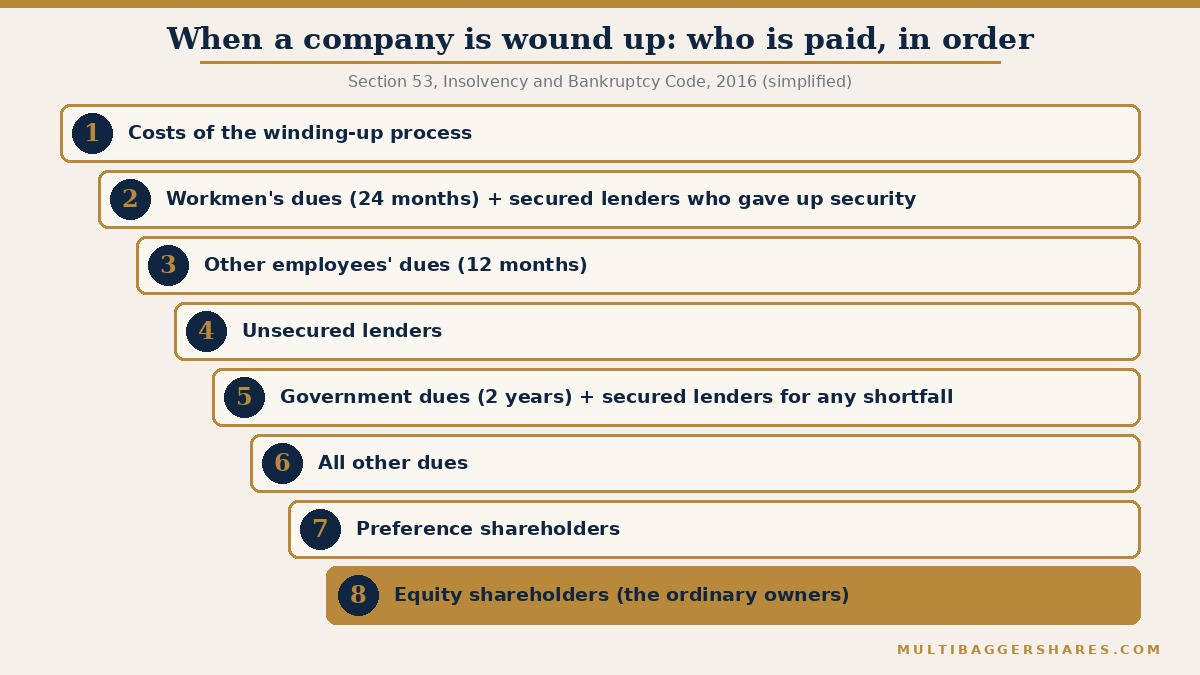
Notice how the law copies the feast. The people who gave the most certain promises are served first, and the person who kept no promise, the owner, is served last. This is not a punishment. It is the price of the owner’s special right. In exchange for standing last, the owner gets everything that is left when times are good, with no upper limit.
A second example is about attitude, not law. In his letter to shareholders for 2009, Warren Buffett wrote that his company Berkshire Hathaway would never become dependent on the kindness of strangers. He meant lenders. A business that relies on borrowing fresh money to repay old loans is relying on other people being in a generous mood on a particular day. In a crisis, the mood changes, and the line forms very quickly. The same letter speaks of keeping the company’s liquidity (ready cash and assets that can be sold quickly) well above its likely needs. We mention the company only as a story about how an owner thinks about the queue. It is not a view on any share.
How you can use it
You can use this idea with any company’s yearly accounts. The statement of profit and loss (the page that lists a year’s income and costs from the top to the bottom) is, in fact, the queue written out. It starts with sales. Then it lists the cost of materials, the cost of employees and other expenses. Then comes a line called finance cost, which is the interest. Then tax. And at the very bottom is profit after tax, the owner’s slice. Read it from the top to the bottom, and you are watching the line move.
First, count who stands ahead of the owner and how big each claim is. If the suppliers and staff take most of the rupee, the owner’s slice is thin to begin with. A business that keeps only a few paise out of every rupee has little room for error.
Second, ask how fixed those claims are. Material costs tend to fall when sales fall. Wages, rent and interest usually do not. The more fixed the claims ahead of you, the harder the shock lands on the owner. Interest is the stiffest of them all, because a bank does not accept a smaller payment just because the year was weak.
Third, compare the interest bill with the money available to pay it. We met this idea in an earlier lesson on the interest coverage ratio (how many times a company’s profit before interest could pay its interest bill). If the profit available covers the bank’s share many times over, the queue is comfortable. If it barely covers it, the owner’s slice is balanced on a knife-edge.
Fourth, watch whether new people are joining the queue. A new loan adds a claim ahead of you. New shares, in the same company, mean the leftovers must be split among more owners, which we looked at in an earlier lesson on dilution. A company that keeps adding claims is asking the owner to share an ever smaller slice.
Fifth, notice how you feel about last place. Many beginners look only at the sales line, because it is the biggest and most exciting number. The experienced investor reads down to the bottom of the page and asks how much of each rupee actually reaches the owner, and how much it could shrink in a bad year.
Last, keep the idea in its place. It teaches you how to read a business. It does not tell you whether any share is priced high or low, and it is not a prediction about any company. It will not tell you whether the managers are honest. It is one lens, a good one, and it should be used together with the others you have learnt.
Key takeaways
- Every rupee a business earns is paid out in a queue: suppliers, staff, lenders, the government, and the owner last.
- The owner’s claim is residual, meaning it is not a promised sum but only what is left, so it swings more than anyone else’s.
- Debt makes the lender’s claim fixed, so in a bad year the owner’s slice shrinks much faster in the indebted business than in the debt-free one.
- When a company is wound up, Section 53 of India’s Insolvency and Bankruptcy Code puts equity shareholders at the very end of the line.
- Read the profit and loss statement as a queue, and ask how many claims stand ahead of the owner and how fixed they are.
— Manish Goel · multibaggershares.com
Manish Goel is a Chartered Accountant and Principal Officer of Multibagger Securities Research & Advisory Pvt. Ltd. (MSRAPL), a SEBI-registered Investment Adviser, Registration No. INA100007736. This content is published by MSRAPL for education only and is not personalized investment advice.
Disclaimer: This article is published by multibaggershares.com for education and general information only. It is not investment advice, investment research, or a recommendation to buy, sell or hold any security. Any companies named are discussed only as illustrative examples. Markets carry risk; please do your own research or consult a qualified professional before making any investment decision. |