Why, Why, Why, Why, Why: How to Get Past a Company’s First Explanation

Water and Diamonds: Why Something the World Cannot Do Without Can Still Be a Hard Business
October 10, 2026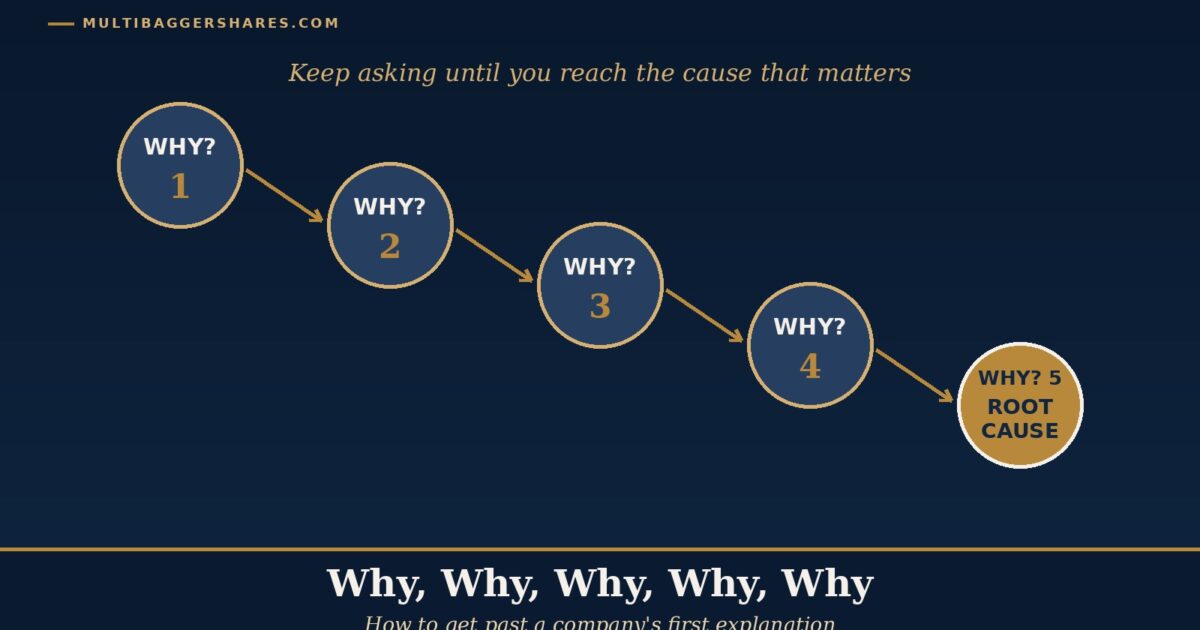
Suppose a child has a fever, and the doctor gives some medicine to bring it down. The fever goes. Three days later it comes back. A careless doctor gives the same medicine again. A good doctor does something different. She asks why. Why is there a fever? There is an infection. Why is there an infection? The child drank unclean water. Why was the water unclean? The tank at home has not been cleaned for a year. Now the doctor knows what to fix. It is the tank, not the thermometer.
A company’s results are a little like that child. When profit falls, the company gives its first explanation. It may blame the weather, the government, or ‘a challenging year’. Often the explanation is true as far as it goes. But it is the fever, not the tank. Today we will learn a simple habit that helps you go from the first answer to the real one.
The habit is called the five whys. It is as plain as it sounds. You ask why, and then you ask why of the answer, and you keep going. You will see how it works on a machine in a factory and on an imaginary snack-maker. You will also see where it can mislead you, and how to use it with a company’s annual report beside you.
What it really means
The habit comes from Toyota, the Japanese car maker. Taiichi Ohno was an engineer and manager at Toyota who is often called the architect of the Toyota Production System (the way the company organises its factories). In his book on that system, whose English edition came out in 1988, he wrote about asking why five times whenever a problem shows up. The practice itself is usually traced to Sakichi Toyoda, the founder of the family business that grew into Toyota.
Ohno’s idea rests on one difference. A symptom is the sign that something is wrong, like the fever. A root cause is the deepest cause you can reach and actually do something about, like the dirty tank. If you fix only the symptom, the problem comes back. If you fix the root cause, it usually does not.
Why five? Because in practice the first answer is almost never the last. It is a guide and not a law. Sometimes three whys are enough. Sometimes you need seven. The rule is simply to keep asking until the answer is something you can act on, or something you can honestly say is just bad luck.
Why would an investor care about a factory habit? Because an investor, like a factory manager, is reading the symptoms of a business. Sales, profit and margin (the share of each rupee of sales that is kept as profit) are all symptoms. The tank is somewhere underneath. The investor who can find it understands the business better than the one who only reads the headline number.
Why it works
First answers are comfortable. They are usually about something outside the company: the monsoon, the exchange rate, the price of oil, the government. Nobody can be blamed for those. Each further why makes the answer less comfortable and more useful, because it moves from what happened to the company to what is true about the company.
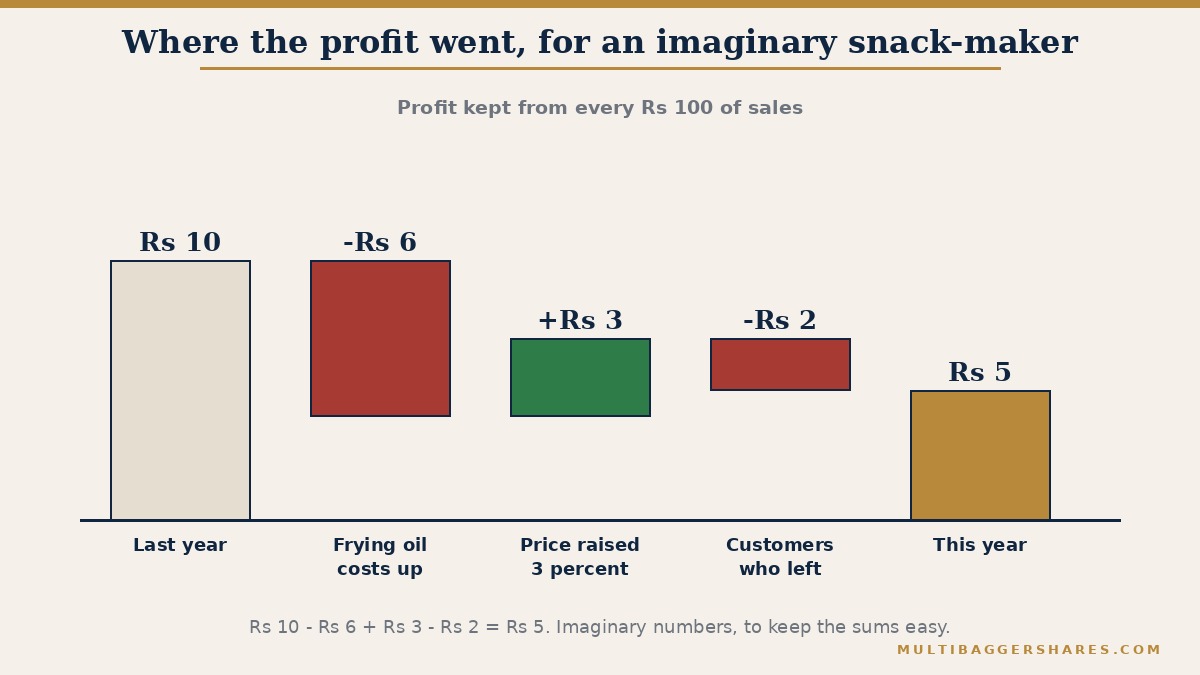
Let us try it on an imaginary snack-maker called Anand Namkeen. All the numbers are made up, chosen only to keep the sums easy. Last year, for every Rs 100 of sales, Anand Namkeen kept Rs 10 as profit. This year it keeps Rs 5. Profit has halved. The management’s note says: ‘Edible oil prices were volatile this year.’
That is the first answer, so we ask why. Why did profit halve? Frying oil became dearer, and that added Rs 6 to its costs for every Rs 100 of sales. Why did that hurt so much? Because the company raised its prices by only 3 percent, which won back just Rs 3. Why only 3 percent? Because when it tried to charge more, some customers left, and the lost sales took away another Rs 2. Rs 10 less Rs 6, plus Rs 3, less Rs 2 leaves Rs 5.
Now we ask the question that matters. Why did customers leave so easily? Because the packets look alike and taste alike, and the shopkeeper stocks whichever one earns him the better margin. Nobody walks into the shop and asks for Anand Namkeen by name. And why does nobody ask for it by name? Because the company has never given people a reason to. That is the fifth answer. The oil was only the fever. The tank is that the product has nothing special.
Look how different the two stories are. The first answer says: bad luck, oil prices. A reader who stopped there would expect profit to come back when oil gets cheaper. The fifth answer says: this company cannot pass costs on to its customers, so the next rise in any cost will hurt just as much. We met this idea in the last lesson, when we spoke about pricing power (the ability to raise your prices without losing your customers). The five whys is the tool that leads you to it.
Suppose a rival snack-maker faced the same rise in oil. It raised prices by 6 percent, and almost nobody left, because its customers ask for it by name. Its profit hardly moved. Same oil, same year, very different business. Only the later whys show the difference.
The habit protects you in good years too. When profit rises, the first explanation is just as comfortable: ‘strong demand’, ‘a good monsoon’, ‘favourable conditions’. Ask why again. Did profit rise because the business became better, or because oil happened to be cheap this year? A business whose profit rises only when luck is kind has not changed. A business whose profit rises because more customers now ask for it by name has. The first kind of improvement fades. The second kind tends to stay, and that is what a long-term owner is looking for.
A real example or two
The most famous example comes from Ohno’s own book, and it is a story about a machine, not a company. A machine on the factory floor stops. Why did it stop? There was an overload, and the fuse blew. The easy fix is to put in a new fuse. But Ohno asked why again.
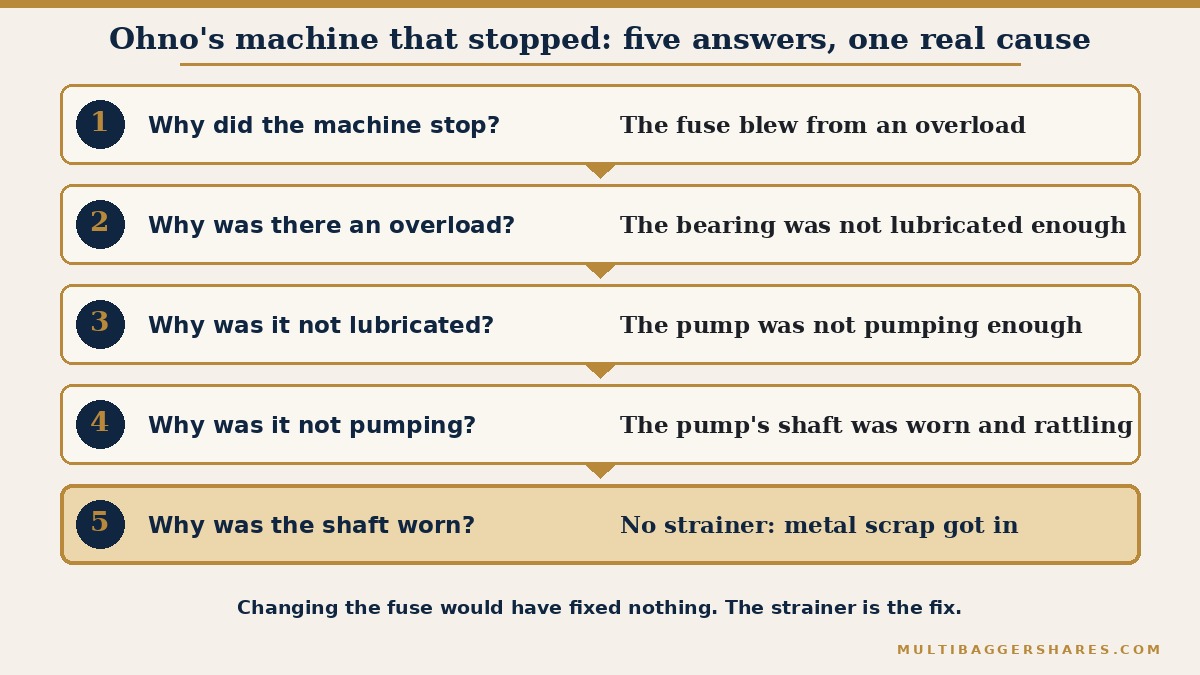
Why was there an overload? The bearing (the part the shaft turns in) was not lubricated enough. Why not? The lubrication pump was not pumping enough. Why not? The shaft of the pump was worn and rattling. Why was it worn? No strainer (a fine mesh that keeps dirt out) had been fitted, so metal scrap got in. Now the real fix is clear. Fit a strainer. If the workers had only changed the fuse, the machine would have stopped again in a few days, and the fuse would have blown again.
Notice the lesson for a reader of accounts. Every box in that ladder was true, and every one would have looked like a reasonable explanation if the story had stopped there. It was only the last box that showed what to change. Lean-manufacturing writers have even pointed out that Ohno’s own story could be pushed further with more whys. So five is a starting guide and not a magic number.
Now picture how annual reports are written. Most have a section where the managers explain how the year went (it is often called the management discussion). In a weak year, you will often read phrases such as a ‘challenging environment’, ‘input cost pressure’ or ‘subdued demand’. These phrases are the fuse. They are not false. They are only the first answer. The five whys is simply the habit of not stopping there.
It is also a way of finding out what you do not know. Sometimes you will ask a why and discover that the report gives you no way to answer it. That is useful too. It tells you where your knowledge ends, and a wise investor stays within what he can understand.
How you can use it
You can use this habit at your kitchen table, with a company’s annual report beside you (the yearly booklet in which a company explains how it did). Here is a simple order of steps.
First, write down the company’s own first explanation for a change in sales or profit, in its own words. Do not improve it. Just copy it.
Second, ask why, and answer only from facts you can find: the numbers, the notes, the managers’ own statements. Do not answer from a guess or a story you find convincing. If you cannot answer from the report, write ‘I do not know’ and move on. That is an honest answer.
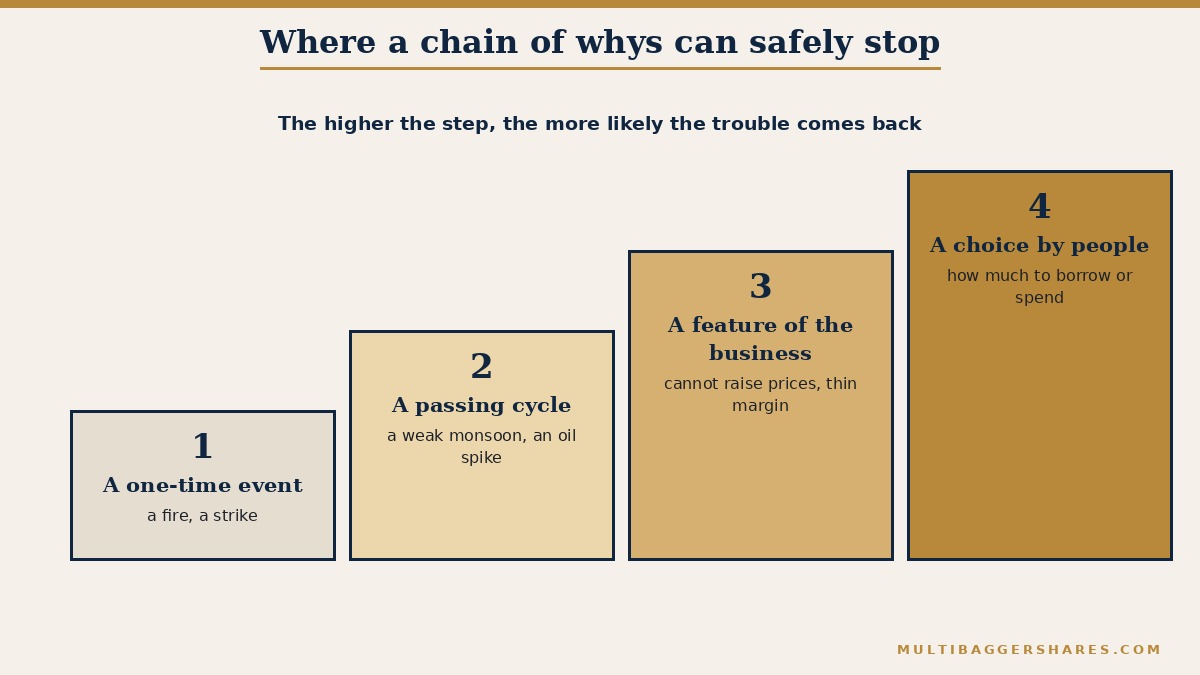
Third, keep going until you reach a stopping point. Look at the staircase below. A one-time event, such as a factory fire or a strike, is the bottom step. A passing cycle, such as a weak monsoon or a spike in oil prices, is the second. A feature of the business, such as being unable to raise prices, is the third. A choice made by people, such as how much to borrow or how much to spend, is the top. The higher you climb, the more likely it is that the trouble will come back.
Fourth, test your final answer with one question: would the same cause strike again next year? If the answer is a fire, probably not. If the answer is that the company cannot raise prices, quite possibly yes. The point of the exercise is not to be clever about last year. It is to understand what is permanent about the business.
Here is a short second example, with a different symptom. An imaginary company reports that its sales rose but the cash in its bank did not. Why? Because customers are paying late. Why? Because the company gives its buyers longer time to pay, in order to win their orders. Why? Because its rivals offer the same terms, and any company that does not would lose the order. The root is that the company competes by lending money to customers, not by being special. The first answer was a timing problem. The last answer is a feature of the business.
Fifth, be careful about three traps. The first trap is to stop at a convenient blame, such as the government or the weather. The second is to keep asking forever, until the answer is as large as ‘human nature’. Stop when you reach something you can check. The third is to expect one single answer every time. Real problems often have more than one cause, so you may end up with a small tree and not a single ladder.
Last, keep the habit in its place. It explains what happened and what is likely to repeat. It does not tell you whether a share is priced high or low today, and it is not a prediction. It will not tell you whether the managers are honest, or whether the company has too much debt. It is one good question, asked again and again. This is a lesson in how to think, and nothing more.
Key takeaways
- A company’s first explanation for a fall in profit is usually the symptom, like a fever, and not the root cause, like the dirty tank.
- Taiichi Ohno of Toyota taught the habit of asking why again and again, and five is a guide, not a law.
- Answer each why only from facts you can find in the numbers and notes, and write ‘I do not know’ when you cannot.
- Keep asking until you reach something about the business itself, such as its inability to raise prices, because that is what repeats.
- Test your final answer by asking whether the same cause would strike again next year.
— Manish Goel · multibaggershares.com
Manish Goel is a Chartered Accountant and Principal Officer of Multibagger Securities Research & Advisory Pvt. Ltd. (MSRAPL), a SEBI-registered Investment Adviser, Registration No. INA100007736. This content is published by MSRAPL for education only and is not personalized investment advice.
Disclaimer: This article is published by multibaggershares.com for education and general information only. It is not investment advice, investment research, or a recommendation to buy, sell or hold any security. Any companies named are discussed only as illustrative examples. Markets carry risk; please do your own research or consult a qualified professional before making any investment decision. |