From Rs 200 to Rs 10: Why a Business That Cannot Set Its Own Price Must Win on Cost

The One-Man Shop: Why a Business That Cannot Run Without One Person Is Fragile
October 21, 2026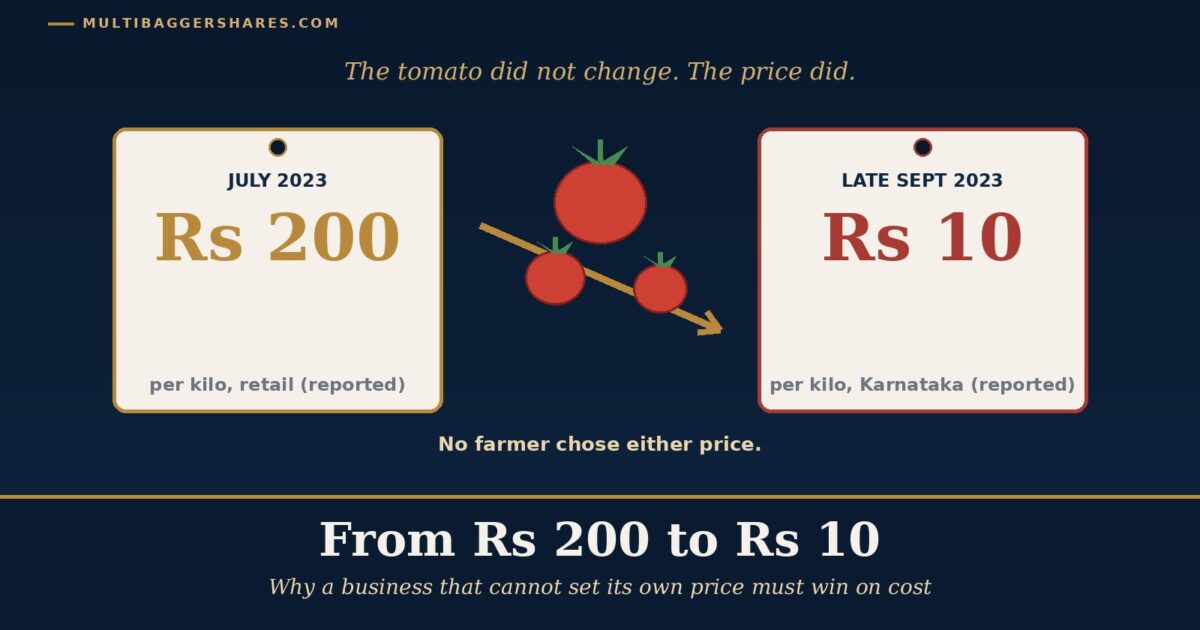
In July 2023, a kilo of tomatoes in parts of India cost around Rs 200. Tomatoes became front-page news. Some farmers who happened to have a good crop that month earned a windfall (a sudden, unexpected gain), as news reports at the time said. Now jump ahead to late September of the same year. In Karnataka, a big tomato-growing state, a kilo was selling for about Rs 10, according to a report in Deccan Herald on 26 September 2023. A 15-kilo box that had fetched about Rs 2,300 in July and August was going for somewhere between Rs 45 and Rs 120. One farmer told the newspaper that picking his crop would cost him more than he could earn by selling it.
The tomato did not change. It was the same red fruit in July and in September. What changed was the price, and not a single farmer chose it. Each one simply took whatever the market offered that morning. This is today’s lesson. Some businesses can set their own price, and some cannot. The second kind can still be good businesses, but only if they are run in one very particular way, and it is worth learning to spot the difference.
What it really means
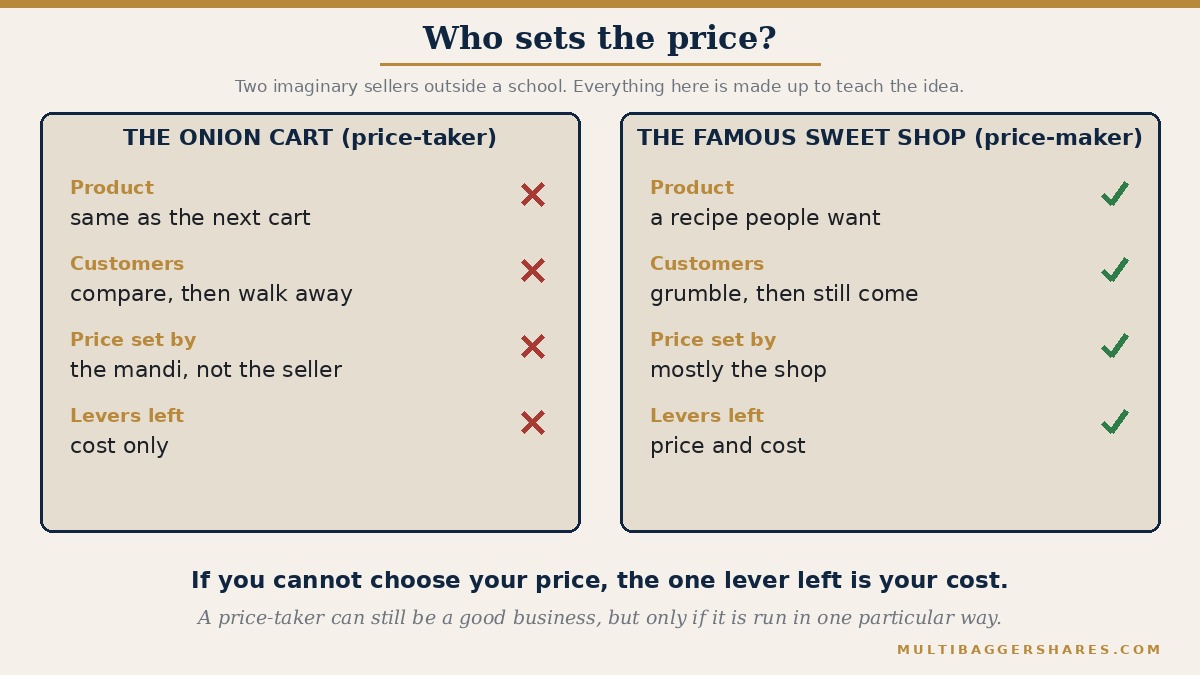
Investors have a name for a business that must accept whatever price the market gives it. They call it a price-taker (a seller who cannot charge more than the going rate, because customers would simply go elsewhere). The opposite is a price-maker (a seller who has some power to decide its own price, because customers value something that only this seller offers).
Why can one seller choose a price while another cannot? Usually it comes down to a commodity (a product that is the same no matter who made it, such as wheat, sugar, onions, rice or a plain steel bar). When the product is identical, the customer has no reason to prefer one seller over another. So the customer looks only at the price, and buys from whoever is cheapest.
Picture two sellers outside a school. One runs a vegetable cart. The other runs a small sweet shop with a recipe the whole neighbourhood loves. If the vegetable seller raises the price of onions by Rs 2, buyers walk to the next cart, ten steps away. If the sweet seller raises his price by Rs 2, most people grumble and still buy, because there is no second shop with that taste. The sweet seller sets the price. The onion seller is told the price.
In a mandi (a wholesale market), this happens in plain view. Sellers bring their produce, buyers arrive, and the price settles where the two meet. If a lot of produce arrives on a day when buyers want little, the price falls. If very little arrives and buyers want a lot, it climbs. Economists call the amount on sale the supply and the amount buyers want the demand, but you can simply think of it as sellers on one side and buyers on the other, with the price decided by the crowd.
Being a price-taker does not make a business bad. Millions of honest farmers, miners and mill owners work in this way. It simply changes the rules of the game. If you cannot choose your price, then there is only one lever left in your hand, and that lever is your cost.
Why it works
The first thing to understand is the cycle. When the tomato price touched Rs 200, every farmer within reach of a seed shop noticed. One farmer quoted in the same newspaper report said that many growers had switched to tomatoes from other crops after seedlings were sold in large numbers. So when the next harvest came, a great many more tomatoes arrived at the market together. Prices that were too high had called up the supply that pushed them down. A simple rule of thumb in such trades is that high prices tend to cure themselves, and low prices tend to cure themselves too, because farmers and factories stop producing when it no longer pays.
The second thing is that, in such a market, one year’s profit often says more about the price than about the business. When the price is high, every seller looks clever. When it falls, every seller looks foolish. A farmer who earned a fortune in July was not necessarily a better farmer than his neighbour. He was standing in the right place when the price rose. So we should be careful about admiring a price-taker’s best year, and equally careful about condemning its worst.
The third thing is the most important one. When the price is the same for everybody, the difference between a survivor and a casualty is cost. Let us make up two onion farmers to see this. Meena grows onions at a cost of Rs 12 for every kilo. She has good seed, a well on her land, and a short road to the market. Raju grows onions at a cost of Rs 18 for every kilo, because his land is far from the road and he pays more for water and transport. Both of them take whatever price the mandi gives.
In a good season, the price is Rs 25 a kilo. Meena earns Rs 13 on every kilo and Raju earns Rs 7. Both are happy, though Meena is far happier. Now a glut arrives, with too many onions in the market, and the price drops to Rs 15. Meena still earns Rs 3 on every kilo. Raju loses Rs 3 on every kilo. If each of them sells 10,000 kilos, Meena makes about Rs 30,000 and Raju loses about Rs 30,000. These numbers are made up, but the shape is real.
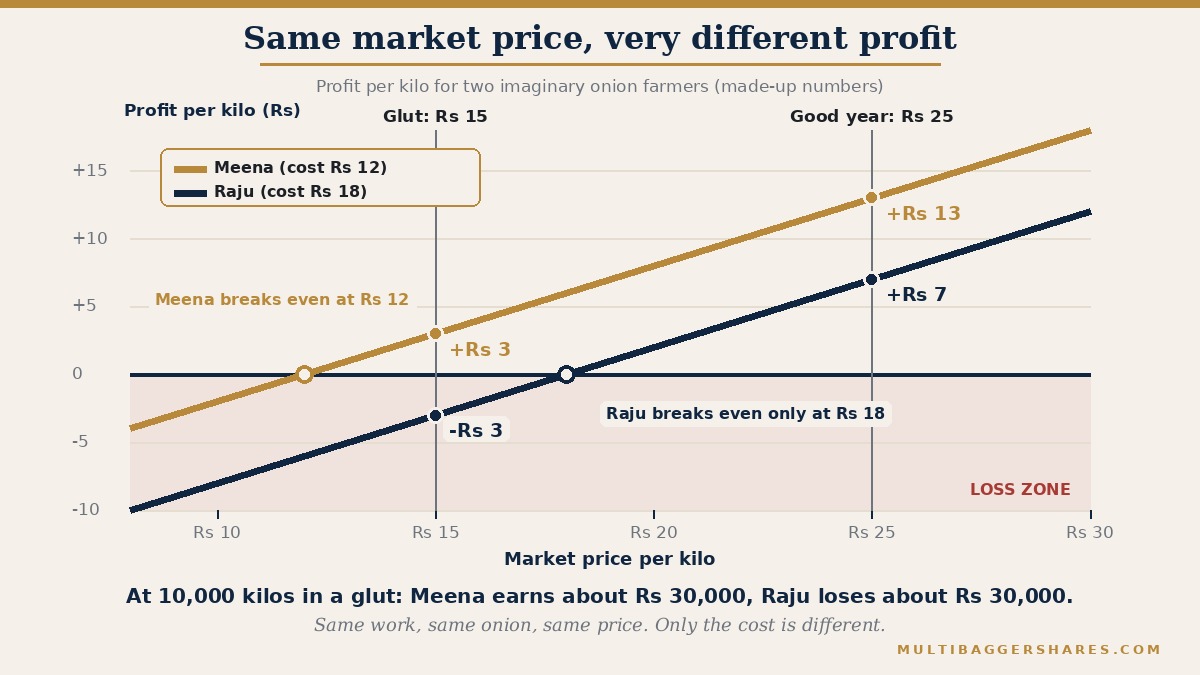
Look at what the picture shows. The two farmers do the same work and sell the same onion at the same price, yet their results are poles apart. Meena can survive a price as low as Rs 12. Raju cannot survive anything below Rs 18. A run of bad seasons will push Raju out of business. And when growers like Raju stop planting, fewer onions reach the market, and the price slowly recovers. Who is standing in the field when that happens? Meena.
This is why people who study such businesses say that the low-cost producer (the seller whose cost for each unit is lower than almost all of its rivals) is the one most likely to last. It gets through the bad years without borrowing heavily, it keeps earning something when others lose money, and it is still there when the rivals have gone home. A cost advantage can come from many places: a better location, larger scale, a smarter process, cheaper access to the main raw material, or simply a team that wastes less.
There is a final reason, and it is about debt. A price-taker cannot know when the bad year will come. Debt (money borrowed that must be repaid on a fixed date, whatever the market is doing) makes a bad year much more dangerous, because the lender does not care that the price of onions has fallen. A high-cost price-taker with a lot of debt is in the most fragile position of all.
A real example or two
The tomato story is our first example, and it is told here only as history. In July 2023 the retail price in parts of the country went up to about Rs 200 a kilo. By late September in Karnataka it had fallen to about Rs 10. Officials quoted by the newspaper blamed the arrival of many more tomatoes and weaker demand from other states. One market in Kolar received about 4.21 lakh quintals in September, against about 2.31 lakh quintals in the same month a year earlier. One farmer with high harvesting costs said he chose to leave his ten acres unpicked. The farmers did not change. The price did, and the price was never in their hands.
The second example comes from a famous investor. In his shareholder letter for 2007, Warren Buffett wrote about what protects a business that earns good returns. He said that competitors will keep attacking any such business, and that a lasting advantage needs “a formidable barrier such as a company’s being the low-cost producer”. He named GEICO and Costco as examples of the first kind. In the same letter he turned to airlines, an industry where one seat on one route looks much like another. About that business he wrote that a “durable competitive advantage has proven elusive ever since the days of the Wright Brothers”, and that its demand for capital had been “insatiable”.
Read those two ideas side by side. For a business that sells much the same thing as everyone else, the strongest protection is to be the cheapest to run. And where that protection is missing, the business may keep needing more and more money just to stay in the race. We tell this only as a lesson in how to think, and not as a view on any company or share.
Notice, too, that a price-taker can slowly climb out of price-taking. Think of loose flour that every shop sells the same way, and a packed flour that carries a name people trust. The wheat is still wheat. But the packet adds something the customer values, which is a promise of quality, and that gives the seller a little room to set a price. Not every commodity can do this, but when one can, it changes the nature of the business.
How you can use it
You do not need special data to apply this idea. You only need patience, an annual report or two, and a few plain questions. Try these five on any business you study.
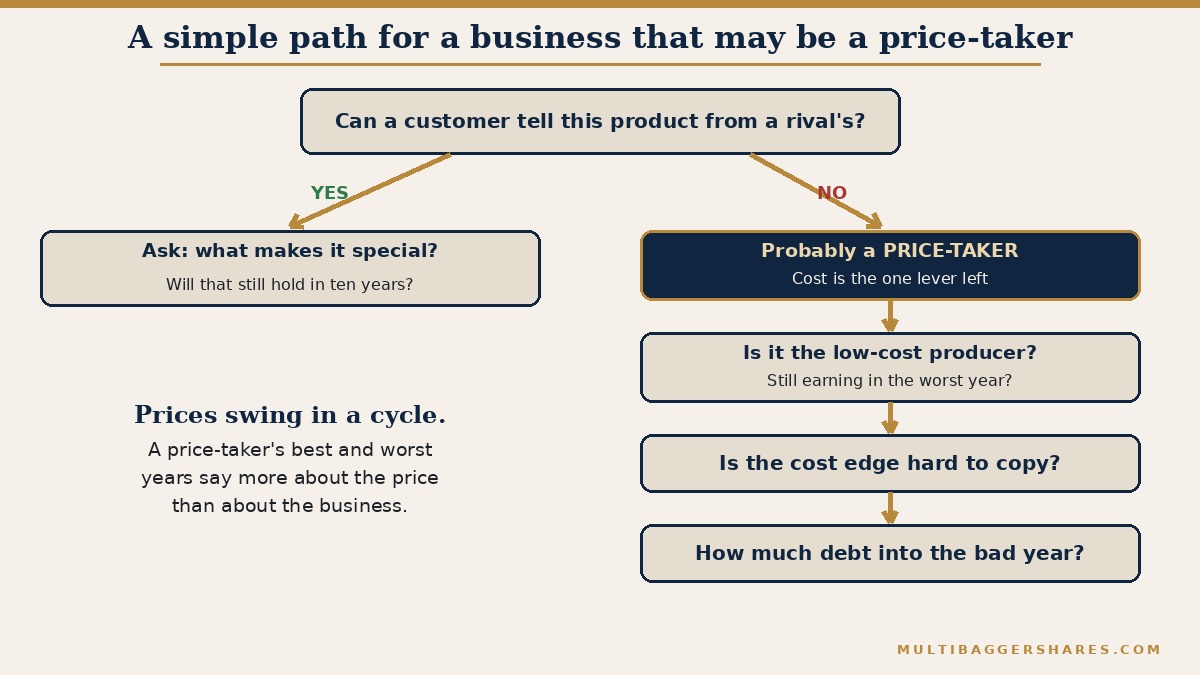
Question one: can a customer tell this product apart from a rival’s? Imagine the labels were removed. Would the customer care which one they got? If the answer is no, you are probably looking at a price-taker. If the answer is yes, ask what makes it special, and whether that will still be true in ten years.
Question two: does the price follow the market, or lead it? Look at the company’s profit margin (the share of each rupee of sales that is left as profit) over eight or ten years. A margin that jumps up and crashes down with the cycle is the mark of a price-taker. A margin that stays fairly steady through good and bad years suggests the seller has some power over its price.
Question three: if it is a price-taker, is it the low-cost producer? Compare it with its rivals. Does the annual report talk about cost for each unit, such as per tonne, per kilo or per kilometre? And in the worst year of the cycle, was this business still earning something while others were losing money? That test is worth more than any promise in a brochure.
Question four: why is its cost low, and can a rival copy that? A cost advantage built on a mine right next to the factory, or a plant that is much larger than anyone else’s, is hard to copy. A cost advantage built on one lucky year of cheap raw material is not an advantage at all. It is weather.
Question five: how much debt will it carry into the bad year? You cannot predict when the price will fall. Nobody can. What you can do is ask whether the business could live through a long run of low prices without being forced to borrow its way out.
A few cautions will keep you balanced. First, a price-taker is not a villain. Some low-cost producers are excellent businesses and have rewarded patient owners. The point is only that their strength lies in cost and balance sheet, and not in charging more. Second, do not try to guess the next price of onions, tomatoes, steel or sugar. The clever people who tried have been wrong often enough. Third, a price-maker is not automatically safe either. A brand can fade, and a favourite recipe can be copied. This is one lens among many, and it sits beside the others you have been learning: returns on capital, debt, cash flow and honest management.
There is also something kind in this lesson for ordinary investors. It tells us to be humble about what we cannot control. The farmer cannot control the price of a tomato. The investor cannot control the next headline. But the farmer can control his seed, his water and his road, and the investor can control what kind of business he chooses to study. Choose to look at the things a business can control. Those are the things that tell you what kind of business it is.
Come back one last time to the farmers in Karnataka. The price of Rs 200 made headlines, and the price of Rs 10 left at least one field unpicked. Yet the quiet question was never about either number. It was about what it cost each farmer to bring a kilo to market. The one who could bring it at the lowest cost could face both prices. That is the whole lesson in a single tomato.
This article is for education only. It does not tell you what to do with any particular investment.
Key takeaways
- A price-taker must accept the going market price because its product is the same as everyone else’s; a price-maker has something customers value that others do not offer.
- When you cannot set your price, cost is the one lever left, so the low-cost producer is the one most likely to survive the bad years.
- Prices swing in a cycle, so a price-taker’s best and worst years often say more about the price than about the business.
- The tomato went from about Rs 200 a kilo in July 2023 to about Rs 10 in Karnataka by late September, a reminder that no farmer set that price.
- Ask five questions: can customers tell the product apart, does the price follow or lead, is it the low-cost producer, can the cost edge be copied, and how much debt does it carry.
— Manish Goel · multibaggershares.com
Manish Goel is a Chartered Accountant and Principal Officer of Multibagger Securities Research & Advisory Pvt. Ltd. (MSRAPL), a SEBI-registered Investment Adviser, Registration No. INA100007736. This content is published by MSRAPL for education only and is not personalized investment advice.
Disclaimer: This article is published by multibaggershares.com for education and general information only. It is not investment advice, investment research, or a recommendation to buy, sell or hold any security. Any companies named are discussed only as illustrative examples. Markets carry risk; please do your own research or consult a qualified professional before making any investment decision. |