The First Cockroach: Why One Unpleasant Surprise From a Business Is Rarely the Last

The Cracking Whip: Why a Small Wobble in Shop Sales Becomes a Big Swing at the Factory
November 17, 2026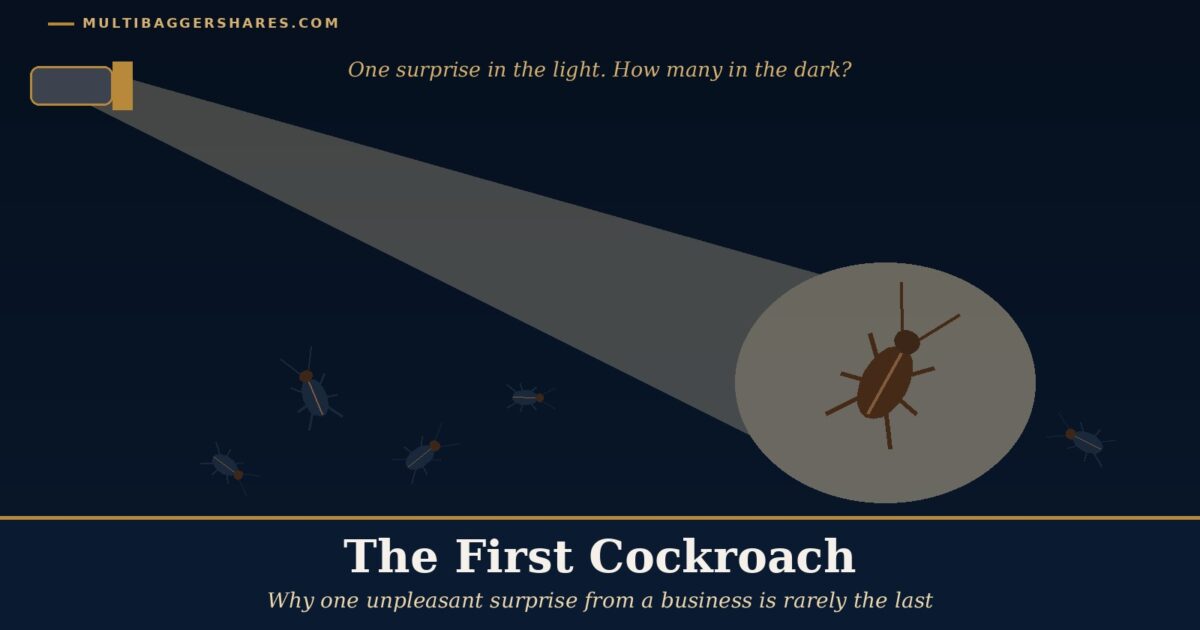
Late one night, Lata goes into her kitchen for a glass of water. She switches on the light and sees a single cockroach run across the floor and disappear under the sink. She could shrug and go back to bed. It is only one, after all. But Lata grew up in an old house near the market, and her mother taught her something long ago. If you see one cockroach, do not think about the one. Think about where it came from. So the next morning Lata takes a torch and looks under the sink. Behind the pipe she finds a damp corner, a small crack in the wall and, yes, a few more cockroaches.
Lata’s neighbours, Priya and Arjun, both own a few shares in an imaginary company called Sunrise Pumps. One quarter, Sunrise announces a surprise. Some dealers who sell its pumps cannot pay what they owe, so the company must write off eight crore rupees. The managers call it a one-time event. Arjun reads the headline and moves on. Priya does what Lata did in her kitchen. She asks where the problem came from, and whether it is likely to be alone.
Over the next two years, Sunrise has more surprises. Its results come out three weeks late. Then it marks down the value of pumps sitting unsold in a warehouse. Then its finance chief leaves suddenly. None of these is a disaster on its own, and each one comes with a calm explanation. But together, they tell a story that the first surprise was already hinting at. This essay is about that hint.
What it really means
Investors have a name for this pattern. They call it the cockroach theory (the idea that bad news from a company tends to arrive in groups, so the first problem you see is often a sign of others you cannot see yet). It is not a law of nature, like gravity. It is a rule of thumb, a habit of mind. It says: when a business gives you one unpleasant surprise, do not treat it as a single, isolated event until you have good reason to.
A few plain words will help. A write-off (when a company admits that something it counted as an asset, such as money owed to it or goods in a warehouse, is worth much less or nothing, and takes the loss into its accounts) is one common kind of surprise. Another is an exceptional item (a gain or loss that the company shows separately in its results because it says the event is unusual and not part of normal business). A third is an auditor (an outside accountant who checks the company’s accounts each year and gives an opinion on whether they are fair) who resigns in the middle of the job.
Each of these can happen to a good company once. Weather damages a warehouse. A big customer fails. An auditor retires. The cockroach theory does not say that every surprise means a rotten business. It says that the first surprise is information. It is a small window into how the business is run, and you should look through that window carefully before you close it.
The theory has been part of market talk for a long time, but it got a fresh airing in October 2025. Two American companies connected to cars had gone bankrupt within weeks of each other: a used-car seller and lender called Tricolor, and an auto-parts maker called First Brands, which had borrowed more than ten billion dollars. On his bank’s earnings call on 14 October, Jamie Dimon, the long-serving head of JPMorgan Chase, was talking about the bank’s loss of about 170 million dollars on loans linked to Tricolor. He said he probably should not say it, but when you see one cockroach, there are probably more.
Why it works
Why should bad news come in groups? It is not bad luck. There are three simple reasons, and you can see all three in Lata’s kitchen.
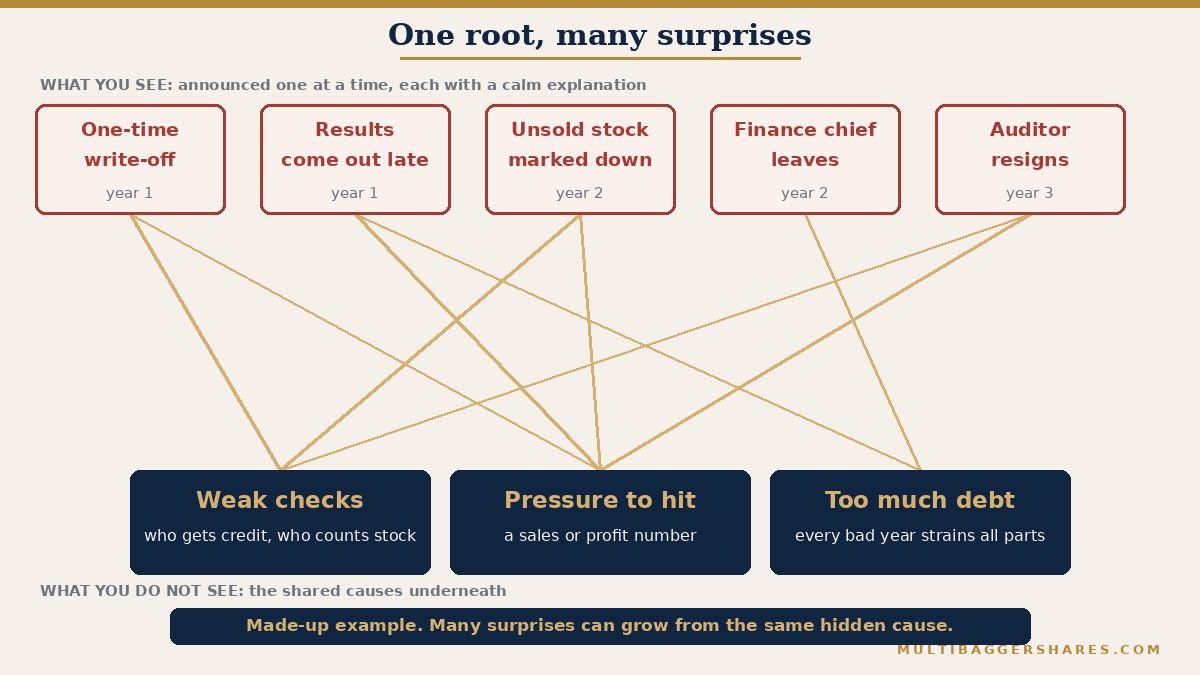
The first reason is a shared root. The cockroaches under Lata’s sink were not separate accidents. They all came from the same damp corner and the same crack in the wall. Problems in a business work the same way. If the company has weak checks on who gets credit, it will not have just one bad dealer. If the managers are under heavy pressure to hit a sales number, that pressure will show up in more than one place: in loose credit, in stock pushed onto dealers, in costs moved from one year to the next. If the company carries too much debt (borrowed money that must be repaid with interest), a bad year strains every part of it at once. One root can feed many surprises.
The second reason is the slow drip. Telling bad news is painful. Most people, including managers, hope that a problem will fix itself before anyone has to hear about it. So the bad news that finally comes out is usually the part that could no longer be hidden or explained away. Like a leaking tap, the first drop you notice is rarely the first drop that fell. When a company finally says something has gone wrong, it is fair to ask what else it has been hoping would get better on its own.
The third reason is that you only see the edge. As an outsider, you see what the company chooses to tell you and what the rules force it to tell you. You do not see the files, the meetings or the phone calls. A cockroach that runs across the floor is the one that came out into the light. For every one that comes out, there may be others still behind the pipe. The same is true for an investor reading a company’s announcements from far away.
There is also a fourth reason, and it is about us, not about the company. When managers call a problem one-time, the word itself is comforting. It invites us to stop thinking. A careful investor notices the word, and then checks whether the same company has used it before. A one-time event that happens every year is not one-time. It is part of how the business really works.
A real example or two
Here are two stories from business history. They are told only to teach the idea. They say nothing about whether any company’s shares are good or bad today, and they are not a comment on anyone’s shares.
The first story is the one we have already met. In September 2025, Tricolor and First Brands collapsed in quick succession. Jamie Dimon’s remark about cockroaches was not a prediction about any single company. It was a reminder to lenders and investors that when one borrower turns out to be far weaker than it looked, it is wise to ask whether the same blind spots exist elsewhere: the same loose checks, the same hopeful assumptions, the same habit of believing the paperwork. How the wider story ends is still being written, and that is fine. The lesson is about the habit of looking under the sink, not about guessing the future.
The second story is Indian, and the whole chain of cockroaches is now on the public record. In India, the Reserve Bank checks each bank’s books and can disagree with how many loans the bank has counted as bad loans (loans whose borrowers have stopped paying on time, usually for more than ninety days; bankers call them NPAs, or non-performing assets). The difference between the bank’s count and the regulator’s count is called a divergence (a gap between what a bank reported and what the regulator found).
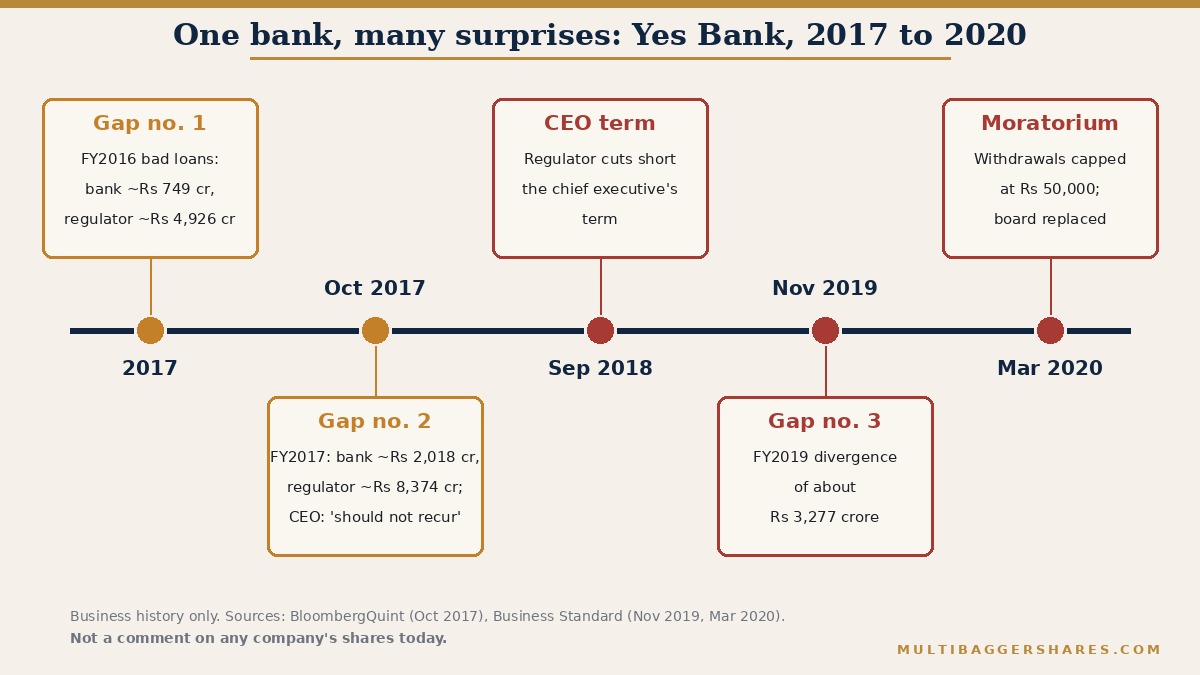
In 2017, Yes Bank disclosed that for the year ending March 2016 it had reported bad loans of about 749 crore rupees, while the Reserve Bank counted about 4,926 crore rupees. That was the first cockroach. In October 2017 came a second. For the year ending March 2017, the bank had reported about 2,018 crore rupees of bad loans, and the regulator counted about 8,374 crore rupees, a gap of roughly 6,350 crore rupees, around three times what the bank had shown. At the time, the bank’s chief executive, Rana Kapoor, said he was certain that divergences should not be a recurring item on the balance sheet.
The story did not stop there. In September 2018, the Reserve Bank cut short Mr Kapoor’s term as chief executive. In November 2019, the bank disclosed a third divergence, this time of about 3,277 crore rupees for the year ending March 2019. And on 5 March 2020, the government and the Reserve Bank placed the bank under a moratorium (a temporary freeze on a bank’s normal business while a rescue is arranged), limited depositors to withdrawals of 50,000 rupees and replaced its board. Looking back, the first divergence was a cockroach in the kitchen light. An investor who asked where it came from had about three years to look under the sink.
It is important to be fair here. Hindsight makes every story look obvious, and plenty of companies have one bad surprise, fix the cause and go on to do well. The point of these stories is not that the first surprise always leads to collapse. It is that the first surprise deserved serious questions, and that the answers, over time, told careful readers a great deal.
How you can use it
Go back to Priya. When Sunrise Pumps announced its eight crore write-off, she did not panic, and she did not ignore it either. She made a short list of questions. You can use the same list for any business you own or study, the next time it gives you an unpleasant surprise.
One: what exactly went wrong, and why? A good explanation names a specific cause. For example, one large dealer in one state failed after a flood, and here is what we have changed in how we give credit. A weak explanation stays vague, with words like market conditions or certain receivables (money that customers and dealers still owe the company). If you cannot tell what the root was, you cannot tell whether it is still there.
Two: has this word been used before? Open the annual reports of the last five years and look for exceptional items and one-time charges. One in five years can be bad luck. One almost every year is a pattern. Count them the way Lata counted cockroaches behind the pipe.
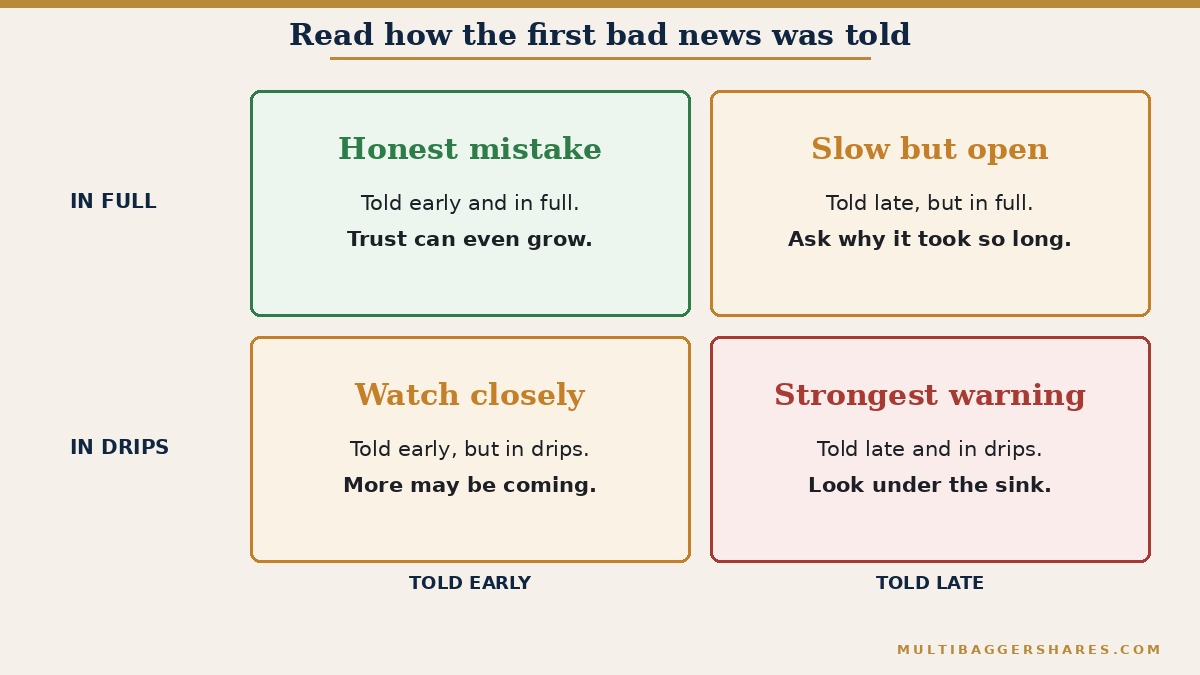
Three: was the news told early and in full, or late and in drips? Honest managers usually tell the whole story at once, even when it hurts, because they would rather take one hard day than many. A company that adds a little more bad news every quarter, each time saying the worst is over, is showing you its habits. Figure 3 shows a simple way to sort what you see.
Four: are there other small signs nearby? Look at the parts of the accounts that often move together with hidden trouble. Is money owed by customers growing faster than sales? Is unsold stock piling up? Is borrowing rising? Are results coming out late? Has the finance chief, the company secretary or the auditor left in a hurry? No single sign proves anything. But when several appear close together, the kitchen is telling you something.
Five: is the fix believable? After a real problem, a well-run company changes something you can see. It tightens its rules, brings in an independent check, or changes the people responsible. If nothing changes except the words in the press release, the damp corner is still there.
A few gentle cautions. First, do not see cockroaches everywhere. Every business has bad quarters, and a single honest mistake, told early and fixed openly, can actually raise your trust in the managers. Second, do not let one surprise turn into fear. The aim is not to react to the news, but to raise the amount of proof you need before you believe the comfortable explanation. Third, write down what you learned. Next time, you will want to remember whether this company’s surprises came alone or in groups.
This is a lesson about judging the honesty and the quality of a business, not about the price of any share or whether to buy or sell it. It simply helps you read bad news the way Lata read that one cockroach: calmly, carefully, and with a torch in your hand.
Key takeaways
- The cockroach theory says bad news from a business often comes in groups, so treat the first surprise as information, not as an isolated event.
- Surprises cluster because many grow from one hidden root, because bad news usually comes out slowly, and because outsiders see only the edge.
- A one-time charge that keeps coming back is not one-time; count exceptional items across five years of annual reports.
- Judge how the first bad news was told: early and in full is reassuring; late and in drips is the strongest warning sign.
- This is a way to judge the honesty and quality of a business. It is education only, not a judgement on any company or share.
— Manish Goel · multibaggershares.com
Manish Goel is a Chartered Accountant and Principal Officer of Multibagger Securities Research & Advisory Pvt. Ltd. (MSRAPL), a SEBI-registered Investment Adviser, Registration No. INA100007736. This content is published by MSRAPL for education only and is not personalized investment advice.
Disclaimer: This article is published by multibaggershares.com for education and general information only. It is not investment advice, investment research, or a recommendation to buy, sell or hold any security. Any companies named are discussed only as illustrative examples. Markets carry risk; please do your own research or consult a qualified professional before making any investment decision. |